I awoke in a strange tomb, filled with machines that were alien to me. A voice that I didn't recognize and whose source I couldn't identify begged me forward. I exited the tomb to find a world that was not only alien to me, but ruined and hostile. This world I was tasked with saving, and save that world I did. Along the way I helped people out in small ways, finding ingredient for their cooking or taking pictures for them, and in big ways, stopping beasts that threatened their homes or saving them from attacking creatures, and I recovered my memories along the way.
It had been 100 years since the times that I remembered, and all but a few that I cared about were long dead. I stopped my training and preparations short to finish the mission by destroying Ganon and saving Princess Zelda. Afterwards I went back out into the land I now remembered was known as Hyrule to continue finding the ancient shrines that granted me strength and to continue doing what I knew how to do, help people. I helped a man build a town from nothing and find a wife. I showed weapons to a child who had heard about them from his now gone grandfather and who desperately wanted to see them himself. I helped so many people it became hard to find more people who needed help. I found some men tearing down an abandoned house down and bought it for myself. I invested in that house, made it nice, made it my own. I settled down. Hyrule is safe, I hope.
I finished Breath of the Wild this week for the most part. I beat the game, all the shrines, and the side quests. I still have some unupgraded armor and some side tasks that aren't tracked that I haven't done, but I've done the things that I really care about. Truth be told I don't have a lot of experience with open world games. Prior to BotW I guess you could say the last ones I played was Metal Gear Solid V and Shadow of Mordor though Grand Theft Auto: Vice City is more similar to BotW. I'd say that the closest experience that I've had to Breath of the Wild would be World of Warcraft. They both really capture a feeling of exploration, especially during the my early time playing the WoW in the base game and its Burning Crusade and Wrath of the Lich King expansions.
The Legend of Zelda series of games is one that's near and dear to my heart. If you take the original game's release date of Feb 21, 1986 and do the time conversion to American Central Time, my birth was only a handful of hours off. Like Link, I'm also left-handed (though that's changed for Link since motion controls) and I have pointy ears. I saw people play the first two Zelda games but the first one I really got to dig into and beat for myself was A Link to the Past. I've been hooked ever since and now that I have Breath of the Wild done, all I need to do is wrap up my playthrough of Majora's Mask and I'll have completed every canonical Legend of Zelda game, console and handheld.
Running out of significant things to do in Breath of the Wild has been bittersweet. I've loved the game immensely and I've been glad to do everything that I've done and am sad to have run out of major things to do. If the game would let me I'd gladly cross the great canyon that separates Hyrule from the rest of the world to the north and west or drive a sand seal through the Gerudo Desert to parts unknown.
It was so amazing to play a game, not just a Zelda game, that pushes you out into the world and says "Go where you want. Here's your goals, but I'm not going to stop you from doing what you want to do." There are entire zones that aren't necessary to any of the main quests. This is very different from the previous entry Skyward Sword which was very structured/linear. Like many people I enjoyed Skyward Sword but I didn't finish it until a year or more later because I just wasn't drawn to it. I've been consumed by Breath of the Wild for the past week and a half and I really think that's because it's really earned being called an adventure game. You quest and explore and are HEROIC. It's truly amazing to not know exactly how to get somewhere or what you'll encounter along the way.
One of the recurring complaints about Breath of the Wild has been w/ the durability system they added for weapons and shields. While it is frustrating for a great piece of gear to break, it creates a tension and adds a layer of strategy to the battles that I really enjoy. It adds value and strategy by forcing you to consider what weapon you want to use against a particular enemy and making you make sure you have a good spread of weapons for the enemies that you're encountering. Finally breaking out the weapon you've been saving for a special occasion or an enemy that's just pissed you off is incredibly satisfying. All they really needed was a nicer UI for dropping/exchanging items.
The oddest thing is that I don't know if I'd want a Breath of the Wild 2. The Zelda games generally have the same rough story/map, it'd be too much if they had the same gameplay as well. For a mechanical successor to BotW to succeed it's going to need to take place somewhere new or have a different story archetype. Even if there's never another Zelda that I love as much as Breath of the Wild I'll still be incredibly happy. They've done something incredibly magical with it that was the Zelda game that I wasn't even aware was the one I've always wanted.
Showing posts with label video games. Show all posts
Friday, March 17, 2017
Wednesday, December 31, 2014
The most important games to me from 2014
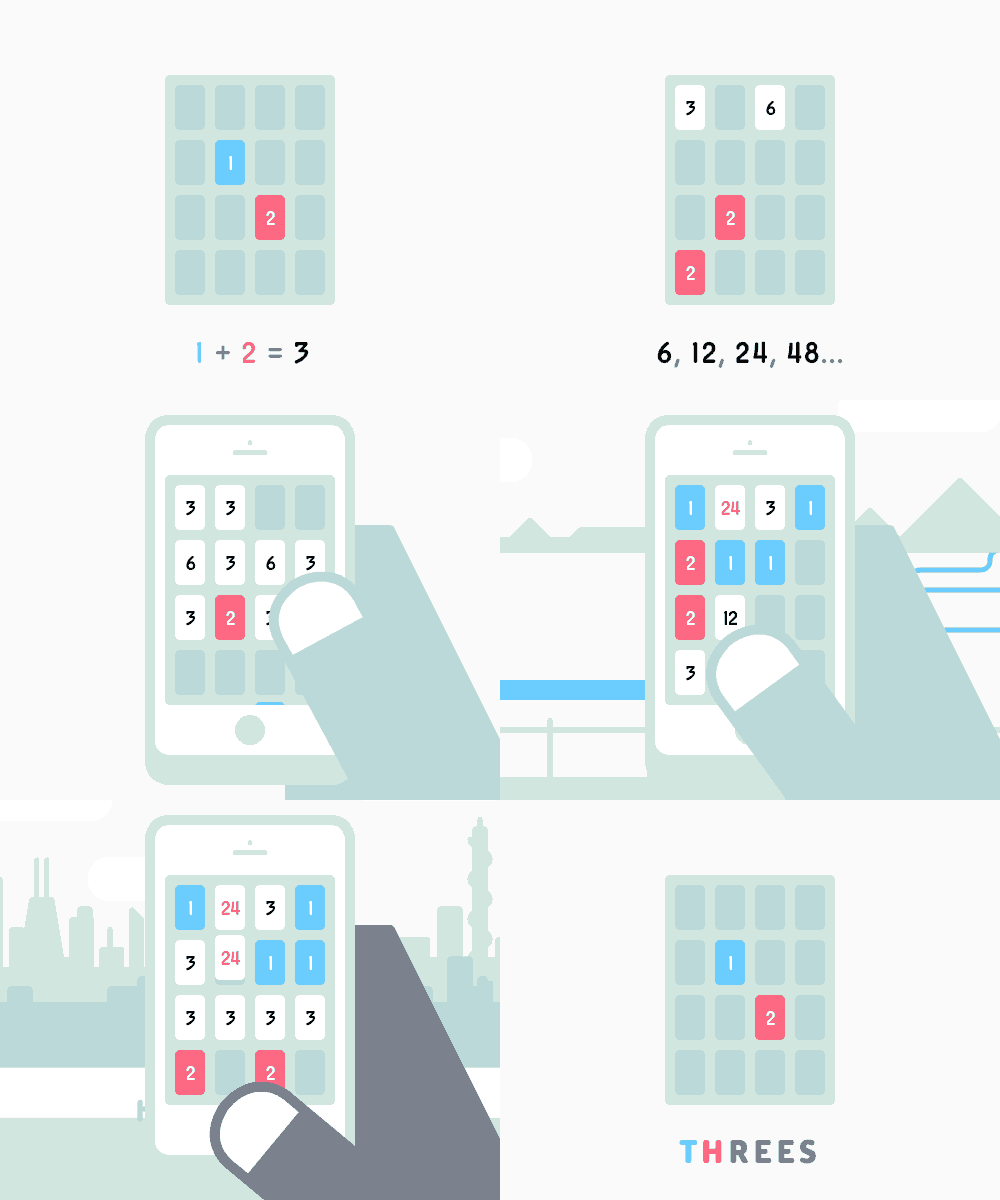
Threes
Episode 5 of five out of ten magazine features an essay by Brendan Keogh about games exactly like Threes. About how these deeply systemic game are hard to talk. Graphics, story, sound, and some elements of gameplay are easy to talk about, but systems are harder. Threes is kinda like Tetris in that new tiles are always entering the board and you have to figure out how to combine them to make more room. In Threes there are things you have control over (how you're going to shift and combine tiles) and things you don't have control over (what tile is coming up next and where it enters). You're given enough knowledge about what tile is coming next and where it can enter that you can make intelligent decisions about what to do.
It's the things that you don't have control over that make the things you do have control over fun and interesting. Threes is a focused example of how random effects, information, and choice mix together to make an amazing gameplay experience.
I reached my pinnacle in this game in October by getting a 3072 tile on my board. I've done it a couple more times since then but I highly doubt I'll ever do better. But I keep playing.
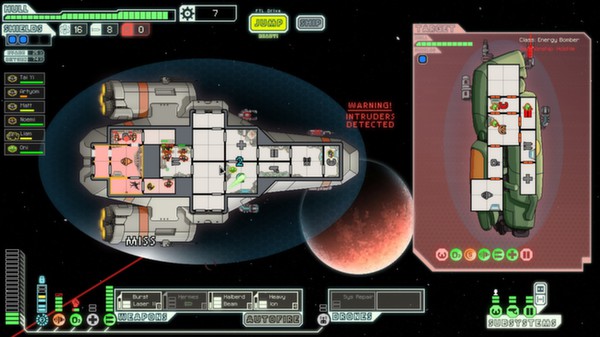
FTL: Faster than Light
FTL came out in 2012, but it received a significant update this year, which is when I really fell for it. FTL is a roguelike, which is an utterly useless descriptor, unless you're familiar with the game Rogue, in which case it still doesn't tell you anything about the game. Roguelikes are games that have a relatively short duration but make up for that by using random generation to create replayability. Roguelikes must have a definite end goal and be hard. Failure must be an reasonably possible outcome.
FTL has you controlling a spaceship and it's crew, racing to alert the Federation of the oncoming rebel threat, like a reverse Star Wars. As you play you'll defeat enemy ships and get scrap and other material which you use to upgrade your ship. FTL asks you to overcome increasingly difficult enemies by figuring out where best to spend your scrap to complement your ships current build and the enemies your facing. Every run through FTL feels different even if you're using the same ship (of which there are 29).
Hearthstone
I love Hearthstone. In particular I love Hearthstone Arena. I love it for all the same reasons I love the above two game. Hearthstone Arena asks you to construct a deck out of randomly selected cards that are presented to you three at a time to use against other people who have similarly constructed a deck. Hearthstone arena is great because you don't have to buy the cards to use in it. You don't even have to pay to enter unless you don't have enough gold, which brings me to my second point.
Hearthstone's daily quest system is perfect. You get a quest every day, you can save up to three daily quests, and every day you can reroll one of your quests. If you want to play casually you can reroll quests to try and get quests that can be completed at the same time. If you want to be hardcore and try to get the most coins possible from quests you just reroll your 40 gold quests to try and get 60 gold quests. They challenge you to try new classes but offer you enough flexibility to avoid them if you want.
PT
If the above games are about choice granting you power and control to face randomly generated adversity, then PT is the opposite of that. It's not random. You have no power. PT is the scariest fucking shit I've ever played and it's free if you have a PS4. You're stuck in a hallway with no way to fight what haunts you. You can escape, but you have to figure out how, and it's not easy. PT is like nothing I've ever played before.
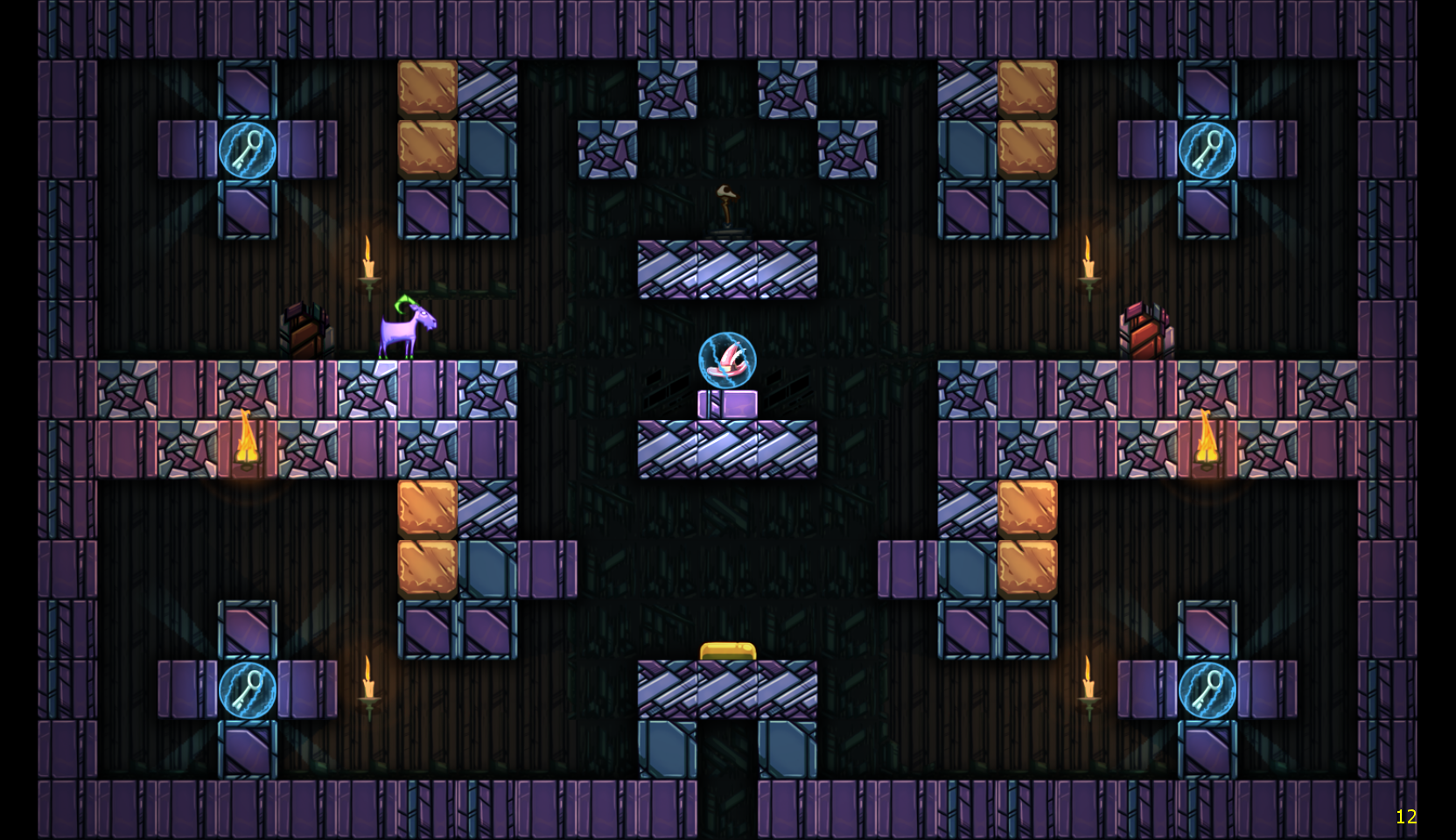
Escape Goat 2
I know that Goat Simulator got more attention for it's title, wacky gameplay, and satirical bent but I enjoyed this game far more. Platformers are one of my favorite categories of games. Puzzles too. Puzzle platformers tend to fall flat but Escape Goat 2 manages it perfectly. It stays fresh and fun throughout without becoming impossibly obtuse, which is what generally happens with puzzle games. It has charming graphics and sound. It has a goat and a mouse. There's one puzzle that comes to mind that was really just too hard, but I was able to look up a solution fortunately. I don't really have too much to say about this game really. It's just a really solid game that deserves more attention than it got.
Desert Golfing
Desert FUCKING Golfing. Desert Golfing is an incredibly simple game. It doesn't integrate with facebook or twitter. There are no in-app purchases. Contrary to mobile game best practices, it costs $1.99 to download. There's no daily bonus that begs me to log back in. Its feels like a rebellion against F2P and social gaming. It's the complete opposite of current trends.
You just golf. Place, drag, release. Place, drag, release. Place, drag, release. Next hole.
The difficulty comes and goes. When it's hard you're relieved to get past it. When it's easy, you celebrate the skill you've gained.
Nobody at work understands why I love Desert Golfing.
I'm stuck in Desert Golfing, stage 2303.
UPDATE: I loaded up Desert Golfing right after writing that sentence and beat that stage first try. IT TOOK ME SO MANY TRIES
Other games I really enjoyed but don't really have words for right now:
Mario Kart 8
Shadow of Mordor
Monument Valley
Shovel Knight
The Uncle Who Works for Nintendo
Sportsfriends
Nidhogg
Episode 5 of five out of ten magazine features an essay by Brendan Keogh about games exactly like Threes. About how these deeply systemic game are hard to talk. Graphics, story, sound, and some elements of gameplay are easy to talk about, but systems are harder. Threes is kinda like Tetris in that new tiles are always entering the board and you have to figure out how to combine them to make more room. In Threes there are things you have control over (how you're going to shift and combine tiles) and things you don't have control over (what tile is coming up next and where it enters). You're given enough knowledge about what tile is coming next and where it can enter that you can make intelligent decisions about what to do.
It's the things that you don't have control over that make the things you do have control over fun and interesting. Threes is a focused example of how random effects, information, and choice mix together to make an amazing gameplay experience.
I reached my pinnacle in this game in October by getting a 3072 tile on my board. I've done it a couple more times since then but I highly doubt I'll ever do better. But I keep playing.
FTL: Faster than Light
FTL came out in 2012, but it received a significant update this year, which is when I really fell for it. FTL is a roguelike, which is an utterly useless descriptor, unless you're familiar with the game Rogue, in which case it still doesn't tell you anything about the game. Roguelikes are games that have a relatively short duration but make up for that by using random generation to create replayability. Roguelikes must have a definite end goal and be hard. Failure must be an reasonably possible outcome.
FTL has you controlling a spaceship and it's crew, racing to alert the Federation of the oncoming rebel threat, like a reverse Star Wars. As you play you'll defeat enemy ships and get scrap and other material which you use to upgrade your ship. FTL asks you to overcome increasingly difficult enemies by figuring out where best to spend your scrap to complement your ships current build and the enemies your facing. Every run through FTL feels different even if you're using the same ship (of which there are 29).
Hearthstone
I love Hearthstone. In particular I love Hearthstone Arena. I love it for all the same reasons I love the above two game. Hearthstone Arena asks you to construct a deck out of randomly selected cards that are presented to you three at a time to use against other people who have similarly constructed a deck. Hearthstone arena is great because you don't have to buy the cards to use in it. You don't even have to pay to enter unless you don't have enough gold, which brings me to my second point.
Hearthstone's daily quest system is perfect. You get a quest every day, you can save up to three daily quests, and every day you can reroll one of your quests. If you want to play casually you can reroll quests to try and get quests that can be completed at the same time. If you want to be hardcore and try to get the most coins possible from quests you just reroll your 40 gold quests to try and get 60 gold quests. They challenge you to try new classes but offer you enough flexibility to avoid them if you want.
PT
If the above games are about choice granting you power and control to face randomly generated adversity, then PT is the opposite of that. It's not random. You have no power. PT is the scariest fucking shit I've ever played and it's free if you have a PS4. You're stuck in a hallway with no way to fight what haunts you. You can escape, but you have to figure out how, and it's not easy. PT is like nothing I've ever played before.
| Goat of the Year 2014 |
I know that Goat Simulator got more attention for it's title, wacky gameplay, and satirical bent but I enjoyed this game far more. Platformers are one of my favorite categories of games. Puzzles too. Puzzle platformers tend to fall flat but Escape Goat 2 manages it perfectly. It stays fresh and fun throughout without becoming impossibly obtuse, which is what generally happens with puzzle games. It has charming graphics and sound. It has a goat and a mouse. There's one puzzle that comes to mind that was really just too hard, but I was able to look up a solution fortunately. I don't really have too much to say about this game really. It's just a really solid game that deserves more attention than it got.
Desert Golfing
Desert FUCKING Golfing. Desert Golfing is an incredibly simple game. It doesn't integrate with facebook or twitter. There are no in-app purchases. Contrary to mobile game best practices, it costs $1.99 to download. There's no daily bonus that begs me to log back in. Its feels like a rebellion against F2P and social gaming. It's the complete opposite of current trends.
You just golf. Place, drag, release. Place, drag, release. Place, drag, release. Next hole.
The difficulty comes and goes. When it's hard you're relieved to get past it. When it's easy, you celebrate the skill you've gained.
Nobody at work understands why I love Desert Golfing.
I'm stuck in Desert Golfing, stage 2303.
UPDATE: I loaded up Desert Golfing right after writing that sentence and beat that stage first try. IT TOOK ME SO MANY TRIES
Other games I really enjoyed but don't really have words for right now:
Mario Kart 8
Shadow of Mordor
Monument Valley
Shovel Knight
The Uncle Who Works for Nintendo
Sportsfriends
Nidhogg
Wednesday, October 9, 2013
Board Games!
![]() |
| This is actually an old picture, it's gotten much worse. |
We have 56 games, in total. Not all of them are in that picture, because some of them are actually behind the others. For example, you can see Munchkin there but we actually have other versions of Munchkin, they're just stashed behind Carcassonne, Ghost Stories, and Yahtzee.
There's quite a variety there, too. You see classic games like Risk and Monopoly, but there's plenty of other games too. There's the cooperative fire-fighting simulator Flash Point: Fire Rescue. There's the popular Eurogame about connecting train routes Ticket to Ride. There's the literally-only-sixteen-cards get-your-love-letter-to-the-princess simulator Love Letter (a truly excellent game). There's also the dexterity-challenging magnet-balancing game Polarity.
This might seem like a sudden shift for me but it's really a natural extension of a trend that's been going on for roughly a decade.
![]() |
| Forbidden Island, a cooperative game where you play as treasure hunters trying to get four relics from an island before it sinks. |
I can't really say that I know what caused it. Maybe it was because of my friend the next room over my freshman year of college. Maybe it's because that was the year Katamari Damacy was released. Maybe it's because that was the year that the PSP and the DS were released, and I hadn't really been into portable gaming since the original Pokemon some long time prior. Or possibly it's because of all these things. Ever since that year, however, I've constantly been seeking new gaming experiences. I would rather play small, mediocre, yet novel games as opposed to a full-price game that's well polished yet doesn't bring much new to the table. In the past this has meant playing mobile/handheld games and download-only games, but now it's extending to tabletop games.
Tabletop games really offer a lot of things that video games don't.
Meat Space Nine
Tabletop games are all about playing with your friends right around you. You can see and talk to each other in ways that are hampered by communicating over headset or having to share real estate on a screen. This isn't to say that there aren't great video games that you can play with your friends all on the same couch, Smash Bros. and Towerfall and great examples of such, but this is what board games are all about. It is their jam.
![]() |
| Dungeons & Dragons: Castle Ravenloft |
No need for dexterity
Tabletop games are almost always turn-based as well (Escape: The Curse of the Temple notwithstanding). Many people can't play competitive video games because of a reliance on manual dexterity, fast reaction times, having to juggle a lot of information without time to think, or they can get nauseous in the case of a first-person game. This gives tabletop games an extra level of accessibility that video games don't have.
Hackability
Most video games go to great lengths to keep you from playing them in ways that the developers don't intend. You can't make your own rules, except on a social level ("Nobody's allowed to pick Oddjob, okay!?"). You can't add and remove components. You can't do anything, usually. Tabletop games literally cannot avoid this. Don't want to play with a particular rule? GONE. Want to add your own class to the roster of characters? DO IT. Want to add a rule or more content to the game? EASY. Think something is unbalanced? CHANGE IT. They're literally powerless to stop you. This makes them great for budding game designers to experiment with how changing rules affects the gameplay or for hobbyist to make something that they love even better. If I think that Smash Bros isn't balanced well it takes a ton of effort to make it more balanced. If I think a Dungeons and Dragons class is unbalanced, that's easy to fix.
More apparent mathiness
One thing that really appeals to me in particular is, in addition to their hackability, is that their turn-based nature makes it easier to see the math behind the game and optimize your gameplay. For example, in Ticket to Ride, you get 1 point for a 1 train section, 2 for 2, 4 for 3, 7 for 4, 10 for 5 and 15 for 6. Here you can easily see that you get more points per train from doing longer routes and should try and do those if possible. This advantage becomes even more clear when you realize that by playing trains there is an opportunity cost in that any turn spent playing trains is a turn in which you aren't drawing cards. So you could spent two turns playing 3 trains each and be down 6 cards and only have 8 points or you could spend two turns, 1 playing 6 trains and 1 drawing cards, and have 15 points and only be down 4 cards.
I have by no means given up on video games. I still love and play those. Most recently I've been playing a lot of Hearthstone and Spelunky.
Wednesday, June 5, 2013
The Next-Gen Systems: The PS4, XBox One, and WiiU
![]() |
| Controller comparison not to scale. The WiiU pad is HUGE |
Nintendo has embraced the second-screen the most with its inclusion in the default controller for the WiiU. Having already had some experience using it I can say that it allows for some very interesting designs. Nintendo Land really shows off some of its potential, but other games like New Super Mario Bros. U don't do much interesting with it. Though the simplest use of it is as a duplication of the main screen so you can play games TV-less, which I've already found to be great.
The PS4 is doing its second-screen implementation by making Remote Play with the Vita a core feature of the console. Remote Play is one of my favorite features of the PS3 (and something I was really hoping would be a core part of the Vita) and I'm very excited that it will be a more core part of the PS4. One advantage for remote play is that it can work non-locally, allowing you to stream content over the internet and Sony is requiring that Remote Play be worked into each PS4 game.
The XBox One's second-screen comes in the form of SmartGlass, which we don't really know much about but should give applications additional content on a paired tablet device w/ SmartGlass installed.
Each system's motion control is a continuation of what they did for the last generation. The Wii Remote motion control technology (but not the form factor) has been included in the WiiU Gamepad. It's also compatible with the Wii Remotes from the Wii. The PS4 controller has more advanced motion controls included in it than the PS3's Sixaxis had, as well as a motion controller-esque light on the front of the controller. They've also included a touch pad on the controller and it's compatible with the same motion controllers from the PS3. The XBox One is including a more advanced Kinect that comes with the console by default which must be plugged in at all time.
The last shared feature among the consoles is social networking/sharing. Friends were a major addition to the current generation but social networking didn't really explode until after they were all out. The 360 came out in November 2005 and the PS3 and Wii came out in November 2006. Facebook didn't become open until September 2006 and Twitter started in July 2006 but didn't take off until much later. Social networks have become firmly embroiled in our everyday lives now and as such are becoming embedded in our next consoles. Facebook and Twitter are already in the Vita, which combined with the ability to screenshots makes it a great combination.
Nintendo has set up its own social network for the WiiU that's based around various boards for each game, called the Miiverse, users can post screenshots and drawings to the Miiverse and ask for help from each other. The PS4 is getting close with facebook as well allowing users to upload videos of gameplay to various sites or even stream gameplay through UStream. The XBox One will also allow users to upload videos of gameplay to the internet and will no doubt have integrated social network features. They haven't been discussed at length yet, however.
I've very excited for all the consoles. I'm most excited for the PS4 (I'll admit to fanboyism), but I'm expecting good things from all of them. The video uploading and streaming/sharing features look really intriguing and the second screen functionality I've experienced with the WiiU and with Remote Play for the PS3 give me great hope for how that's going to turn out on these consoles.
With E3 coming up I'm really excited for what we're going to be seeing, more so than I've been in years. I'm hoping to hear more about the gaming features of the XBox One from Microsoft and I'm hoping to see more games from Sony and Nintendo. Which features and consoles are you most excited for?
The PS4 is doing its second-screen implementation by making Remote Play with the Vita a core feature of the console. Remote Play is one of my favorite features of the PS3 (and something I was really hoping would be a core part of the Vita) and I'm very excited that it will be a more core part of the PS4. One advantage for remote play is that it can work non-locally, allowing you to stream content over the internet and Sony is requiring that Remote Play be worked into each PS4 game.
The XBox One's second-screen comes in the form of SmartGlass, which we don't really know much about but should give applications additional content on a paired tablet device w/ SmartGlass installed.
Each system's motion control is a continuation of what they did for the last generation. The Wii Remote motion control technology (but not the form factor) has been included in the WiiU Gamepad. It's also compatible with the Wii Remotes from the Wii. The PS4 controller has more advanced motion controls included in it than the PS3's Sixaxis had, as well as a motion controller-esque light on the front of the controller. They've also included a touch pad on the controller and it's compatible with the same motion controllers from the PS3. The XBox One is including a more advanced Kinect that comes with the console by default which must be plugged in at all time.
The last shared feature among the consoles is social networking/sharing. Friends were a major addition to the current generation but social networking didn't really explode until after they were all out. The 360 came out in November 2005 and the PS3 and Wii came out in November 2006. Facebook didn't become open until September 2006 and Twitter started in July 2006 but didn't take off until much later. Social networks have become firmly embroiled in our everyday lives now and as such are becoming embedded in our next consoles. Facebook and Twitter are already in the Vita, which combined with the ability to screenshots makes it a great combination.
Nintendo has set up its own social network for the WiiU that's based around various boards for each game, called the Miiverse, users can post screenshots and drawings to the Miiverse and ask for help from each other. The PS4 is getting close with facebook as well allowing users to upload videos of gameplay to various sites or even stream gameplay through UStream. The XBox One will also allow users to upload videos of gameplay to the internet and will no doubt have integrated social network features. They haven't been discussed at length yet, however.
I've very excited for all the consoles. I'm most excited for the PS4 (I'll admit to fanboyism), but I'm expecting good things from all of them. The video uploading and streaming/sharing features look really intriguing and the second screen functionality I've experienced with the WiiU and with Remote Play for the PS3 give me great hope for how that's going to turn out on these consoles.
With E3 coming up I'm really excited for what we're going to be seeing, more so than I've been in years. I'm hoping to hear more about the gaming features of the XBox One from Microsoft and I'm hoping to see more games from Sony and Nintendo. Which features and consoles are you most excited for?
Monday, May 28, 2012
10 Things I've Never Done in WoW
![]() |
| Turn into an ogre and swim in lava? Done it. |
Never have I ever...
- ...cleared any Cataclysm raids. The guild I started the expansion with wasn't capable, and I just haven't made an effort to get that done. This is all despite the fact that my current guild does raid every week. I just have trouble getting inspired to pull the time together to do so. No LFR. I only completed Baradin Hold when it had one boss in it.
- ...leveled a Horde character past the low 60s. My highest level horde character is a Forsaken warrior who's still in Hellfire Peninsula. I started playing as Horde, but fell out of playing Horde because Sarah and I wanted to level a paladin and a shaman together, and thus we rolled Draenei (since this was before Cataclysm when Tauren gained paladins).
- ...leveled through the 1-60 content after Cataclysm. I think this is mainly because I took a break during the middle of Cataclysm. I know that there is a ton of really great stuff out there and I really want to see it.
- ...leveled a plate wearer to 85. I have a level 80 Death Knight from Wrath that just kinda happened? I started it out of curiosity and that curiosity carried me to 80 where he stagnated. I'm currently leveling a Blood Elf warrior who is in his 20s.
- ...done the Molten Front. I'm working on it right now and I HAVE to do it. I have a thing about hippogryphs and bear pets. I got both of the hippogryphs from the Argent Tournament as well as the bear, squire, and the squire's horse. The Argent Tournament had a TON of great stuff.
- ...gotten a Amani Bear. I was upset that they removed the bear from Zul'Aman back in patch 3.0 and was so happy that they added the bear back into the revamped Zul'Aman. This is another thing that my guild is doing that I for some reason haven't gotten involved in.
- ...used a highly customized user interface. I use the base interface (I don't even have a boss mod or recount right now). I don't think I actually have any addons at the moment.
- ...been an auction house aficionado. I just post my stuff just below where other people have it posted. I've very rarely bought an item and flipped it for a higher price or bought something to make it into something else to sell at a higher price. An AH Baron, I am not.
- ...read a Warcraft novel. The only WoW fiction that I've read was some of the comics. The Ashbringer series of comics was quite excellent and I highly recommend reading it. But there is no way that you could get me to read a novel.
- ...gotten any of the Cataclysm drakes. I just realized that while writing this. It seems like it'd be prudent to do so. I think I'd like to do this through the Glory of the Cataclysm Hero achievement.
Labels:
Burning Crusade,
Cataclysm,
game,
games,
gaming,
MMO,
video game,
video games,
Warcraft,
World of Warcraft,
WoW,
wrath,
Wrath of the Lich King
Sunday, May 20, 2012
How Many Diablo III Builds Are There?
In Diablo III you can have a an ability mapped to both of your mouse buttons and to the 1-4 keys on your keyboard. By default each skill in the game can only be placed on a particular button. For example, my Zombie Dogs have to be bound to the 1 key. This means that under the default settings you can't have some skills on your bar at the same time because they would have to be bound to the same key.
Followers
There is, however, an option called elective mode that removes this restriction and allows you to put whatever skills you want on whichever key/button you want. This has led me to wonder how many different builds you can get out of each particular mode. So to look at this, I will use my witch doctor, Tauzex, as an example. The number of skills I use in this post will come from him. Other classes have different numbers of skills, so these numbers will vary from class to class.
Some background on what goes into a build
- You have 6 active skills and 3 passive skills at max level
- Each active skill can have 1 of 5 runes attached to it.
- I will assume that you'd never want to use a skill unruned
- In both modes at max level, you can pick any 3 of your passive skills with no restrictions.
I will not be considering a build with the same skills but on different buttons as being a different build.
For my witch doctor, the number of skills that I can attach to each key in standard mode is
- 1 key: 4
- 2 key: 3
- 3 key: 4
- 4 key: 3
- Left Click: 4
- Right Click: 4
- Passive Skills: 15
In general, the number of builds in either mode is the number of choices you have for your active skills times the number of choices you have for your passive skills (since your active skill choices and your passive skill choices are independent of each other). In both modes, the number of passive skills that you can select is the same
![]() |
| The middle section is read as "15 choose 3" and is explained in the footnote* |
To count the number of active skill choices, I will first count how many choices of skills you have and then factor in the different rune choices for those builds. If you have a selection of 6 skills and each of those skill has 5 runes, the number of ways that you can rune a particular set of skill is
So now we just have to count the number of skill choices each mode has.
Active Skill Choices in Standard Mode
To figure out the number of builds in standard mode, I just have to multiply the number of choices I have for each skill slot. This comes out to
choices for your active skills. In whole, this brings active mode to
builds for your character. That's over 16 billion distinct builds.
Active Skill Choices in Elective Mode
In elective mode, you aren't restricted by abilities needing to be placed in certain positions. So as a witch doctor I would just need to select 6 active skills out of my 22 total active skills. The number of choices in elective mode is
choices for your active skills. In whole, this brings elective mode to
builds for your character. That's over 530 billion distinct builds. This can be done for the other classes as well, which gives us the following table.
| Class | Guided Mode | Elective Mode |
| Barbarian | 20,160,000,000 | 652,863,750,000 |
| Demon Hunter | 21,840,000,000 | 717,670,078,125 |
| Monk | 9,828,000,000 | 308,626,500,000 |
| Witch Doctor | 16,380,000,000 | 520,451,796,900 |
| Wizard | 34,125,000,000 | 1,259,070,312,500 |
Followers
We shouldn't forget our followers! They play an important role in single-player gameplay. So how many choices do we have for our follower builds. Well, there are 3 followers, and each one requires that you make 4 choices that each have 2 options.
So that multiplies the number of distinct was to outfit your character by 48. Of course, since you don't have a follower in multiplayer mode, this doesn't apply there.
Conclusion
Wow, that's a ton of different builds for your characters, and elective mode has so many more builds. In fact, elective mode over 32 times as many builds as standard mode does. I don't believe I have to tell you that that's an impressive number of choices!
* As I said above, that particular notation is read as " choose ." In mathematics it's known as a combination (as opposed to a permutation) and is calculated as follows.
where
Labels:
active,
Blizzard,
build,
builds,
counting,
Diablo,
Diablo 3,
Diablo III,
game,
games,
gaming,
Math,
mathematics,
passive,
rune,
skill,
skills,
video game,
video games,
Witch Doctor
Tuesday, April 3, 2012
Minipost: -isms and -ists in MMOs
There's been some recent discussion about sexism by characters in World of Warcraft that has been sparked by a particular NPC in the beta named Ji Firepaw. On one side you have "This is offensive, please change it" and on the other side you have "It's not offensive" and "That would be censorship" and some other defenses. I'm not here to argue the cases, those link above do a much better job of explaining that than I could. I'm here to talk about what makes such a character different in an MMO versus a book/movie or even another video game.
In a book or a movie, a character such as Ji is targeting their offensive statements at other characters. In a typical video game, they're targeting their offensive statements at a character you're playing. In an MMO, they're often targeting their offensive statements at you.
Some video games let you customize your character so maybe you might argue that the character is you. However, even in Mass Effect it's not you, it's Shepard. Some video games do have the quality of MMOs where the character is close to you because they lack a firm identity but I'd argue that the character is more 'you' in MMOs because it's how you interact with other players. The other players affirm that the character is you, in a way.
Furthermore, video games are about the freedom to do what you want. You have agency in this world, but that agency is incomplete. When NPCs do things such as that, you often have absolutely no means by which to correct them. You just have to sit there and let it happen, powerless to change the attitudes of the NPCs around you, which is incredibly disheartening.
And that's why these things matter more in an MMO.
In a book or a movie, a character such as Ji is targeting their offensive statements at other characters. In a typical video game, they're targeting their offensive statements at a character you're playing. In an MMO, they're often targeting their offensive statements at you.
Some video games let you customize your character so maybe you might argue that the character is you. However, even in Mass Effect it's not you, it's Shepard. Some video games do have the quality of MMOs where the character is close to you because they lack a firm identity but I'd argue that the character is more 'you' in MMOs because it's how you interact with other players. The other players affirm that the character is you, in a way.
Furthermore, video games are about the freedom to do what you want. You have agency in this world, but that agency is incomplete. When NPCs do things such as that, you often have absolutely no means by which to correct them. You just have to sit there and let it happen, powerless to change the attitudes of the NPCs around you, which is incredibly disheartening.
And that's why these things matter more in an MMO.
Labels:
MMO,
sexism,
video games,
videogames,
World of Warcraft,
WoW
Friday, March 16, 2012
Journey's Unique Multiplayer
Multiplayer in video games is a very interesting thing. For some games, it's the one of the primary draws. This is especially true of racing games, sports games, fighting games, and shooters. In those contexts, it's competitive, the various players are working against each other and only one player (or team) can win. I typically am not a fan of that type of multiplayer, but there has been a title or two in days past that have drawn my attention.
Multiplayer can also be of the cooperative variety, where the different players assist each other to accomplish tasks. In some games, the cooperative multiplayer is separate from the single-player part of the game. Sometimes that means a separate set of missions. Sometimes that means that the cooperative part is stored on a separate save. However it's done, multiplayer has always something that the player opts into. A choice is made at some point, they either select a menu option to take part in multiplayer or they tell their friend to pick up the other controller and join them.
Journey is a very unique game in many ways, but one of those ways is in its approach to multiplayer. For one, the only way to opt out of the multiplayer would be to forcibly disconnect your system from the internet. You see, after you have completed the introductory section, which literally teaches you the five things that you need to know about for the duration of the game, the game will find another, random player who is at the same point in the game as you and decide that you will play together. A white mark will appear on the edge of the screen that is typical of so many games to indicate that there is something of interest in that direction. When you turn the camera to it you will find someone else who looks almost exactly like you.
If you didn't know it was another player you might think it was an NPC. You can't type or talk to each other and aren't shown the other player's name. The only ways that you have to communicate are through your actions, which are limited to movement and singing. Some accounts I've seen so far have talked about how they communicated with the other player. One such account said that they adapted to echoing two short chirps for "Ready?" and "I'm ready."
Furthermore, since there's no way to talk to one another, you can't harass the other player. You can't grief them. You can't inconvenience them. There aren't any tasks that you can't complete yourself, so you can't even let the other person down. Those who do fear potential harassment, at the end of a playthrough, after the credits roll, the game does tell you the names of everyone you played with.
One thing that I find particularly interesting is that as you gain trophies (the PS3's version of achievements), your character's robe becomes more ornate. Because of this your robe acts as a sort of indicator of your knowledge of the game. None of the trophies have a prohibiting skill requirement, they're pretty much all about finding things. So if you see someone whose robe is particularly adorned, then they know where much of the game's things are and just might show you where they are. In fact, as of this writing, I'm one trophy away from having all of them, and that trophy requires that I spend a week not playing the game. Once I have that, I'll have earned the platinum trophy and I plan on going through the game showing other players where things are, and hopefully they'll pass the knowledge on themselves.
Playing Journey has been a fascinating experience in more ways than way. It has really challenged ideas that I've had about multiplayer, storytelling, and achievements. I'm very curious about how the concepts used in it could be put in other games. Could Journey's anonymous multiplayer be put to good use in other games, such as cooperative shooters? What about a game, such as a shooter, where you "sign up" for various missions and the game picks a random partner for you to play with. Turn off the friendly fire and the ability to communicate and you could potentially have a rewarding experience. It's an interesting thought, and it's something that I really hope to see some day again in the future.
Multiplayer can also be of the cooperative variety, where the different players assist each other to accomplish tasks. In some games, the cooperative multiplayer is separate from the single-player part of the game. Sometimes that means a separate set of missions. Sometimes that means that the cooperative part is stored on a separate save. However it's done, multiplayer has always something that the player opts into. A choice is made at some point, they either select a menu option to take part in multiplayer or they tell their friend to pick up the other controller and join them.
Journey is a very unique game in many ways, but one of those ways is in its approach to multiplayer. For one, the only way to opt out of the multiplayer would be to forcibly disconnect your system from the internet. You see, after you have completed the introductory section, which literally teaches you the five things that you need to know about for the duration of the game, the game will find another, random player who is at the same point in the game as you and decide that you will play together. A white mark will appear on the edge of the screen that is typical of so many games to indicate that there is something of interest in that direction. When you turn the camera to it you will find someone else who looks almost exactly like you.
![]() |
| Your clothing becomes more detailed as you accumulate trophies and the gold accents crawl up it. |
It's a very interesting experience. On my first playthrough I had two companions with me for my journey. The first went away after the first section but I got a new one just as I started the second section. Working together, flying around, and solving puzzles together made it a unique experience, like two children playing together even though neither can talk yet. We explored and made our way to the top of the mountain together. Sometimes we would go our separate ways and get separated, eventually not being able to see each other. If that happened, one of us would sing out a loud note which would inform the other of our location, and the other would respond and we would move towards each other.
![]() |
| Deserts are only in the beginning of the game. |
In my second playthrough, I wanted to spend more time exploring. This meant that I would often run away from my partner to look at things, and they wouldn't wait for me. I wouldn't have waited for me either. So I spent a good amount of time in the game without somebody with me. It completely transforms the experience. It makes you feel alone. The world in Journey is not an inviting one. At it's best it's neutral about your presence and becomes hostile towards the end. Having somebody else there with you, to experience what you're experiencing, makes the entire gameplay experience different.
Furthermore, since there's no way to talk to one another, you can't harass the other player. You can't grief them. You can't inconvenience them. There aren't any tasks that you can't complete yourself, so you can't even let the other person down. Those who do fear potential harassment, at the end of a playthrough, after the credits roll, the game does tell you the names of everyone you played with.
One thing that I find particularly interesting is that as you gain trophies (the PS3's version of achievements), your character's robe becomes more ornate. Because of this your robe acts as a sort of indicator of your knowledge of the game. None of the trophies have a prohibiting skill requirement, they're pretty much all about finding things. So if you see someone whose robe is particularly adorned, then they know where much of the game's things are and just might show you where they are. In fact, as of this writing, I'm one trophy away from having all of them, and that trophy requires that I spend a week not playing the game. Once I have that, I'll have earned the platinum trophy and I plan on going through the game showing other players where things are, and hopefully they'll pass the knowledge on themselves.
Playing Journey has been a fascinating experience in more ways than way. It has really challenged ideas that I've had about multiplayer, storytelling, and achievements. I'm very curious about how the concepts used in it could be put in other games. Could Journey's anonymous multiplayer be put to good use in other games, such as cooperative shooters? What about a game, such as a shooter, where you "sign up" for various missions and the game picks a random partner for you to play with. Turn off the friendly fire and the ability to communicate and you could potentially have a rewarding experience. It's an interesting thought, and it's something that I really hope to see some day again in the future.
Labels:
achievements,
co-op,
co-operative,
competitive,
coop,
cooperative,
games,
gaming,
Journey,
multiplayer,
nonWoW,
PS3,
PSN,
thatgamecompany,
unique,
versus,
video games,
videogames
Obisidian's problem with reward cutoffs and continuity
There are tons of things in life which fall under the category of "If X is greater than Y, then you get this." For example, at my current job: I'm going to get laid off eventually. I haven't been working here long, and by the time the layoff happens I will have been here less than a year. If I had been here longer such that when I get laid off I will have been employed for over a year, then my severance will be double of what I will end up receiving. In simpler terms
Obsidian, developers of Fallout: New Vegas, have found themselves in a similar situation recently. In their contract with Bethesda, Obsidian would only receive a bonus if the New Vegas received a Metacritic score of 85 or higher. The game has an 84. Therefore they receive no bonus, and this has likely led to their recent layoffs and the reported cancellation of an unnamed next-generation title. I'm guessing they needed that bonus to keep that team running. I feel bad for Obsidian, because as far as I'm aware they did pretty good work with Fallout: New Vegas.
Now, I'm not here to discuss how using Metacritic as a measure of how good a game is quite flawed because Metacritic pulls from reliable, trustworthy sources and other, less reliable sources. I'm here to talk about the mathematics of the situation and how
Graphically, Obisidian's situations can be represented as such
We can all see this plainly, once they hit 85, they get the bonus. Otherwise, they don't. You see, the unfairness lies in the discontinuity in the graph. Does it make sense that they get nothing for an 84 but get it all for an 85? I argue that it's not. Instead of the function that is in their contract, I propose a different function. What if, starting at a score of 80 they receive a small bonus that increases until maxing out at 85.
This seems to make more sense to me, since it rewards different levels of accomplishment in varying amounts. Now, of course, this contract deal would obviously benefit Obsidian more than the previous contract, so if this were part of a discourse, a compromise would likely have to be struck. If might start at 82 instead of 80 and cap out at 87 instead of 85. I made a composite image of that with the payment model that was used.
As you can see, when comparing the two, my way benefits Obsidian if the score is from 82 to 85, It benefits Bethesda if the score is from 85 to 87, and it's the same everywhere else. Under this model, Bethesda still wouldn't have gotten the full bonus, but they would have gotten something. In fact, they would have received 40% of the bonus, which may not have been enough to save their game team, but it would have been something.
I think that people often underestimate the impact that a reward structure can have. Discontinuous ones such as the letter grade system, Obsidian's bonus, and my severance can have very harsh effects for falling just under the cutoff.
I don't think people understand just how important continuity is when we create functions (and these payoff systems are functions) for our life. Every real world phenomenon is continuous. Although things can seem sudden to the point of being an instantaneous difference, they never really are. Their change can be sharp, but it's always there. For example, the people who write the tax code understand this, although the marginal tax rate is a discontinuous function, it makes the actual amount of tax you pay a continuous (specifically, a continuous and increasing) function of your income. That is, until you start to talk about various tax exemptions and loopholes.
So what is it about continuous functions that makes them important? The important thing about a continuous function is that if you have a threshold on how much change you want in your output, there is some amount of change in your input that can be tolerated before breaching that threshold. To rephrase the problem with Obsidian's bonus payment function in these terms is that if you're sitting at a Metacritic score of 85, there is NO amount by which the score can go down and produce a small change in the bonus.[2]
[1] The grade scale at my high school was:
- Employed < 1 year: Severance=X
- Employed ≥ 1 year: Severance=2X
Obsidian, developers of Fallout: New Vegas, have found themselves in a similar situation recently. In their contract with Bethesda, Obsidian would only receive a bonus if the New Vegas received a Metacritic score of 85 or higher. The game has an 84. Therefore they receive no bonus, and this has likely led to their recent layoffs and the reported cancellation of an unnamed next-generation title. I'm guessing they needed that bonus to keep that team running. I feel bad for Obsidian, because as far as I'm aware they did pretty good work with Fallout: New Vegas.
Now, I'm not here to discuss how using Metacritic as a measure of how good a game is quite flawed because Metacritic pulls from reliable, trustworthy sources and other, less reliable sources. I'm here to talk about the mathematics of the situation and how
Graphically, Obisidian's situations can be represented as such
We can all see this plainly, once they hit 85, they get the bonus. Otherwise, they don't. You see, the unfairness lies in the discontinuity in the graph. Does it make sense that they get nothing for an 84 but get it all for an 85? I argue that it's not. Instead of the function that is in their contract, I propose a different function. What if, starting at a score of 80 they receive a small bonus that increases until maxing out at 85.
This seems to make more sense to me, since it rewards different levels of accomplishment in varying amounts. Now, of course, this contract deal would obviously benefit Obsidian more than the previous contract, so if this were part of a discourse, a compromise would likely have to be struck. If might start at 82 instead of 80 and cap out at 87 instead of 85. I made a composite image of that with the payment model that was used.
As you can see, when comparing the two, my way benefits Obsidian if the score is from 82 to 85, It benefits Bethesda if the score is from 85 to 87, and it's the same everywhere else. Under this model, Bethesda still wouldn't have gotten the full bonus, but they would have gotten something. In fact, they would have received 40% of the bonus, which may not have been enough to save their game team, but it would have been something.
I think that people often underestimate the impact that a reward structure can have. Discontinuous ones such as the letter grade system, Obsidian's bonus, and my severance can have very harsh effects for falling just under the cutoff.
I don't think people understand just how important continuity is when we create functions (and these payoff systems are functions) for our life. Every real world phenomenon is continuous. Although things can seem sudden to the point of being an instantaneous difference, they never really are. Their change can be sharp, but it's always there. For example, the people who write the tax code understand this, although the marginal tax rate is a discontinuous function, it makes the actual amount of tax you pay a continuous (specifically, a continuous and increasing) function of your income. That is, until you start to talk about various tax exemptions and loopholes.
So what is it about continuous functions that makes them important? The important thing about a continuous function is that if you have a threshold on how much change you want in your output, there is some amount of change in your input that can be tolerated before breaching that threshold. To rephrase the problem with Obsidian's bonus payment function in these terms is that if you're sitting at a Metacritic score of 85, there is NO amount by which the score can go down and produce a small change in the bonus.[2]
[1] The grade scale at my high school was:
- A=100-93,
- B=92-85,
- C=84-77,
- D=76-70,
- and F=69-0.
Labels:
Bethesda,
bonus,
cutoff,
cutoffs,
Fallout,
Fallout 3,
Fallout: New Vegas,
grade scale,
grades,
graphs,
layoff,
Math,
math/statistics,
mutant bears,
New Vegas,
Obsidian,
video games,
videogames
Thursday, March 8, 2012
WoW Survey Results: behind the scenes of "crossplay"
During the writing of my post on crossplay, I encountered a problem. When I was looking at the difference in crossplay between the young and the old group, I wanted a way to talk about whether a particular increase for a race or class was more or less than the average increase. I've included a small sample of one of those tables below.
| Crossplay by age for race | ||
|---|---|---|
| Younger | Older | |
| Average | 27.62% | 34.65% |
| Human | 31.28% | 41.51% |
| Troll | 16.67% | 26% |
My next instinct was to try ratios (division) for the last column. This would give the humans a result of 1.33, a ~33% increase, and the trolls a result of 1.56, a ~56% increase. While this looks good for these two numbers, I actually have conceptual problems with this as well. Suppose I included a third race here for which the young group had 90% female characters and 100% female characters for the older group. This would give us a result of 1.11 (repeating, of course). I feel that's too low though; going from having 10% male characters to zero is a pretty significant thing. So I wanted something that will scale well at the low end and at the high end. Just as gaining 10 percentage points is a big deal when you have very little, such as the trolls, it's also a big deal when there's not much left to pick from, such as for this hypothetical race.
where p is the percentage of female characters for that group. When I did all the calculations and thought about how I felt about the results, everything just looked right. The values that I felt should be bigger than others were all that way.
So if you're wondering how this stuff get's done; that's how. It's trial, error, and intuition.
Labels:
behind the scenes,
crossplay,
game,
games,
gender,
Math,
race,
statistics,
survey,
video games,
videogames,
Warcraft,
World of Warcraft,
WoW,
WoW Statistics,
WoWSurvey2011
Wednesday, March 7, 2012
WoW Survey Results: Looking at crossplay
![]() |
| Actually a dude |
For this article, and forever on until I manage to find a better one, I will use the term "crossplay" to refer to when a person plays a character whose gender is different from their gender.
In general, from my survey results, male respondents engaged in crossplay ~33.96% of the time and female respondents engaged in crossplay ~9.19% of the time. Right of the bat we see that men engage in crossplay far more than women do, almost 4 times as much. If you ask, most male players would likely tell you that you spend all of your time in this game looking at your character's butt and they would like to enjoy looking at what is presented to them.
Is that all there is too it? Guys, why do (or don't) you play female characters? Ladies, why do (or don't) you play male characters? Well, we can look at this ourselves a bit while we wait for potentially helpful comments. Let's get some breakdowns in here. Unfortunately, as in the past, I can't supply a breakdown of crossplay for female respondents due to an insufficient volume of female respondents. I'm so totally bummed about that. So, if I fail to stipulate it later on, I'm just talking about crossplay by male players.
| Percent of crossplay for male respondents for each class | |||||||||
|---|---|---|---|---|---|---|---|---|---|
| Priest | Paladin | Mage | Shaman | Rogue | Druid | Hunter | Warlock | Death Knight | Warrior |
| 49.21 | 40.57 | 38.62 | 34.04 | 32.81 | 31.53 | 29.88 | 28.78 | 27.59 | 24.66 |
What immediately springs out for me is something that I've noticed before. We find the warlock, Death Knight and warrior are at the bottom of a list. We saw this before when I was looking at gender and class, when those were 3 of the 4 least played classes for female respondents. It's interesting that three of the four least played classes for female respondents are the least crossplayed classes for male respondents. Although pinpointing why it's this way will have the same troubles that we had back then. The correlations between armor type, role, location in battle, and theme will confuse the analysis. We also see that our light-wielders, the priest and the paladin, hold solid leads in the top spots with the cloth-wearing mage in the third spot. Let's look at this a few different ways.
| Average crossplay by armor type | |||
|---|---|---|---|
| Cloth | Leather | Plate | |
| 38.87 | 32.17 | 31.95 | 30.94 |
| Average crossplay by role | ||
|---|---|---|
| No Heal | Heal | |
| No Tank | 32.52 | 41.61 |
| Tank | 26.13 | 36.05 |
| Average crossplay by fight location | ||
|---|---|---|
| Melee | Mix | Ranged |
| 28.35 | 35.37 | 36.62 |
The three tables above really break down what I think are some of the predominant factors that influence whether a male player will crossplay. I think that armor type and how it affects aesthetics and role/fighting location and how that affects perception really make up the most of it. I'll admit that I am not immune to this as well, but I'll get into that after this next section. Now let's look at how race influences crossplay.
| Percent of crossplay for male respondents for each race | |||||||||||
|---|---|---|---|---|---|---|---|---|---|---|---|
| Draenei | NE | BE | Human | Gnome | Goblin | Worgen | Undead | Troll | Dwarf | Orc | Tauren |
| 59.70 | 52.87 | 52.60 | 40.64 | 35.77 | 31.36 | 25.33 | 22.94 | 21.72 | 14.83 | 13.92 | 12.80 |
There is some wide variance here, huh. Analyzing the races is different since they can't be broken into groups as easily as classes can be. The thing that tends to stick out to me, is the comparative of the female model, especially when that is compared to the male model. We see that the female models that are the most attractive (according to human standards, of course) are at the top of this list. I have complete faith that the patented female Draenei hip wiggle has played no small role in vaulting them to the front of this list. Gnomes, while certainly not having human proportions, are much like tiny humans, which is probably the factor that has placed them in the number 5 spot above all the "monstrous" races and the dwarves. Interestingly, although dwarves are quite human, moreso than the gnomes in my opinion, they are at tenth place here. I guess guys just tend to be too shallow for them. They probably couldn't handle a playing a dwarven lady anyway. One last table for this section, you probably noticed this yourself with the last one.
| Crossplay by faction | |
|---|---|
| Alliance | Horde |
| 38.19% | 25.89% |
This combined with the fact that the Horde has fewer female players than the Alliance means that the Horde is a bit of a sausage fest, comparatively. Sorry Horde bros, that's just the way it is.
![]() |
| Also really a dude |
In full disclosure I must admit that I am not immune to the draw of the female characters, although I believe my percentage is lower than the average. My very first female character was a Night Elf priest (how typical, right?) and my second female character is a human warrior, which I've talked about before (and need to play more). I honestly can't remember any others that I may have.
So it seems that the trends that drive men to play a female character are the oft-quoted attractiveness and their perception of in-game gender roles. What I'm particularly interested in is why there is such a difference in the percentage of crossplay between male and female players. Do women play so few male characters because female characters tend to be more attractive? What other components are there to this?
But wait, there's more - Age and crossplay
There is an age component to all of this, too. In general, older male players are more likely to play female characters than younger male players. Going back to the two groups that I set up for my post about the ages of male players and how that impacted what they played, I found that in general, the 18 and younger group played female characters 27.62% of the time while the 25 and older group played female characters 34.65% of the time. Futhermore, the increase from one group to another was not uniform, some groups saw a higher increase than others.
| Crossplay by age for class | |||
|---|---|---|---|
| Younger | Older | Comparison of odds* | |
| Average | 27.62% | 34.65% | 1.39 |
| Priest | 46.02% | 47.26% | 1.05 |
| Mage | 37.27% | 37.24% | 1.00 |
| Paladin | 35.33% | 42.71% | 1.36 |
| Shaman | 30.08% | 32.88% | 1.14 |
| Hunter | 27.27% | 25.51% | 0.91 |
| Rogue | 23.85% | 26.84% | 1.17 |
| Druid | 23.81% | 39.87% | 2.12 |
| Warlock | 21.11% | 27.78% | 1.44 |
| Death Knight | 17.65% | 27.75% | 1.79 |
| Warrior | 15.15% | 25.48% | 1.91 |
So every group except for the hunter and the mage saw an increase in their amount of crossplay among the male respondents at they ageds. When looking at this chart, however, some of the classes increased less than the average increase. So while female characters tend to appeal more as we move from the younger group to the older group, some don't increase as much. In summary, as male players age
- Decreased: hunter, mage
- Increased<Average: priest, shaman, rogue, paladin
- Increased>Average: warlock, Death Knight, warrior, druid
| Crossplay by age for race | |||
|---|---|---|---|
| Younger | Older | Comparison of odds* | |
| Average | 27.62% | 34.65% | 1.39 |
| Draenei | 58.75% | 53.7% | 0.81 |
| Night Elf | 47.58% | 47.11% | 0.98 |
| Blood Elf | 44.44% | 52.02% | 1.36 |
| Human | 31.28% | 41.51% | 1.56 |
| Goblin | 23.61% | 30.43% | 1.42 |
| Gnome | 22.92% | 39.19% | 2.17 |
| Dwarf | 18.18% | 13.25% | 0.69 |
| Worgen | 17.65% | 30.84% | 2.08 |
| Troll | 16.67% | 26% | 1.76 |
| Undead | 15.79% | 29.27% | 2.21 |
| Orc | 10.62% | 9.17% | 0.85 |
| Tauren | 10.48% | 21.88% | 2.42 |
In summary, this is
- Decrease: dwarf, draenei, orc, Night Elf
- Increase<Average:Blood Elf
- Increase>Average:goblin, human, troll, worgen, gnome, undead, tauren
I could have done the various breakdowns that I normally do but I think what we saw was pretty clear and that I would spare you all. ;-)
Conclusion
Male crossplay is something that has many factors. In general, it seems to be affected by the attractiveness of the female model of the chosen race as well as the aesthetics of the class's armor. Futhermore, it seems to be affected by the in-game gender roles that the players seem to ascribe to their character's PVE roles.
As male players get older, things seem to change. They seem to become more willing to crossplay in general. It seems likely to me that this isn't due to an increased desire to play female characters but a loss of feeling that they have to play male characters. Furthermore, they seem to becomes more open in how they crossplay, not feeling as strong a pull to tend to those perceived in game gender roles and becoming more open to crossplaying with races that they might not find as attractive as others.
All in all, no matter how much analysis I do here, we can't conclude anything about why a particular person engages in crossplay or why they crossplay with the particular character(s) that they do. For some, it could just be about having something nice to look at. For some, it could be for roleplay purposes. For others, it can be part of their transition process as a transgendered person.
In the future, I'd like to be able to take a look at female crossplay. The fact that it is more rare makes the possibility of analyzing it all the more appealing. If I get the chance to do a study like this again in the future I will go to great steps to get a large enough number of female respondents so that I can achieve such an analysis.
Next time, I intend to look at what I'm calling "class correlations." I'll be looking at what classes tend to be played by the same person and how if one person plays one class, how likely is it that they play the other classes. Are there some classes that are much likelier to be played together than others? We'll find out.
*The comparison of odds column is calculated as follows. If p(young) is the percentage of female characters for the young group and p(old) being the same for the older group, with both being between 0 and 1, then the comparison of odds,
This is a measure of the increase in crossplay from the young group to the male group. It is the odds that a older respondent crossplays for that class divided by the odds that a younger respondent crossplays for that class.
Labels:
age,
Blizzard,
crossplay,
female,
games,
gender,
male,
Math,
mathematics,
sex,
statistics,
stats,
survey,
video games,
videogames,
Warcraft,
World of Warcraft,
WoW,
WoW Statistics,
WoWSurvey2011
Monday, February 6, 2012
20 Days of WoW Blogging: Day 12 - A day in the life
![]() |
| Going to work. |
![]() |
| Fred and George |
I don't usually find time to play WoW on weekdays, but I'm finding more time to do so. In my free time I'll also do some statistics work for my upcoming blog posts. If I'm really in the mood, then I'll do some Java coding on various projects that I'm working on. I do spend most of my time relaxing.
Over the weekend, I try to get ahead of my blogging for the week, writing posts to be scheduled during the week. I'll also try to catch up on my WoW playing and my playing of other video games. Sometimes there will be other things on the internet that I'd previously failed to read, so I'll read those too. The weekend is mostly for relaxing. I finally get to sleep in, and that's wonderful.
Labels:
20 days,
autobiography,
blogging,
cats,
Java,
statistics,
video games,
World of Warcraft,
WoW
Tuesday, November 15, 2011
Gaming Miscellany: Uncharted 3 and Sonic Generations
Uncharted 3 When his enemies see the half-tuck, they know to be afraid.
Another wonderful entry in the Uncharted series. I just finished chapter 10 (I think). I watched the opening scene for when they get to Syria. I'm also playing it on hard difficulty, because I just tend to play games on hard these days. There's a part of me that wants that challenge. I think it started with Devil May Cry 3. That reminds me, I need to buy Dark Souls.
Uncharted was a game that I had really high hopes for. It was a very good game, that's no doubt, but it wasn't as good as I would have liked. It, Mirror's Edge, and other games tend to fall into a similar patter. The pattern is that a new game promises interesting platforming, runs out of interesting platforming, and the game devolves into combat as the game progresses and loses its platforming.
I was Uncertain about Uncharted 2 because of my problems with the first one. However, the reviews and chatter started to roll in so I played it via Gamefly. It was a truly amazing game. The platforming didn't die out towards the end. The set pieces were beautiful. The story was amazing and the gameplay shined. I loved every minute of it.
Uncharted 3 isn't as many leaps and bounds better than Uncharted 2. I'm not even sure if it's better than Uncharted 2. So I'm not as impressed because my expectations were raised so high. That said, it's still an amazing game. The grenade throwback mechanic is really well done and adds some good depth to the gunplay. The platforming is solid but has mostly been climbing so far. The climbing in Uncharted is so easy it almost may as well be automated.
I really look forward to beating this game.
Sonic Generations "Let's fly away together, Sonic." said Sonic. "I can't, Sonic. They don't have that mechanic in my levels." Sonic replied. -my personal fanfic collection
I wouldn't have bought this game if it weren't for the demo station set up at GameStop. The music for Green Hill Zone just captured me and wouldn't let me go. So, that was sneaky clever shit they pulled. Damn nostalgia. I'd played the demo previously and been unimpressed, but that changed when I got the full game. I don't really know why.
For the first three level, which pulled from Sonic the Hedgehog, Sonic 2, and Sonic 3 for inspiration, I enjoyed the classic sonic versions. However, as the levels have progressed, I've been enjoying the new Sonic versions of the levels more and more, to where my enjoyment of new Sonic has overcome my enjoyment of the classic Sonic versions.
I'm six levels deep now, so we'll see how the rest of the game pans out. All things considered, this game has me reconsidering checking out Sonic 4 again. This game has probably been a great success for Sega and I think they deserve it.
I have about a billion other games that I have bought recently and need to play. Expect more in the future as I slowly make my way through playing all of them.
Another wonderful entry in the Uncharted series. I just finished chapter 10 (I think). I watched the opening scene for when they get to Syria. I'm also playing it on hard difficulty, because I just tend to play games on hard these days. There's a part of me that wants that challenge. I think it started with Devil May Cry 3. That reminds me, I need to buy Dark Souls.
Uncharted was a game that I had really high hopes for. It was a very good game, that's no doubt, but it wasn't as good as I would have liked. It, Mirror's Edge, and other games tend to fall into a similar patter. The pattern is that a new game promises interesting platforming, runs out of interesting platforming, and the game devolves into combat as the game progresses and loses its platforming.
I was Uncertain about Uncharted 2 because of my problems with the first one. However, the reviews and chatter started to roll in so I played it via Gamefly. It was a truly amazing game. The platforming didn't die out towards the end. The set pieces were beautiful. The story was amazing and the gameplay shined. I loved every minute of it.
Uncharted 3 isn't as many leaps and bounds better than Uncharted 2. I'm not even sure if it's better than Uncharted 2. So I'm not as impressed because my expectations were raised so high. That said, it's still an amazing game. The grenade throwback mechanic is really well done and adds some good depth to the gunplay. The platforming is solid but has mostly been climbing so far. The climbing in Uncharted is so easy it almost may as well be automated.
I really look forward to beating this game.
Sonic Generations "Let's fly away together, Sonic." said Sonic. "I can't, Sonic. They don't have that mechanic in my levels." Sonic replied. -my personal fanfic collection
I wouldn't have bought this game if it weren't for the demo station set up at GameStop. The music for Green Hill Zone just captured me and wouldn't let me go. So, that was sneaky clever shit they pulled. Damn nostalgia. I'd played the demo previously and been unimpressed, but that changed when I got the full game. I don't really know why.
For the first three level, which pulled from Sonic the Hedgehog, Sonic 2, and Sonic 3 for inspiration, I enjoyed the classic sonic versions. However, as the levels have progressed, I've been enjoying the new Sonic versions of the levels more and more, to where my enjoyment of new Sonic has overcome my enjoyment of the classic Sonic versions.
I'm six levels deep now, so we'll see how the rest of the game pans out. All things considered, this game has me reconsidering checking out Sonic 4 again. This game has probably been a great success for Sega and I think they deserve it.
Labels:
fanfiction,
games,
gaming,
impressions,
Sonic 4,
Sonic Generations,
Uncharted,
Uncharted 3,
video games
Tuesday, October 11, 2011
Random Stuff 2: With Frontalot!
I'm definitely open to adding iconic video game symbols too. The Aperture Science aperture is a good one in my mind right now. Other things include, a metroid, an E-Tank, the master sword, an Arwing, a Moogle, a bandana, and many others. Granted, I may not actually get all of this stuff, or any of it, but it's fun to think about.
Blizzard announced an in-game pet for World of Warcraft that is bought with real money, but can be traded in-game. This has been labelled as Blizzard experimenting with real-money transaction. However, unlike the previously released pets, this one doesn't apply to all of your characters. So if you want to have it on all your characters, you'll have to buy it multiple times. This has people upset.
I really don't like it when people to mad about shit like this. You can disagree with it and wish it were another way, but don't get mad. You have to realize that you're getting mad about something that doesn't affect yours or anybody else's gameplay and is completely optional. Blizzard never had to ever even make this stupid pet, and if they hadn't, you would have never known the difference. You lose absolutely nothing by this pet existing. Stop it, stop being mad about it, it's not worth it.
Then again, is me getting mad about other people getting mad about shit that doesn't matter any better? Probably not. Probably not at all. On an unrelated not, I miss Umaro and Gogo. They were the best. I need to beat that game with a party of Umaro, Gogo, Mog and Gau. And Gogo can't use any 'added abilities', just Mimic.
Subscribe to:
Posts (Atom)