Showing posts with label game. Show all posts

Wednesday, January 7, 2015

The Core Loop vs The Revenue Funnel

Here are some thoughts I had the other day about F2P game design as "loops" versus the common analytical tool of a "funnel" and how the design goals of these games collide against the business decision of being F2P. For more ideas of what a "core loop" is, a Google Image search will give you lots of examples.


Mike Sacco coined a nice term for this combination

Saturday, October 20, 2012

The Farm Report: Harvest Moon - 1st Spring

I've started playing a few different farming games recently. It started with Farmville 2, then WoW farming, and then I bought a Harvest Moon game (Back to Nature)to play on the train to and from work. I haven't played a Harvest Moon game since Harvest Moon 64 for the Nintendo 64 many years ago. Fortunately I still remember a bit about the games and that seems to have helped me starting off.

I made two mistakes in the first season of the game. The first was not buying seeds on my first day, since the market was closed on the second day (it's closed on Tuesdays). This set my gardening back by two days, which slowed down my ability to reinvest in my farming. The second mistake was I upgraded my axe first, which doesn't actually have any ability to improve my immediate farming ability. Getting the watering can upgraded would have simplified my watering process and upgrading the hammer would have let me clear out some more portions of my field.

I planted some cucumbers because they were a recurring crop and then invested the rest of my money into potatoes and turnips, which are cheaper, single-harvest crops. I was also able to get four patches of grass planted so that I'll be ready to start investing in animals come summer. While I didn't have many crops initially, I spent much of my time in the mine to get extra money and some items to sell. Having upgraded my axe I also made sure to go to the hills to break up stumps for lumber for future house upgrades.

I was able to get my hammer and watering can upgraded near the end of spring. Quite fortunately it rained one of the days my watering can was out for upgrades (it takes 3 days for them to upgrade an item) so my farming wasn't set behind so bad.

My plan for summer is to harvest a ton of crops and invest in animals, so I can have a sizable stable come Winter when you can't plan crops without a greenhouse/hothouse. To that end I'm setting up two animal areas, one for sheep/cows and another for chickens (their building aren't next to each other like the were in Harvest Moon 64. I also hope to start the path down romance during the summer.

I've never played this particular Harvest Moon before. This one, Back to Nature, came out for the PS1 8 months to ~1 year after Harvest Moon 64 was released. As such the two games play very similarly and seems to share many assets. I have absolutely zero problems with this since I absolutely adored Harvest Moon 64. The layout of the town and surrounding areas is completely different and your farm is laid out differently as well. Some of the game systems are slightly different, and the characters, while they look the same, play different roles in some cases and the story bits are different as well. The graphics aren't quite up to the pace of the 64 title but it's not a very big difference.

So far, though, I'm really enjoying my time playing this game. You unfortunately can't take screenshots of PS1 titles on the Vita (licensing issues I presume) so I can't provide evidence that the blacksmith greets me with "Well if it isn't Tau from the Butts farm."

Thursday, July 26, 2012

Risk Battle Statistics and Simulator

Number of Attackers: Offensive Airfield
Number of Defenders: Defensive Airfield

Offense Rolls:
Defense Rolls:
Offense Wins:
Defense Wins:
Cumulative Offense Wins: 0
Cumulative Defense Wins: 0
Offensive Kill-Death Ratio: NA


I was trying to find an image to put above and then I had the bright idea to code the above simulator. After an embarrassingly long amount of time due to my Javascript inexperience, it is done. An explanation of how battle works in Risk is at the bottom following the *

A long time ago I wrote a post that contained some probability calculations associated with the popular board game Risk. This was long before I knew how to format things nicely on the internet and before I was aware of some other things. That said, I think that I can approach the content and its presentation much better now than I could then so I've redone the post.

The original post was focused on showing that you should always choose to attack and defend with as many units as you can, that the odds work out best for you that way. This means that the offense should always attack with 3 if possible and the defense should always defend with 2.

It turns out that the latest version of the Risk rules (which are the rules used in Risk: Factions, a downloadable title for the PS3 and XBox 360) can have situations which modify your battles. Fulfilling certain objectives can allow a player to attack with up to 4 soldiers or defend with up to 3. Furthermore, the player can obtain an airport which bestow a +1 bonus to that player's highest die roll when attacking or defending for any battle that takes place on or adjacent to the territory which has the airport.

I decided that I wanted to see how these variables affect the probabilities of success and the kill-death ratio for the offense. To quickly explain the data in the chart:
  • Most entries fall under "X Kills" which is the probability that under those circumstance the offense will kill X of the defender's pieces. Remember that if the offense doesn't kill a defender's piece then the defender kills a piece belonging to the offense.
  • KDR stands for Kill-to-Death Ratio and is how many pieces the offense should expect to kill for every piece they expect to lose. For example, in the 3 vs 2 matchup with an airport for the offense, the offense should expect to kill almost 2 of the defender's pieces for each piece they lose. A KDR>1 is good for the offense. A KDR<1 is good for the defense.

Probability of offense winning X rolls and KDR
3 vs 2
2 Kills1 Kill0 KillsKDR
Normal37%34%29%1.17
Off +151%31%18%1.97
Def +124%41%35%0.80
3 vs 3
3 Kills2 Kills1 Kill0 KillsKDR
Normal14%21%26%38%0.58
Off +120%25%31%24%0.88
Def +18%21%27%45%0.44
4 vs 2
2 Kills1 Kill0 KillsKDR
Normal46%33%21%1.67
Off +163%25%12%3.11
Def +130%45%25%1.09
4 vs 3
3 Kills2 Kills1 Kill0 KillsKDR
Normal25%26%25%24%1.03
Off +137%25%24%14%1.61
Def +114%31%27%28%0.78

There's nothing surprising here, but it is very interesting to see how much of an advantage the offense has in the normal situation and how much that advantage changes depending on various conditions. There is another advantage that the offense has that isn't discussed here. The offense gets to choose when and where they attack, which allows the to pick battles that they are fairly certain they can win. Play wisely, everyone.

*In classic Risk the objective is to conquer all the territory on the map. You do this by engaging your enemies in battle. To do this you select up to three units on a territory you control to attack an adjacent territory. The owner of that territory can defend with up to two units (these numbers can be increased under certain conditions)

Each player rolls a die for each unit they are attack/defending with and sorts them from highest to lowest. The compare matching dice and if the offense's roll is higher than the defense's the defense loses a piece. If the defense's is higher or there is a tie, then the offense loses a piece. This repeats until the defender loses all their pieces on the territory or the offense gives up.

Example: The offense attacks with 3 pieces and the defense defends with 2. Their rolls are
  • Offense: 4 6 2
  • Defense: 5 4
Sorted, the offense has 6, 4 and 2 and the defense has 5 and 4. The offense's 6 beats the defense's matching 5 but the defense's 4 beats the offense's matching 4 since the defense wins ties. Both sides lose a piece. The 2 is ignored.

Wednesday, May 30, 2012

WoW: MoP Drop Rate Statistics Calculators

Normal Loot

Drop Rate
Number of Kills
Probability of drop =
Probability
Kills Needed =
Average Next Drop Prob Median
??? ??? ≤???

LFR Drops

Drops per boss
Pieces eligible
Pieces Needed
Average Next Drop Prob Median
??? ??? ≤???

Explanation of the Normal Loot section
First, you'll have to enter in the drop rate. From that, the table below will populate. It will tell you the average number of kills needed for the piece to drop, the probability that it will drop on the next kill (which should be equivalent to the entered probability) and the median number of kills required to see the item drop. If, for example the median number of kills is 4, then there is a 50% or better chance it will have dropped on or before the fourth kill.

Second, if you enter in the number of kills that you've performed, then it will tell you the probability that the item should have dropped at least once in those kills. If you enter in something in the "Probability" field, it will tell you the number of kills needed to have that probability of the item dropping at least once.

For example, if you have a drop rate of .5 and 5 kills, there is a 0.968 (actually 0.9875, but the results are rounded) probability that the item will drop at least once in those five kills. If the drop rate is still 0.5 and you enter a probability of .90, it tell you that 4 kills are necessary to have a 90% or better chance of the item having dropped at least once.

Explanation of the LFR Drops section
This is based on the LFR loot system that will be introduced in Mists of Pandaria. An explanation can be found here. You just enter in how many piece of loot the boss will drop among the raid, how many pieces of loot in its table you are eligible for, and how many of those pieces you actually want. When you have that entered the table will populate with the same type of information that is in the above table.

I based this on the assumption that a boss will drop a particular number of pieces. If it is the case that you have a fixed X% chance to win loot, then I will alter it. It is also based on a 25 player group. Furthermore, the top section is about a piece dropping and not necessarily that you'll win it. The bottom section involves you winning a piece that you want.

If you have any questions about this or about loot drops, please don't hesitate to ask below. If you have comments, recommendations or requests, then please ask.

Monday, May 28, 2012

10 Things I've Never Done in WoW

Turn into an ogre and swim in lava? Done it.
Bravetank posted a writeup of 10 things they've never done in WoW, and it has similarly inspired me to do the same. This may or may not have to do with me not writing about WoW in a long time.

Never have I ever...
  1. ...cleared any Cataclysm raids. The guild I started the expansion with wasn't capable, and I just haven't made an effort to get that done. This is all despite the fact that my current guild does raid every week. I just have trouble getting inspired to pull the time together to do so. No LFR. I only completed Baradin Hold when it had one boss in it.
  2. ...leveled a Horde character past the low 60s. My highest level horde character is a Forsaken warrior who's still in Hellfire Peninsula. I started playing as Horde, but fell out of playing Horde because Sarah and I wanted to level a paladin and a shaman together, and thus we rolled Draenei (since this was before Cataclysm when Tauren gained paladins).
  3. ...leveled through the 1-60 content after Cataclysm. I think this is mainly because I took a break during the middle of Cataclysm. I know that there is a ton of really great stuff out there and I really want to see it.
  4. ...leveled a plate wearer to 85. I have a level 80 Death Knight from Wrath that just kinda happened? I started it out of curiosity and that curiosity carried me to 80 where he stagnated. I'm currently leveling a Blood Elf warrior who is in his 20s.
  5. ...done the Molten Front. I'm working on it right now and I HAVE to do it. I have a thing about hippogryphs and bear pets. I got both of the hippogryphs from the Argent Tournament as well as the bear, squire, and the squire's horse. The Argent Tournament had a TON of great stuff.
  6. ...gotten a Amani Bear. I was upset that they removed the bear from Zul'Aman back in patch 3.0 and was so happy that they added the bear back into the revamped Zul'Aman. This is another thing that my guild is doing that I for some reason haven't gotten involved in.
  7. ...used a highly customized user interface. I use the base interface (I don't even have a boss mod or recount right now). I don't think I actually have any addons at the moment.
  8. ...been an auction house aficionado. I just post my stuff just below where other people have it posted. I've very rarely bought an item and flipped it for a higher price or bought something to make it into something else to sell at a higher price. An AH Baron, I am not.
  9. ...read a Warcraft novel. The only WoW fiction that I've read was some of the comics. The Ashbringer series of comics was quite excellent and I highly recommend reading it. But there is no way that you could get me to read a novel.
  10. ...gotten any of the Cataclysm drakes. I just realized that while writing this. It seems like it'd be prudent to do so. I think I'd like to do this through the Glory of the Cataclysm Hero achievement. 
So what have you never done? My list is pretty decent and I really hope to accomplish some of these some day.

Sunday, May 20, 2012

How Many Diablo III Builds Are There?

In Diablo III you can have a an ability mapped to both of your mouse buttons and to the 1-4 keys on your keyboard. By default each skill in the game can only be placed on a particular button. For example, my Zombie Dogs have to be bound to the 1 key. This means that under the default settings you can't have some skills on your bar at the same time because they would have to be bound to the same key.

There is, however, an option called elective mode that removes this restriction and allows you to put whatever skills you want on whichever key/button you want. This has led me to wonder how many different builds you can get out of each particular mode. So to look at this, I will use my witch doctor, Tauzex, as an example. The number of skills I use in this post will come from him. Other classes have different numbers of skills, so these numbers will vary from class to class.

Some background on what goes into a build
  • You have 6 active skills and 3 passive skills at max level
  • Each active skill can have 1 of 5 runes attached to it. 
  • I will assume that you'd never want to use a skill unruned
  • In both modes at max level, you can pick any 3 of your passive skills with  no restrictions.
I will not be considering a build with the same skills but on different buttons as being a different build. 

For my witch doctor, the number of skills that I can attach to each key in standard mode is
  • 1 key: 4
  • 2 key: 3
  • 3 key: 4
  • 4 key: 3
  • Left Click: 4
  • Right Click: 4
  • Passive Skills: 15
In general, the number of builds in either mode is the number of choices you have for your active skills times the number of choices you have for your passive skills (since your active skill choices and your passive skill choices are independent of each other). In both modes, the number of passive skills that you can select is the same
The middle section is read as "15 choose 3" and is explained in the footnote*
To count the number of active skill choices, I will first count how many choices of skills you have and then factor in the different rune choices for those builds. If you have a selection of 6 skills and each of those skill has 5 runes, the number of ways that you can rune a particular set of skill is 
So now we just have to count the number of skill choices each mode has.

Active Skill Choices in Standard Mode
To figure out the number of builds in standard mode, I just have to multiply the number of choices I have for each skill slot. This comes out to
choices for your active skills. In whole, this brings active mode to 
builds for your character. That's over 16 billion distinct builds.

Active Skill Choices in Elective Mode
In elective mode, you aren't restricted by abilities needing to be placed in certain positions. So as a witch doctor I would just need to select 6 active skills out of my 22 total active skills. The number of choices in elective mode is 
choices for your active skills. In whole, this brings elective mode to 
builds for your character. That's over 530 billion distinct builds. This can be done for the other classes as well, which gives us the following table.

ClassGuided ModeElective Mode
Barbarian20,160,000,000652,863,750,000
Demon Hunter21,840,000,000717,670,078,125
Monk9,828,000,000308,626,500,000
Witch Doctor16,380,000,000520,451,796,900
Wizard34,125,000,0001,259,070,312,500

Followers
We shouldn't forget our followers! They play an important role in single-player gameplay. So how many choices do we have for our follower builds. Well, there are 3 followers, and each one requires that you make 4 choices that each have 2 options. 

So that multiplies the number of distinct was to outfit your character by 48. Of course, since you don't have a follower in multiplayer mode, this doesn't apply there.

Conclusion
Wow, that's a ton of different builds for your characters, and elective mode has so many more builds. In fact, elective mode over 32 times as many builds as standard mode does. I don't believe I have to tell you that that's an impressive number of choices!

* As I said above, that particular notation is read as " choose ." In mathematics it's known as a combination (as opposed to a permutation) and is calculated as follows.
where

Wednesday, May 16, 2012

Diablo III First Impressions

Diablo III came out yesterday (5/15/2012) and although it spent much time down because of the massive amount of traffic they were experiencing, I was able to spend a good couple of hours playing. I wasn't really sure what I wanted to play until a couple hours before doing so. I originally settled on the wizard but when I got to the character creation screen I went for the witch doctor. I feel like whatever attracted me to play him is the same thing that made me want to play a warlock in WoW.

I logged in and watched the great character intro scene. Once the game started I did the first thing necessary: turn down my graphics settings so it played at a decent framerate. I was a bit dismayed that my computer had as much trouble as it did, but it's from 2007 and its graphics card is from 2008 and well, what do you expect?

The witch doctor started out okay. I had Shoot Poison Dart and Stab With Knife for my two actions. I didn't really enjoy that very much. But Shoot Poison Dart was quickly replaced by Throw Jar of Spiders and I really started to love the flavor of the class. In short order I also received Grabby Zombie Hands, Summon Zombie Dogs, and Shoot Flaming Bats and I was quite happy.

The voice acting in the game is a wonderful addition. It allows you to take in the lore and story without slowing down and stopping, which is very important so that you can keep that Diablo pace without miss out on the story. I really enjoy the random spurts of lore you occasionally get from the "Lore" button that will occasionally appear in the bottom right of the screen. The more thorough questing system is a wonderful addition to the game. It still feels like Diablo (as opposed to WoW) but makes it much easier to keep track of what's going on.

I also think that the skill system in Diablo III is great. For those who haven't played it you have skills bound to left mouse, right mouse, and 1-4. Each of those buttons has a particular set of skills that can be assigned to it, and there is no overlap in what skills can go in each position. Furthermore, skills have runes that are accessed as you level up which augment them. And skills cannot be switched out mid-combat.

Having your skills locked to certain buttons gets me really excited. It's simultaneously simplifies the gameplay and challenges you. By not having access to all of your skills at a time you're forced to strategize outside and inside of battle. You have to figure out what skills go well together and execute them well. It allows for a great diversity of gameplay because switching out your skills and runes you can create a vastly different character.

And yes, the game still feels like a Diablo game.

With regards to the launch day issues: I don't feel contempt for Blizzard, because I do understand that there is a limited degree to which you can prepare for these things, but it is still their responsibility to prepare for it and I do hold them accountable. I understand all the reasons that they have for requiring the online connectivity and agree that it's the best choice, because it's not JUST a single-player game. There is an economy, of currencies both virtual and real, that is attached to this so that security is of paramount importance.

Interestingly, I read an article a short while back about Zynga's server structure. They have their own servers that they use to host all of their games that they have custom built and everything, like anyone with a large number of servers should. However, they also utilize Amazon's cloud servers to deal with spikes in their server needs. This way they can quickly react to changing server loads without having the type of errors that Blizzard is having. Now, I don't work for Blizzard nor am I particularly versed in server things, so I don't know if there may be something that could keep them from doing such a thing, but it's definitely something that, if I were an executive and Blizzard and I had heard about, I would have the right people look into it.

In short: amazing game :) but launch day issues :(

Saturday, March 31, 2012

Thrill Digger


Rupees: 140 Games: 1
Bombs: 6 Rupoors: 6
Safe Remaining: 28 Hazards remaining: 12

The Rules of Thrill Digger

Thrill Digger could be described as "minesweeper with uncertainty." When you click on a cell, instead of displaying a number that tells how many bombs surround that cell, a color is revealed that provides vaguer information about how many hazards surround that cell. The colors are:
  • Green: Zero hazards, is worth 1 rupee
  • Blue: 1-2 hazards, is worth 5 rupees
  • Red: 3-4 hazards, is worth 20 rupees
  • Silver: 5-6 hazards, is worth 100 rupees
  • Gold: 7-8 hazards, is worth 300 rupees
I say hazards because there are bad things other than bombs. Bombs, like in minesweeper will end your current game. There are other hazards called Rupoors which instead of increasing your rupee count will decrease your rupee count by 10.

What are rupees for?

The game is hard, and your chance of winning a particular game is very low. A new game costs you 70 rupees and the real goal is how many games you can play before not being able to pay for a new game. So your real goal is to get as many rupees as possible before hitting a bomb.

Differences between Skyward Sword and this version

In Skyward Sword, after you dug up a spot, the game wouldn't leave a reminder of what you had dug up there. This made the game excruciatingly hard because it's really hard to remember so many things. Furthermore, there was no way to mark a location where you thought a bomb to be located. Lastly, I took Skyward Sword's Expert difficulty and adjusted it down a bit to a level that I find to be much better. Lastly, in my version, your first click will never be a hazard, which is very important in minesweeper-esque games.

To mark cells as dangerous, toggle the "Digging" button and then click the ones that have hazards.

I may come back and update this with more features or a better look. But right now it is without bugs (as far as I know) and fully playable.

Friday, March 9, 2012

Lumines and Super Stardust Delta Impressions

Click for full size w/ double the vertical and horizontal resolution.
Super Stardust Delta
Super Stardust Delta is the followup to one of my personal PSN favorites, Super Stardust HD. Super Stardust (of both varieties) is a twin-stick shooter like the immensely popular Geometry Wars but instead of being played in a bounded rectangular area it is instead played on a sphere, meaning that the player (and the enemies) cannot get trapped in a corner. Super Stardust HD featured three main weapons as well as a bomb and boost capability. Super Stardust Delta has brought that down to two main weapons and has added the Black Hole and the Missile Strike which are activated by touching either the touch screen or the rear touch panel.

One of my major problems with Super Stardust HD was the lackluster boss battles. When the bosses for the later levels were two of earlier bosses, you know you have a problem. SSD has really stepped up the boss battles to be interesting, fun, and different. Furthermore, reducing the number of weapons to two (Gold Melter and Ice Splitter; now called 'fire' and 'ice') was a great decision because Rock Crusher and Ice Splitter were basically the same thing. Ice Splitter just had a narrower spread and a longer range.
I haven't had a great opportunity yet to try out the new special weapons, Black Hole and Missile Strike, but I'm definitely finding an increased usefulness for boost, especially since it doesn't consume your special moves anymore.

The game also includes several minigames to play around with the features of the system. The first game I tried had waves of asteroids fall and in order to break them up, one must press on both the front and rear touch screen to squeeze them to pieces. This was a simple enough minigame and was fairly neat.

The second minigame had me using the front touch screen to move around a blue disc. The object was to avoid being hit with red enemies while killing the blue enemies. The large problem with this is that having my finger over the screen obscured my vision, which is all too critical for a game Super Stardust, especially when you are red/green colorblind. There are more minigames of varying quality, but the real fun is with the main game.

The music tracks are remixed versions of the Super Stardust HD tracks and that's a good thing. They've retained their high quality and addictiveness in the transition to the Vita. The game allows you to play each level individually or back-to-back in the main mode, it also has three difficulties and allows you to play the game in a "Pure" style, as in without the Missile Strike or the Black Hole abilities. All in all, Super Stardust Delta is a much better game than Super Stardust HD and any Vita owner who enjoyed the original or who just enjoys shooting things should definitely give this newer installment a try.

Note: I highly recommend going into the menu and remapping the controls so that the back touch screen doesn't do anything. You will thank me when you don't get hand cramps from trying to avoid touching the back screen. Normally this isn't a problem but since the action in the game lasts so long and is constant, it becomes quite the issue.
Click for full size.
Lumines: Electronic Symphony
Ah, Lumines. Lumines was the game that caused me to want an original PSP, and was the only game that I bought for it at launch. That little game and I have spent so much good time together. From the moment I started it and "Shinin'" by Mondo Grosso started playing I knew that I was in love. Fighting, making my way to the end so that I could hear "Lights" was a journey, and a difficult one at that. I've also enjoyed Lumines II and Lumines Supernova.

Lumines: Electronic Symphony is another entry in the Lumines stable of games . There are a few things that it does differently. To begin, the special chain block doesn't require the formation of a square to activate, it just needs an adjacent square of the same color. This makes it easier to use, but it will often be used at times when you're rather save it. There is also a new shuffle block that when it lands will randomize the color of each block that is connected to it. I haven't been in a 'late-game' situation yet where I've had too many block on the screen. However, I imagine that if I get into one, this block will greatly help me bring that down.

Another interesting addition to the game is the introduciton of avatar abilities. In the past, Lumines has allowed you to select an avatar to represent yourself. However, the avatar has been purely cosmetic. However, in this installment, each avatar has a special ability that can be used when it is charged up. The abilities charges depending upon your performance. The standard avatar ability makes the next piece have a chain in one of its blocks. I haven't actually played around with other avatars yet, but I definitely look forward to seeing what the other ones can do. Avatar abilities are activated by using the touch screen to tap the picture of your avatar and they differ between single- and multi-player modes, for balance.

The other important component to Lumines is the music. In past games, I've found that the best skins are the ones were based on licensed songs. Lumines: Electronic Symphony seems to have realized this and has included a wide assortment of licensed music to base skins on. As such, the music in L:ES is very good. It tends to be more in the foreground than in previous games, but I consider that a good thing. Past music in the games sometimes just felt like a collection of sound effects that were triggered by your actions. Now every song has a good driving theme supported by great effects.

Lumines: Electronic Symphony  is a great game that I wholeheartedly recommend if you own a PlayStation Vita.

If only this song were in it:


Thursday, March 8, 2012

WoW Survey Results: behind the scenes of "crossplay"

I tend to round to two decimal places for all the stuff I do, just so you know. I like two decimal places because it's the same level of accuracy that you get with money; so it feels specific without being overly so.

During the writing of my post on crossplay, I encountered a problem. When I was looking at the difference in crossplay between the young and the old group, I wanted a way to talk about whether a particular increase for a race or class was more or less than the average increase. I've included a small sample of one of those tables below.

Crossplay by age for race
YoungerOlder
Average27.62%34.65%
Human31.28%41.51%
Troll16.67%26%
You'll notice that the last column has been removed also. That's because that's exactly what we're here to talk about. My first instinct for that last column, which I'll just refer to as the "change" column, was to just to take the difference. This would give us a difference of 10.23 for the humans and 9.33 for the trolls. I didn't like that, though, because I felt that the trolls' gain was more significant since they started off much lower than the humans.

My next instinct was to try ratios (division) for the last column. This would give the humans a result of 1.33, a ~33% increase, and the trolls a result of 1.56, a ~56% increase. While this looks good for these two numbers, I actually have conceptual problems with this as well. Suppose I included a third race here for which the young group had 90% female characters and 100% female characters for the older group. This would give us a result of 1.11 (repeating, of course). I feel that's too low though; going from having 10% male characters to zero is a pretty significant thing. So I wanted something that will scale well at the low end and at the high end. Just as gaining 10 percentage points is a big deal when you have very little, such as the trolls, it's also a big deal when there's not much left to pick from, such as for this hypothetical race.

So it occurred to me that just considering how many female characters there were would be insufficient, and that I would also need to look at how many male character there were. This is when I turned to looking at the odds. In short (if you don't want to read that link), the odds of something happening is the probability that it will happen divided by the probability it won't happen. So if the odds of something happening are 10:1, it's 10 times more likely to happen than to not happen. So I decided to look at the ratio of the odds for each age group, or as I summarized in the last post
where p is the percentage of female characters for that group. When I did all the calculations and thought about how I felt about the results, everything just looked right. The values that I felt should be bigger than others were all that way. 

So if you're wondering how this stuff get's done; that's how. It's trial, error, and intuition.

Thursday, July 28, 2011

Adventures in Amateur Game Design, part 2: Changes

Since the original inception of the idea, almost everything about the classes has changed. To start, there would still be four classes. Except they would go from being defender, warrior, archer, and geomancer to warrior, rogue, mage, and priest. Furthermore, each class would go from being a set list of abilities to a three-specialization implementation. So what are all of these classes?

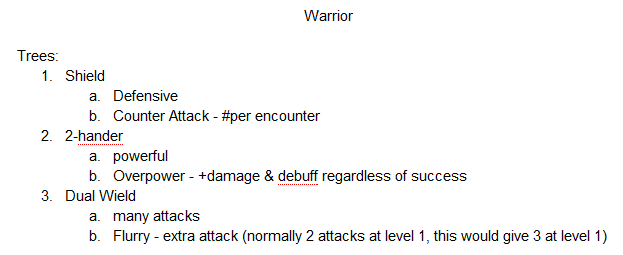
The warrior specs would be shield, 2-handed, and dual wield. The shield spec would focus on defense. The 2-handed spec would focus on powerful attacks and debuff type abilities that originate from overpowering the opponent. The dual wield spec would focus mainly on doing damage through fast, multiple attacks.

The rogue specs would be dagger, bow, and tools. Dagger spec would focus on melee attack, evasion, and maneuverability with weakness exploitation. Bow spec would (of course) focus on ranged attacks. The tool spec would focus on traps and other gadgets to use in battle.

The mage is much like your typical wizard with the specs of arcane, pet, and enhancement. The arcane tree is the typical spellcasting tree, focus on damage spells and other things, such as teleportation. The pet tree would have a permanent companion with special abilities for the pet or to temporarily enhance the pet. The enhancement tree is the one that I'm most unsure about and would love to find a better idea for, it would have buff spells. You can see how it's a fairly shallow idea that needs more. Illusion may be added, as well as debuff abilities, I just need to solidify it.

The priest wouldn't be similar to the WoW priest. The priest would be very tied to the games lore. The priests would be those who celebrate and practice balance and be very tied to the original geomancer concept. The specs would be life/death which would focus on healing, nature, and decay magic. Then there'd be the earth/wind specs and the fire/water specs, which would focus on manipulating those particular opposing elements.

Next time I'm going to talk about how the specs would work, since they function very differently from the WoW specs which are probably what most people reading this are thinking about.

Tuesday, July 26, 2011

Adventures in Amateur Game Design, part 1: Introduction


This was originally going to be "Adventures in Amateur Game Design: Part 1: Introduction: How I got started: Fun with subtitles" but Sarah told me that was stupid. The idea, however, remains the same. Why did I decide to start making a game and what is it?

The idea began to develop after watching How to Train Your Dragon. I really thought that movie established a credible basis upon which to design a game. It's even something that gets poked fun at in the movie.  So I really liked the vikings versus dragons setting.

As far as classes go, there were four: defender, warrior, archer, and geomancer. The defender was a shield using, defensive class. Warrior and archer are self-explanatory. The geomancer would be the mage-type class with an emphasis on some Avatar-esque elemental magic. All the classes would have some magic that would go with their particular niche. They would have attack magics as well as support oriented magic. The defender had personal and party defense magic. The warrior had attack and party buff magic. The archer had attack and enemy debuff magic. The geomancer was just plain magical.

For the system, it would have been a d10, White Wolf-type, system that would use the other dice for damage. I wanted abilities to be of the D&D 4th edition type where they have a certain number of uses per a period of time. I also wanted an initiative system that would allow for dynamic turn ordering, where a character could be 'faster' and have their turn come around more often. Furthermore, I wanted a character to be able to abstain from action to have their next turn come around faster.

That was pretty much all I had before I ran out of ideas and steam roughly a year ago. The idea has since returned to me in full force and I'll be talking about the things that I've changed since then and the inspirations for where they came from. I'll be talking in depth about how I'm going to capture each of these ideas that I've had. Stay tuned, because I think this will get pretty interesting.


Friday, June 17, 2011

Spirit Tracks Thoughts

I beat Spirit Tracks last night, and it was actually really great. I felt like the game did a wonderful job of fully utilizing the touch aspect of the system that it was on. It was a wonderful improvement on the solid gameplay already found in it's predecessor, Phantom Hourglass.

One of the most welcome improvements was the fact that in the "central dungeon", in this game a tower, which is returned to several times during the game, previously completed portions of the tower do not have to be repeated. Many of the items in the game are variations on standard Zelda items: bombs, bow, boomerang, whip. There was also an item which let you blow gusts of wind (using the microphone) and a wand which let you do some really neat puzzle with sand. The wand would hard the sand and make it stand up as a raised platform, allowing link to create barriers or elevator himself.

Princess Zelda plays a more crucial role in this game since her spirit became disembodied. She follows you throughout the game, but not in an annoying way. As a spirit, she can possess certain armored enemies called Phantoms. The Phantoms only occur in the central dungeon and come in a few varieties. The co-op'esque gameplay provided by this mechanic allows for wonderful and interesting interactions with your items.

The boss battles were all wonderful, the ones at the end were especially great.

This game does feature extensive train travel as a core of the game in a way that is somewhat similar to Wind Waker and Phantom Hourglass, though in a more rigid way. There are some special gates that facilitate travel via teleportation, so overall, it's on par with the travel in the other two.

Overall, it was a wonderful game.

Saturday, June 11, 2011

Asymmetric Multiplayer

In my WiiU piece, I talked about how the new controller will allow for hidden information and asymmetric multiplayer opportunities. This has actually an idea that I've had on my mind for quite some time. Way back before the PS3 came out and and Starcraft: Ghost was actually still in development, I had an idea for a mixed mode RTS/FPS game where one player, using a PSP that was connected to the PS3 would control the RTS elements of play and the PS3 players would each take individual control of a unit on the battle field. Granted my idea was sloppy, but someone else has actually come up with a similar idea that should work out much better.

This idea has actually come to light in the form of Dust 514, a PS3 shooter that takes place in the persistent EVE Online universe. EVE players take control of the RTS elements and the Dust 514 players take control of individual soldiers.

At Nintendo's conference they showed a tech demo called Chase Mii where one player, using the tablet controller, is chased by the players that are using the Wii Remote. Because they are using the tablet controller, the location of the chased player can't be spotted by the other players. This solves 'screen looking.'

Up until now the significant majority of multiplayer games, both cooperative and competitive, have been symmetric, where each player plays the same way, has access to the same things, etc. So what are some ways that this new multiplayer paradigm can be leveraged?