Showing posts with label mathematics. Show all posts

Monday, February 2, 2015

Pandemic: The Cure - standard deviation and probability

Initial setup
Recently we have been playing Pandemic: The Cure. The goal of the game is (loosely) to cure all the diseases. Each player has a certain number of dice that they roll on their turn (5 for most players, 7 if you're the Generalist) that give them their possible actions for the turn. One of the actions lets you use one of your die to "bottle up" a disease die and at the end of your turn you roll your bottled up disease dice and if the total amount rolled on the dice for a particular color of disease is greater than 13, then you have cured that disease.

Bottling up the diseases is great because it removes that disease die from play and helps you discover the cure, but until you discover the cure that die of yours you used to "bottle" it up is locked up and you can't use it, meaning you'll have fewer possible actions on your turn, making you less effective until the cure is discovered.

Disease Dice
Each color of disease die has different face values from the other colors'. Each one has a "Cross" face (value 0) and 5 other values. The average value of the faces on each die is 3 but since the values are different the standard deviations of the values on the dice are different. The values on the faces of the dice are as follows.

ValueBlackYellowBlueRed
1st0000
2nd3211
3rd3221
4th3434
5th4566
6th5566
Avg3333
Std Dev1.6722.532.68

So in terms of trying to cure the diseases, the likelihood that the total of the values across all the dice you roll of a color will meet the required sum is different. Below is a table of probabilities of curing the disease with various numbers of a color of dice. The amount needed to cure a disease is normally 13, but sometimes can be 11.

BlackYellowBlueRed
# Dice11+13+11+P13+11+13+11+13+
20.00%0.00%0.00%0.00%11.11%0.00%11.11%0.00%
332.87%7.41%34.72%12.04%34.26%20.37%40.28%23.15%
470.14%46.91%67.67%45.76%60.88%45.06%62.73%45.76%
589.51%77.22%86.52%73.53%79.90%67.30%78.29%67.36%
696.81%91.85%95.03%88.94%90.71%82.81%88.70%82.04%
799.12%97.42%98.33%95.86%96.05%91.82%94.62%90.59%

You'll see that for certain numbers of dice and goal numbers to reach, the probability of curing the disease can be quite different. For example, with 3 dice and a goal of 13 the probabilities range from 7.41% to 23.15%. Most differences are <10%, but that can be a fairly significant difference.

You'll see that no die is universally easier or harder to find cures with. Getting 13+ is only really possible once you have 4 dice. A goal of 11 isn't very likely until you have at least 3 dice, and even then the odds are very bad. It's very hard for a single character other than maybe the generalist to amass 4 or more dice by themselves. After you have 3 dice bottled up you only have two dice left. So getting the 1 in 6 result of being able to bottle up on your dice when you only have two dice is fairly unlikely. The game allows you to trade your bottled up dice to another player if you're on the same square. This probability table tells me that that's a very important part of the game.

Advanced discussion:
In the above two tables, I ordered the dice colors by their standard deviations, lower on the left and higher on the right. One thing you might notice is that for 3 dice, the higher variance dice (aka higher standard deviation) have a higher probability of success. You'll notice that for higher numbers of dice, the colors with a lower standard deviation tend to have a higher chance of success.

When you have 3 dice, the average value of the sum is 9 (because the average for any given die is 3). Nine is insufficient for either goal so results near the average are bad. So you want a result that's far from the average, meaning you want a higher standard deviation. When you're at 5+ dice, the average result, 15, is above the goal so lower standard deviations are better.

When average is bad and you want that extreme result, you'll do better with a higher standard deviation. When the average is good and you don't need an extreme result, you'll do better with a lower standard deviation.

Player Dice, showing all faces
Epidemic Roll Change
Another place where probability plays a big role (roll?) is with epidemics. Each character die has one face which, when rolled, will advance the epidemic track. The generalist, with their seven dice instead of the normal 5, stands a much greater chance of rolling these values on their turn. To balance this, the generalist is allowed to ignore the effect of the first epidemic they roll each turn. This has a huge effect, and it makes the generalist have an overall lower change of advancing the epidemic track than other characters. Below is a table of probabilities for how far each character will advance the epidemic track on their initial roll of dice (with full dice i.e. no dice locked up from bottling up diseases).

AdvancementNormalGeneralist
040.19%66.98%
140.19%23.44%
216.08%7.81%
33.22%1.56%
40.32%0.19%
50.01%0.01%
6NA0.0004%
Avg0.830.45

The other advantage of being the generalist is that when you have no epidemics on your initial roll (28% of the time w/ 7 dice, higher w/ fewer) you can freely reroll dice to try and get a better result w/ no fear of the consequences of rolling an epidemic.

Wednesday, May 30, 2012

WoW: MoP Drop Rate Statistics Calculators

Normal Loot

Drop Rate
Number of Kills
Probability of drop =
Probability
Kills Needed =
Average Next Drop Prob Median
??? ??? ≤???

LFR Drops

Drops per boss
Pieces eligible
Pieces Needed
Average Next Drop Prob Median
??? ??? ≤???

Explanation of the Normal Loot section
First, you'll have to enter in the drop rate. From that, the table below will populate. It will tell you the average number of kills needed for the piece to drop, the probability that it will drop on the next kill (which should be equivalent to the entered probability) and the median number of kills required to see the item drop. If, for example the median number of kills is 4, then there is a 50% or better chance it will have dropped on or before the fourth kill.

Second, if you enter in the number of kills that you've performed, then it will tell you the probability that the item should have dropped at least once in those kills. If you enter in something in the "Probability" field, it will tell you the number of kills needed to have that probability of the item dropping at least once.

For example, if you have a drop rate of .5 and 5 kills, there is a 0.968 (actually 0.9875, but the results are rounded) probability that the item will drop at least once in those five kills. If the drop rate is still 0.5 and you enter a probability of .90, it tell you that 4 kills are necessary to have a 90% or better chance of the item having dropped at least once.

Explanation of the LFR Drops section
This is based on the LFR loot system that will be introduced in Mists of Pandaria. An explanation can be found here. You just enter in how many piece of loot the boss will drop among the raid, how many pieces of loot in its table you are eligible for, and how many of those pieces you actually want. When you have that entered the table will populate with the same type of information that is in the above table.

I based this on the assumption that a boss will drop a particular number of pieces. If it is the case that you have a fixed X% chance to win loot, then I will alter it. It is also based on a 25 player group. Furthermore, the top section is about a piece dropping and not necessarily that you'll win it. The bottom section involves you winning a piece that you want.

If you have any questions about this or about loot drops, please don't hesitate to ask below. If you have comments, recommendations or requests, then please ask.

Tuesday, May 29, 2012

The Myth of Compound Interest


Banks and mathematics courses will talk about how monthly compounded interested is better than yearly compounded interest. You might even see a demonstration of it such as this one dealing with 6% yearly interest.

Which shows that a 6% interest rate, when compounded monthly, provides a slightly higher amount of interest. Now, the amount of increase you get is dependent on your base interest rate. In our example, a 6% interest rate becomes a ~6.17% interest rate. A 12% yearly interest rate becomes a ~12.68% interest rate, which is a far better gain than what 6% achieves. But a 12% interest rate is incredibly unlikely to get anywhere.

So why am I calling this a myth? Well, because it's only better than yearly interest under certain conditions. The example they give you presumes that you aren't depositing or withdrawing money from the account. And if you're not depositing or withdrawing money from an account, what good is it? It's either a small amount of money, in which case the additional interest in negligible. If it's a large amount of money, then the person is likely financially secure or wealthy, so they could benefit significantly from the increased interest.

Suppose you're depositing money into the account every month. If you have monthly interest, then a small amount of interest is applied to small amounts of money at the beginning of the year, and larger amounts of money at the end of the year. If, however, you have yearly interest, all of the interest is applied to a large sum of money at the end of the year. Why apply interest to a small amount of money when you could instead have the interest applied to a large amount of money?

The question then becomes, how big of a deal is this discrepancy? Well, I'm glad you asked. I used an R program to come up with some numbers for us. I used a 6% yearly interest rate and invested in the account at $300 per month. Now, the $300 figure isn't important, these results will hold true no matter what the amount is, $300 just seemed like a good figure to work with.

YearsNo InterestMonthlyYearlyDifference
1$3,600$3,719.17$3,816.00$96.83
2$7,200$7,667.73$7,860.96$193.23
3$10,800$11,859.80$12,148.60$288.80
4$14,400$16,310.50$16,693.50$383.00
5$18,000$21,035.70$21,511.10$475.40

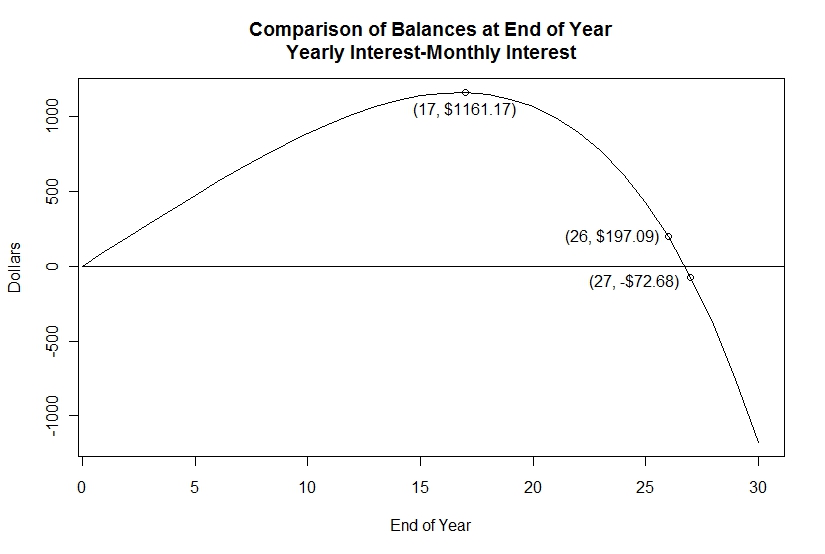
From this, it would appear that the yearly interest is always better than monthly interest, but when you carry the calculations out you find that monthly interest will eventually exceed yearly interest.
Click to Enlarge
From this chart, if you have a 6% interest rate and deposit money at a constant rate, then monthly interest overtakes yearly interest at the end of the year only at year 27. Monthly interest accounts exceed yearly interest accounts in the middle of each year because of the interest that is applied during the year, but at the end of each year prior to year 27, yearly interest comes back. From this graph we see that yearly interest provides, at most, a $1161.17 advantage (with a $0 initial balance and monthly deposits of $300). This scales as long as your monthly deposit is the same. So the advantage maxes out at roughly four times your monthly deposit.

There is another situation where compound interest is better. When the amount of money in an account is in decline, it is better to have compound interest because then the interest will be applied when you have more money (before you lose said money).

So what affects whether monthly or yearly interest is better? The factors are your initial balance and how much you invest each month. If you have a high initial balance, then monthly interest should always be better. If you have little to no initial balance, yearly interest will be better for a long time. If your investment rate increases with time, such as starting by depositing $100 and depositing more and more as time goes on, then yearly interest will stay relevant longer.

So banks tell you about this wonderful thing known as compound interest when it isn't necessarily better for you. I know how you all must feel right now. I mean, how could the banks betray you like this? It's just so hard to believe that they could be like that. I mean, that something they would tell you is a good thing can actually be a bad thing (unless you are financially secure enough to save a large amount of money for a long time.

I think I'll do a followup post that investigates some other investment situations. Keep an eye out for that. 

Sunday, May 20, 2012

How Many Diablo III Builds Are There?

In Diablo III you can have a an ability mapped to both of your mouse buttons and to the 1-4 keys on your keyboard. By default each skill in the game can only be placed on a particular button. For example, my Zombie Dogs have to be bound to the 1 key. This means that under the default settings you can't have some skills on your bar at the same time because they would have to be bound to the same key.

There is, however, an option called elective mode that removes this restriction and allows you to put whatever skills you want on whichever key/button you want. This has led me to wonder how many different builds you can get out of each particular mode. So to look at this, I will use my witch doctor, Tauzex, as an example. The number of skills I use in this post will come from him. Other classes have different numbers of skills, so these numbers will vary from class to class.

Some background on what goes into a build
  • You have 6 active skills and 3 passive skills at max level
  • Each active skill can have 1 of 5 runes attached to it. 
  • I will assume that you'd never want to use a skill unruned
  • In both modes at max level, you can pick any 3 of your passive skills with  no restrictions.
I will not be considering a build with the same skills but on different buttons as being a different build. 

For my witch doctor, the number of skills that I can attach to each key in standard mode is
  • 1 key: 4
  • 2 key: 3
  • 3 key: 4
  • 4 key: 3
  • Left Click: 4
  • Right Click: 4
  • Passive Skills: 15
In general, the number of builds in either mode is the number of choices you have for your active skills times the number of choices you have for your passive skills (since your active skill choices and your passive skill choices are independent of each other). In both modes, the number of passive skills that you can select is the same
The middle section is read as "15 choose 3" and is explained in the footnote*
To count the number of active skill choices, I will first count how many choices of skills you have and then factor in the different rune choices for those builds. If you have a selection of 6 skills and each of those skill has 5 runes, the number of ways that you can rune a particular set of skill is 
So now we just have to count the number of skill choices each mode has.

Active Skill Choices in Standard Mode
To figure out the number of builds in standard mode, I just have to multiply the number of choices I have for each skill slot. This comes out to
choices for your active skills. In whole, this brings active mode to 
builds for your character. That's over 16 billion distinct builds.

Active Skill Choices in Elective Mode
In elective mode, you aren't restricted by abilities needing to be placed in certain positions. So as a witch doctor I would just need to select 6 active skills out of my 22 total active skills. The number of choices in elective mode is 
choices for your active skills. In whole, this brings elective mode to 
builds for your character. That's over 530 billion distinct builds. This can be done for the other classes as well, which gives us the following table.

ClassGuided ModeElective Mode
Barbarian20,160,000,000652,863,750,000
Demon Hunter21,840,000,000717,670,078,125
Monk9,828,000,000308,626,500,000
Witch Doctor16,380,000,000520,451,796,900
Wizard34,125,000,0001,259,070,312,500

Followers
We shouldn't forget our followers! They play an important role in single-player gameplay. So how many choices do we have for our follower builds. Well, there are 3 followers, and each one requires that you make 4 choices that each have 2 options. 

So that multiplies the number of distinct was to outfit your character by 48. Of course, since you don't have a follower in multiplayer mode, this doesn't apply there.

Conclusion
Wow, that's a ton of different builds for your characters, and elective mode has so many more builds. In fact, elective mode over 32 times as many builds as standard mode does. I don't believe I have to tell you that that's an impressive number of choices!

* As I said above, that particular notation is read as " choose ." In mathematics it's known as a combination (as opposed to a permutation) and is calculated as follows.
where

Wednesday, March 7, 2012

WoW Survey Results: Looking at crossplay

Actually a dude
There's a bit of an adage about World of Warcraft that the men are men, and so are the women. This is to say that no matter what the gender of the character you're looking at is, it's likely a guy playing that character. Now, given the percentage of female players that some studies have shown and the percent of the time that players of both genders play oppositely-gendered characters, this is actually unlikely.

For this article, and forever on until I manage to find a better one, I will use the term "crossplay" to refer to when a person plays a character whose gender is different from their gender.

In general, from my survey results, male respondents engaged in crossplay ~33.96% of the time and female respondents engaged in crossplay ~9.19% of the time. Right of the bat we see that men engage in crossplay far more than women do, almost 4 times as much. If you ask, most male players would likely tell you that you spend all of your time in this game looking at your character's butt and they would like to enjoy looking at what is presented to them.

Is that all there is too it? Guys, why do (or don't) you play female characters? Ladies, why do (or don't) you play male characters? Well, we can look at this ourselves a bit while we wait for potentially helpful comments. Let's get some breakdowns in here. Unfortunately, as in the past, I can't supply a breakdown of crossplay for female respondents due to an insufficient volume of female respondents. I'm so totally bummed about that. So, if I fail to stipulate it later on, I'm just talking about crossplay by male players.

Percent of crossplay for male respondents for each class
PriestPaladinMageShamanRogueDruidHunterWarlockDeath KnightWarrior
49.2140.5738.6234.0432.8131.5329.8828.7827.5924.66

What immediately springs out for me is something that I've noticed before. We find the warlock, Death Knight and warrior are at the bottom of a list. We saw this before when I was looking at gender and class, when those were 3 of the 4 least played classes for female respondents. It's interesting that three of the four least played classes for female respondents are the least crossplayed classes for male respondents. Although pinpointing why it's this way will have the same troubles that we had back then. The correlations between armor type, role, location in battle, and theme will confuse the analysis. We also see that our light-wielders, the priest and the paladin, hold solid leads in the top spots with the cloth-wearing mage in the third spot. Let's look at this a few different ways.

Average crossplay by armor type
ClothLeatherMailPlate
38.8732.17
31.9530.94
This table shows a pretty clear trend that indicates that as you go from the lighter armor types to the heavier armor types, the average amount of crossplay by male respondents decreases. This probably plays into the aesthetics of the armor as many male players probably don't imagine a male hero wearing a robe or a female hero wearing bulky plate.

Average crossplay by role
No HealHeal
No Tank32.5241.61
Tank26.1336.05
This table show us that healers tend to have more crossplay while tanks tend to have less crossplay. Does this show that male players consider tanking to be a masculine role and healing to be a feminine role?

Average crossplay by fight location
MeleeMixRanged
28.3535.3736.62
Here we can see that male players tend to crossplay less with characters in melee and more with characters at range. I feel less certain that this one plays into real feelings and feel that it may just be a correlation with the effects of role and armor type.

The three tables above really break down what I think are some of the predominant factors that influence whether a male player will crossplay. I think that armor type and how it affects aesthetics and role/fighting location and how that affects perception really make up the most of it. I'll admit that I am not immune to this as well, but I'll get into that after this next section. Now let's look at how race influences crossplay.

Percent of crossplay for male respondents for each race
DraeneiNEBEHumanGnomeGoblinWorgenUndeadTrollDwarfOrcTauren
59.7052.8752.6040.6435.7731.3625.3322.9421.7214.8313.9212.80

There is some wide variance here, huh. Analyzing the races is different since they can't be broken into groups as easily as classes can be. The thing that tends to stick out to me, is the comparative of the female model, especially when that is compared to the male model. We see that the female models that are the most attractive (according to human standards, of course) are at the top of this list. I have complete faith that the patented female Draenei hip wiggle has played no small role in vaulting them to the front of this list. Gnomes, while certainly not having human proportions, are much like tiny humans, which is probably the factor that has placed them in the number 5 spot above all the "monstrous" races and the dwarves. Interestingly, although dwarves are quite human, moreso than the gnomes in my opinion, they are at tenth place here. I guess guys just tend to be too shallow for them. They probably couldn't handle a playing a dwarven lady anyway. One last table for this section, you probably noticed this yourself with the last one.

Crossplay by faction
AllianceHorde
38.19%25.89%

This combined with the fact that the Horde has fewer female players than the Alliance means that the Horde is a bit of a sausage fest, comparatively. Sorry Horde bros, that's just the way it is.
Also really a dude

In full disclosure I must admit that I am not immune to the draw of the female characters, although I believe my percentage is lower than the average. My very first female character was a Night Elf priest (how typical, right?) and my second female character is a human warrior, which I've talked about before (and need to play more). I honestly can't remember any others that I may have.

So it seems that the trends that drive men to play a female character are the oft-quoted attractiveness and their perception of in-game gender roles. What I'm particularly interested in is why there is such a difference in the percentage of crossplay between male and female players. Do women play so few male characters because female characters tend to be more attractive? What other components are there to this?

But wait, there's more - Age and crossplay
There is an age component to all of this, too. In general, older male players are more likely to play female characters than younger male players. Going back to the two groups that I set up for my post about the ages of male players and how that impacted what they played, I found that in general, the 18 and younger group played female characters 27.62% of the time while the 25 and older group played female characters 34.65% of the time. Futhermore, the increase from one group to another was not uniform, some groups saw a higher increase than others.

Crossplay by age for class
YoungerOlderComparison of odds*
Average27.62%34.65%1.39
Priest46.02%47.26%1.05
Mage37.27%37.24%1.00
Paladin35.33%42.71%1.36
Shaman30.08%32.88%1.14
Hunter27.27%25.51%0.91
Rogue23.85%26.84%1.17
Druid23.81%39.87%2.12
Warlock21.11%27.78%1.44
Death Knight17.65%27.75%1.79
Warrior15.15%25.48%1.91

So every group except for the hunter and the mage saw an increase in their amount of crossplay among the male respondents at they ageds. When looking at this chart, however, some of the classes increased less than the average increase. So while female characters tend to appeal more as we move from the younger group to the older group, some don't increase as much. In summary, as male players age
  • Decreased: hunter, mage
  • Increased<Average: priest, shaman, rogue, paladin
  • Increased>Average: warlock, Death Knight, warrior, druid
One thing to notice is that the classes that had the lowest percentage of female players among the younger group saw the biggest increases. It's distinctly possible that as male players get older, they tend to throw away a bit of their preconceived notions about in-game gender roles. This isn't to say that the older male players are an enlightened bunch, but just that they don't subscribe to those gender roles as strongly.

Crossplay by age for race
YoungerOlderComparison of odds*
Average27.62%34.65%1.39
Draenei58.75%53.7%0.81
Night Elf47.58%47.11%0.98
Blood Elf44.44%52.02%1.36
Human31.28%41.51%1.56
Goblin23.61%30.43%1.42
Gnome22.92%39.19%2.17
Dwarf18.18%13.25%0.69
Worgen17.65%30.84%2.08
Troll16.67%26%1.76
Undead15.79%29.27%2.21
Orc10.62%9.17%0.85
Tauren10.48%21.88%2.42

 In summary, this is
  • Decrease: dwarf, draenei, orc, Night Elf
  • Increase<Average:Blood Elf
  • Increase>Average:goblin, human, troll, worgen, gnome, undead, tauren
 One thing to notice here is that in addition to being more open to crossplay, the older male group also seems to have lost their qualms with the "monstrous" female races, with all of them except for the orc receiving significant gains in popularity. Quite frankly, I can't come up with a reason that the orc and the dwarf would have a decrease in popularity. It's puzzling to me.

I could have done the various breakdowns that I normally do but I think what we saw was pretty clear and that I would spare you all.   ;-)

Conclusion
Male crossplay is something that has many factors. In general, it seems to be affected by the attractiveness of the female model of the chosen race as well as the aesthetics of the class's armor. Futhermore, it seems to be affected by the in-game gender roles that the players seem to ascribe to their character's PVE roles.

As male players get older, things seem to change. They seem to become more willing to crossplay in general. It seems likely to me that this isn't due to an increased desire to play female characters but a loss of feeling that they have to play male characters. Furthermore, they seem to becomes more open in how they crossplay, not feeling as strong a pull to tend to those perceived in game gender roles and becoming more open to crossplaying with races that they might not find as attractive as others.

All in all, no matter how much analysis I do here, we can't conclude anything about why a particular person engages in crossplay or why they crossplay with the particular character(s) that they do. For some, it could just be about having something nice to look at. For some, it could be for roleplay purposes. For others, it can be part of their transition process as a transgendered person.

In the future, I'd like to be able to take a look at female crossplay. The fact that it is more rare makes the possibility of analyzing it all the more appealing. If I get the chance to do a study like this again in the future I will go to great steps to get a large enough number of female respondents so that I can achieve such an analysis.

Next time, I intend to look at what I'm calling "class correlations." I'll be looking at what classes tend to be played by the same person and how if one person plays one class, how likely is it that they play the other classes. Are there some classes that are much likelier to be played together than others? We'll find out.

*The comparison of odds column is calculated as follows. If p(young) is the percentage of female characters for the young group and p(old) being the same for the older group, with both being between 0 and 1, then the comparison of odds,
This is a measure of the increase in crossplay from the young group to the male group. It is the odds that a older respondent crossplays for that class divided by the odds that a younger respondent crossplays for that class.

Thursday, February 9, 2012

WoW Survey Results: Gender and Race

Cats are magic
How do men and women play World of Warcraft? We've all heard talk about the differences between male and female WoW players. Some of that might reflect truth, some of that may reflect enforced gender roles. But has anyone just gone out there and asked them? [Editors Note: Yes, others have. No I won't link you. -HMP]

About a year ago, shortly before patch 4.1 was released, I made a survey and tried to distribute it among several sources, but the only place where it took off was MMO-Champion. In the survey I asked players about their age, gender, their characters, and what they liked to do when playing.

This data was collected during patch late patch 4.0, and consisted only of people who frequent MMO-Champion. As such, it's hard to apply everything here directly to our current WoW population. Absolute results should be assumed to likely not apply, but comparative results should still be quite relevant. For example, I won't talk about the ratio of male to female players or the age distributions of players in my results because I have a unique subset of the WoW playing population.

Race Choices
Player/CharacterHordeAlliance
Male51.21%48.78%
Female45.54%54.46%
 
From this table we can see that female respondents tend to play Alliance characters slightly more than male respondents do. This does not mean that the Alliance has more female players than male players. The only way to do that would be a comprehensive survey of WoW players or an in-game random sampling of players. I wouldn't trust asking people in-game, they'd probably be weirded out by someone whispering them and asking them their age and gender.

Races played by male players
HumanBlood ElfNight ElfTaurenUndeadOrcDraeneiTrollWorgenGoblinDwarfGnome
14.89%12.41%9.00%8.80%8.27%8.10%7.51%7.51%7.19%6.11%5.51%4.66%
Races played by female players
Blood ElfDraeneiNight ElfHumanWorgenTaurenTrollGoblinGnomeUndeadOrcDwarf
17.13%14.47%13.09%10.86%8.07%7.94%7.52%5.85%5.01%3.76%3.34%2.92%

Humans and elves are popular all around, but the popularity/percentage of play changes drastically depending upon the gender of the respondent. In the transition from male to female the human, undead, orc and dwarf representations drastically lowers while the draenei, blood elf, and night elf representations increase dramatically. If you consider the sexual dimorphism for each of the races and the comparative attractiveness between each race's genders it would appear that a large factor in this has to do with wanting one's character to be attractive/human. The more monstrous races tend toward the lower side of the scale, while the more attractive and human ones tend toward the higher side of the scale. In the case of the draenei, the males are large and strange, while their females are more human sized and proportioned. I can't really account for the loss of representation of humans in the transition except that their popularity may pale in comparison to the elves and the draenei.

It's important to remember that people play different races for a great variety of reasons and that the reasons listed above do not apply to everybody's decision. This merely reflects the overall trend. One reason to pick a race that actually went away quite a bit in Cataclysm was race/class combinations. They were far more restrictive prior to Cataclysm and were opened up significantly and now there are far fewer restrictions than there were.

In general, you find that the distribution of races is more even among the male players, while it is more skewed among the female players. I can't really account for what this means, though. Commenters are certainly welcome to speculate.

Next time the discussion will be about the gender of the player and the classes they play. That one is going to be a doozy.

Sunday, February 5, 2012

20 Days of WoW Blogging: Day 11 - Bad habits and flaws

When I was younger, my worst flaw was shyness. I was always afraid to talk to new people, make friends, go somewhere where I didn't know anybody, etc. However, when I was young, I changed schools fairly often. I went to 2 different elementary schools, 2 different middle schools, and 1 high school. I was also sent to all manner of summer camps. So making new friends was something I had to do quite often. This wore away some of this shyness.

My sophomore year of college, I was forced to confront another fear, public speaking. I took a class called Introduction to Advanced Mathematics. This class wasn't taught in a lecture format, but rather in a slightly watered down Moore method. In Moore method teaching, the instructor lays out proofs that the students are to prove, and class time is spent with the students at the chalkboard presenting their proofs. My following math courses were all taught in this method. It was initially daunting, but I grew to absolutely love it. In fact, one of my chief complaints about grad school is that NONE of the classes were taught this way and I sorely missed it. Being lectured just isn't a good environment for me to learn.

Lastly, as a graduate student, I was require to teach two lower-level mathematics courses each semester. This wore off the rest of that public speaking fear to something that I can fully confront.

As I grew older and my shyness wore away, another flaw began to rear its ugly head, sloth. My lack of alacrity has posed many problems for me in my life. It's the reason, that I do poorly in language and history classes, despite the fact that I love language and history. It's the reason that I didn't go to as good of a graduate school as I could have. It's part of the reason that it took so long for me to get a full-time job. It's the reason that I'm so messy. It might be part of the reason that I keep this blog, I can both avoid work while convincing myself that I'm being productive.

Being in a relationship has helped to improve my sloth, since I have someone to be accountable to, but it's still pretty bad.

I'm afraid to go talk to this person that I need to talk to; I'll do it later.

Saturday, November 5, 2011

Advocating the New Talent System: Necessary Conditions for its Success


At Blizzcon, Blizzard announced their changes to the new talent system and their hopes that it would be the end of cookie cutter specs. Smart people realized that this wouldn't be so, that as long as there were choices, people would sim/calculate out which choices would produce optimal DPS. Smarter people realized/made mention that this would just mean we'd have to come up with a cookie cutter spec for each fight. The particular article that I read was Mists of Pandaria: The Myth of the talent tree choice by my personal superhero Fox Van Allen (who has the best name ever).

Let me just say first that I agree with most of what he says in the article. I just don't necessarily agree with the doom-saying. I feel that there is more to be said on the topic. There is a theorem in mathematics that is relevant to this situation. It doesn't have a special name, but it goes like this:
Given any finite set of numbers, that set has a maximum value and attains that value.
In calculus this is true given any function and a closed set on which that function is continuous (or piecewise continuous), but that's not important. Here, a maximum value is one that is greater than or equal to each value in the set. In our case, these numbers are the DPS (or HPS, or relate to damage mitigated) produced on a particular fight by a particular set of talent choices. So on any fight, there will be some spec that is optimal. And since these talent choices are so different, it's unlikely that any two of them will be equal, except in rare cases, so there will almost always be a single optimal spec for any given fight.

Is this okay? Yes it is, under certain conditions. Blizzard has said that they want talent choices to be simpler, more understandable, and more meaningful. They've certainly achieved the meaningful aspect. The choices you make now are actually fairly significant from one another, but how can they make it simpler and more understandable?

I said that this system will be fine under certain conditions, what do I mean by that? What are those conditions? As I see it this system will be a success if
  1. It is clear when (for what bosses/situations) one talent choice is better than another. For example, Divine Star (priest tier 3) would be very good for a movement heavy fight with AOE damage and possibly adds.
  2. If there isn't an obviously superior talent for a particular fight, the talents should produce roughly equal results. The results should be equal enough that your familiarity with a play style should be more important than the simulated results.
  3. Talent choices should not have a significant effect on gearing. I should be able to change talents without feeling like I need to change my gear. I'm worried about enhancement shaman in their tier 4 talents in this regard.
  4. For DPS and tanks, the choices shouldn't change your rotation. You shouldn't have to relearn your class.
With this new system I want to be able to go into a heroic with whatever talent set I want to use and perform well. I shouldn't feel the need to change my spec from fight to fight unless I'm undergeared for the dungeon. During progression raiding, I fully expect for me and my fellow raiders to change their talent set from fight to fight. However, if we overgear the raid, I expect my talent choices to not matter nearly as much.

In the end, I'd argue that the cookie cutter spec IS gone. Cookie cutter, while it actually refers to the homogeneity between characters, seems to imply to me that the spec is optimal for every fight. We have now created a situation where the optimal spec changes from fight to fight. We've eliminated cookie cutter specs, just not optimal specs, and that's okay, because that's impossible.

Picky Math Word Nerd Side Note: These aren't talent trees anymore. They're talent sets. Truthfully, mathematically, they weren't technically trees before. The difference between the old system and the new system is that you have fewer choices, the choices aren't dependent upon one another (no talent requires another talent), they are more exclusive, and they are shared between specs. Diablo II's talent system was more tree-like, though it was really more like a forest (a collection of trees). Even then, it doesn't perfectly fit the description of a forest. I'd say it was more of a set of directed graphs.