Showing posts with label design. Show all posts

Monday, February 2, 2015

Pandemic: The Cure - standard deviation and probability

Initial setup
Recently we have been playing Pandemic: The Cure. The goal of the game is (loosely) to cure all the diseases. Each player has a certain number of dice that they roll on their turn (5 for most players, 7 if you're the Generalist) that give them their possible actions for the turn. One of the actions lets you use one of your die to "bottle up" a disease die and at the end of your turn you roll your bottled up disease dice and if the total amount rolled on the dice for a particular color of disease is greater than 13, then you have cured that disease.

Bottling up the diseases is great because it removes that disease die from play and helps you discover the cure, but until you discover the cure that die of yours you used to "bottle" it up is locked up and you can't use it, meaning you'll have fewer possible actions on your turn, making you less effective until the cure is discovered.

Disease Dice
Each color of disease die has different face values from the other colors'. Each one has a "Cross" face (value 0) and 5 other values. The average value of the faces on each die is 3 but since the values are different the standard deviations of the values on the dice are different. The values on the faces of the dice are as follows.

ValueBlackYellowBlueRed
1st0000
2nd3211
3rd3221
4th3434
5th4566
6th5566
Avg3333
Std Dev1.6722.532.68

So in terms of trying to cure the diseases, the likelihood that the total of the values across all the dice you roll of a color will meet the required sum is different. Below is a table of probabilities of curing the disease with various numbers of a color of dice. The amount needed to cure a disease is normally 13, but sometimes can be 11.

BlackYellowBlueRed
# Dice11+13+11+P13+11+13+11+13+
20.00%0.00%0.00%0.00%11.11%0.00%11.11%0.00%
332.87%7.41%34.72%12.04%34.26%20.37%40.28%23.15%
470.14%46.91%67.67%45.76%60.88%45.06%62.73%45.76%
589.51%77.22%86.52%73.53%79.90%67.30%78.29%67.36%
696.81%91.85%95.03%88.94%90.71%82.81%88.70%82.04%
799.12%97.42%98.33%95.86%96.05%91.82%94.62%90.59%

You'll see that for certain numbers of dice and goal numbers to reach, the probability of curing the disease can be quite different. For example, with 3 dice and a goal of 13 the probabilities range from 7.41% to 23.15%. Most differences are <10%, but that can be a fairly significant difference.

You'll see that no die is universally easier or harder to find cures with. Getting 13+ is only really possible once you have 4 dice. A goal of 11 isn't very likely until you have at least 3 dice, and even then the odds are very bad. It's very hard for a single character other than maybe the generalist to amass 4 or more dice by themselves. After you have 3 dice bottled up you only have two dice left. So getting the 1 in 6 result of being able to bottle up on your dice when you only have two dice is fairly unlikely. The game allows you to trade your bottled up dice to another player if you're on the same square. This probability table tells me that that's a very important part of the game.

Advanced discussion:
In the above two tables, I ordered the dice colors by their standard deviations, lower on the left and higher on the right. One thing you might notice is that for 3 dice, the higher variance dice (aka higher standard deviation) have a higher probability of success. You'll notice that for higher numbers of dice, the colors with a lower standard deviation tend to have a higher chance of success.

When you have 3 dice, the average value of the sum is 9 (because the average for any given die is 3). Nine is insufficient for either goal so results near the average are bad. So you want a result that's far from the average, meaning you want a higher standard deviation. When you're at 5+ dice, the average result, 15, is above the goal so lower standard deviations are better.

When average is bad and you want that extreme result, you'll do better with a higher standard deviation. When the average is good and you don't need an extreme result, you'll do better with a lower standard deviation.

Player Dice, showing all faces
Epidemic Roll Change
Another place where probability plays a big role (roll?) is with epidemics. Each character die has one face which, when rolled, will advance the epidemic track. The generalist, with their seven dice instead of the normal 5, stands a much greater chance of rolling these values on their turn. To balance this, the generalist is allowed to ignore the effect of the first epidemic they roll each turn. This has a huge effect, and it makes the generalist have an overall lower change of advancing the epidemic track than other characters. Below is a table of probabilities for how far each character will advance the epidemic track on their initial roll of dice (with full dice i.e. no dice locked up from bottling up diseases).

AdvancementNormalGeneralist
040.19%66.98%
140.19%23.44%
216.08%7.81%
33.22%1.56%
40.32%0.19%
50.01%0.01%
6NA0.0004%
Avg0.830.45

The other advantage of being the generalist is that when you have no epidemics on your initial roll (28% of the time w/ 7 dice, higher w/ fewer) you can freely reroll dice to try and get a better result w/ no fear of the consequences of rolling an epidemic.

Wednesday, January 7, 2015

The Core Loop vs The Revenue Funnel

Here are some thoughts I had the other day about F2P game design as "loops" versus the common analytical tool of a "funnel" and how the design goals of these games collide against the business decision of being F2P. For more ideas of what a "core loop" is, a Google Image search will give you lots of examples.


Mike Sacco coined a nice term for this combination

Wednesday, October 19, 2011

Tutoring Website

Kingdom Animalia, 'cause boobies, we got em.

Sometime I have great ideas for websites, my last one was Congressman Drinking Bird, a website where you can see just how well your congresspersons match you on the issues by pitting them up against a randomly voting drinking bird. My latest one is a tutoring website. I don't have a catchy name for it, but I do have some great ideas.

The genesis of the idea was for an official website for clients to find tutors. Furthermore, if the tutor set it up to work this way, they could auction off their sessions to the highest bidder. This would work well for a tutor who worked out of a public area, like a library. It could also just work as a place for a tutor to post their schedule and their subjects so that clients can find someone who works for them. Another way to connect clients and tutors would be that if a client couldn't find someone to suit their needs and schedule, they could post a bounty for tutors to find. The last way I can imagine would be to hold a webcam tutoring session.

The site would have a rating system, so that people would know if a tutor was bad. Furthermore, the tutors would also (secretly) rate the students to know if the student was trouble or not. They could also post comments about the student's problem areas and progress that would be visible by the other tutors. 

As with anything like this, there are issues. Warnings would have to be posted and reminded about regarding safety, such as meeting in public places or at your own residence and having adult supervision.

There is the issue of monetization. Ads are a definite way to monetize. Centralized tutoring services (such as Sylvan) could advertise on the site. Textbook/ebook sales are another definite way to generate revenue. The other way would be to have payment be handled by the website and have a commission for each session plus maybe a monthly fee for the tutors (only if they book a session that month, to remove the barrier to entry). 

The risk with handling the money is that now the site becomes responsible for it. If the tutor doesn't show up, they should be paid. If the student doesn't show up (without canceling ahead of time) then the tutor should still be paid. A system would have to be put into place to verify that the tutoring session happened/didn't happen and why. My best idea would be to have an email be sent to the tutor that, when opened, would have a link to the site. Once there, the student or parent would have to enter a special code/password to verify their attendance. I still don't have the logistics of it worked out so that it's foolproof. Another is to have some sort of geolocation tied to IP addresses or maybe a smartphone app tied to the GPS to verify locations. It's rough idea.

Wednesday, October 5, 2011

Time-Traveling Gnomes


I had what may be an awesome idea. It takes place in an alternate history earth where several key points in history went differently and have severely impacted the future. Why did these events happen differently? Because a gnome (like a garden gnome) invented a time machine and accidentally screwed it all up. Now, it's up to your band on gnomes to use the time machine to go back in time and set events straight. Armed with a history book and your diminutive stature, you have to set history right, for better or worse.

The idea first came to me as an gnome-based RPG. I was trying to come up with a good hook for a gnome RPG and was having trouble. The trouble with such small gnomes is that they aren't disposed to grand, heroic acts because of their size.

Speaking into Joan of Arc's ear to guide her to action.

Ensuring Hitler meets his end.

Being the second gunman.

Acting as Einstein's inspiration.

The gnomes can debate and examine these points in history. If they aren't sure that what they've been sent to do is the right thing, they can look for evidence that maybe it is. They can choose not to do it and see what they outcome is. They get to remold the world from these critical points in time, setting new and different events into motion. Changing history.

Wednesday, August 3, 2011

Adventures in Amateur Game Design, part 5: What I haven't figured out.

There are many things that I still haven't figured out how I want them to work. I certainly haven't figured out what I want the specific abilities to be. There are major systems that I still need to nail down first.

Attacking
I know that I want attacking to be on a d10 system, that much is sure. What I don't know is how many attacks players might get, if they get multiple attacks at all. I don't know how I want to do damage, or even health. If I have health scale with level, then I feel like I should do a multiple attack system like in D&D, but I don't really like the multiple attack system.

Stat/Skill Increases
I want the character's stats and skills to increase as they level, but again, I don't know how I want to do this. There's the White Wolf system where you get points that can be invested in things, where things with a higher value require more points to raise. On the other hand, there's the D&D system where stat and skill increases come automatically as you gain levels.

Health
Should I have health scale with your level or should I have health scale directly with your constitution and nothing else? Which system I use then has drastic ramifications for how healing and damage will work.

Setting
At this stage, I don't really know what I want the setting to be like. The original vikings versus dragons idea could stick around, but it's going to need to be much, much more to compelling. I think I'll start by designing a campaign and then working things around that.

Since I've started my full-time job, I've had drastically less time to think about this game, as you might imagine. I've also had drastically less time to blog. So updates will probably be less frequent.

Monday, August 1, 2011

Adventures in Amateur Game Design, part 4: Customization Systems

In my last post, I mentioned that the specializations give you a fixed list of abilities as well as some customization options. The decision to give the different classes different customization systems just arose naturally out of my desires for how I wanted them to operate.

For the Warrior and Rogue: Learned Magic
In the setting, there is this idea that every person knows some magic, it's just part of society. So to that end, at certain points while leveling (roughly every 4 levels, for a total of 5 choices planned before level 20) the character must pick between a mage-like ability or a priest-like ability. For example, a dagger rogue may have to choose between a short-range teleport (from the mage) or a short-range knockback (inspired by the Earth/Wind power of the priest). Another part of this idea is that you can't have both abilities, you have to choose.

This system is adopted from Starcraft II: Wings of Liberty. In the game, as you progress, you have to choose between certain augmentations for your buildings/units. In Starcraft II, there are separate progression trees for Zerg and Protoss inspired upgrades. In my game, each specialization has it's own progression trees. So each warrior will pick abilities out of the progression trees for each spec. The difference is that you'll get a total of 5 choices from your primary spec, 3 from your secondary and 1 from your tertiary spec.

For the Mage and Priest: Spell Augmentations
It wouldn't really make much sense for mages and priests to have the same customization system as the warriors and rogues do. So I wanted something different. One of my problems with other RPGs is that for the casters there is a great breadth of abilities, but they often become outdated as you level. So I want my abilities to scale nicely as you level, which means that I don't need for there to be a wide selection of spells. In order to keep the spells feeling fresh, there will be a point based upgrade buying system for the spell that will allow you to change the way they function.

My go-to example is for Magic Missile. The standard Magic Missile spell fires several unerring projectiles at the target. The first customization option may be to allow Magic Missile to be cast as a free action and therefore in the same turn as another spell. Another option would be to allow the missiles to each have different targets, giving it the option for AOE (area of effect) damage. The last option would be to add some forcefulness to the missiles, giving them each a slight knockback effect.

I would like for the upgrades to be evenly priced, but for them get more expensive depending on how many augmentations you already had for the spell. So maybe the first augmentation would cost 1 point, the second would be 2 points and the last augmentation 3 points. The real trick to this system is figuring out how many points the character will receive. Too many points and they can get everything they really want. Too few points and they feel restricted. There's a delicate balancing point somewhere in there.

Saturday, July 30, 2011

Adventures in Amateur Game Design, part 3: Specialty Design

Like this, but also completely not like this.
So how do the specializations in my RPG differ from the specializations that most people are accustomed to from World of Warcraft? Currently in World of Warcraft, your specialization provides you with a special ability as soon as you pick it at level 10 and provides you with many, minor customization choices as you level. What I don't like, and Blizzard also doesn't like, is that many of the choices feel like false choices where many of the things are 'mandatory' in order to play optimally. I also don't like how many choices there are and the fact that in making one choice, you often have to invest multiple points to make that choice. Furthermore, whichever tree you pick to put points in as your 'secondary' tree doesn't really change your playstyle, just your efficacy.

For my design, I wanted your spec choice to occur at level one, so that different players of the same class can feel different from the beginning. This is reinforced by your primary spec giving you a special ability at level one. As you level up, your spec automatically gives you new abilities at certain levels. To allow for customization and choice, there is a customization system for each class. As currently conceived, the warrior and the rogue have similar systems and the priest and mage share similar systems. This will be the topic of the next post in the series.

Furthermore, after picking a primary spec the player also picks one of the two remaining specs to be their secondary spec. Despite the level one ability, the only difference between your primary, secondary, and tertiary specializations is the rate at which you gain new abilities from them. Meaning that some abilities won't be gained by players who don't choose it as their primary spec. This, too, will be the topic of a later post.

Another aspect of WoW specializations is that certain abilities, despite being available to people who picked each spec, aren't used by players of each spec. For example, every WoW rogue learns Rupture, but now all of them will use Rupture. This seems like a counter-intuitive design and so any ability that the player gets, I want them to use. To that end, if an ability is attained by a player of one spec, I want it to be just as effective and useful to a player of another spec.

In short, for the specializations we have:
  • chosen at character creation,
  • provides an immediate ability that is unique,
  • meaningful secondary specialization,
  • ability strength equality,
  • and an engaging customization system.
Details about the customization systems is what will follow in the next post.

Thursday, July 28, 2011

Adventures in Amateur Game Design, part 2: Changes

Since the original inception of the idea, almost everything about the classes has changed. To start, there would still be four classes. Except they would go from being defender, warrior, archer, and geomancer to warrior, rogue, mage, and priest. Furthermore, each class would go from being a set list of abilities to a three-specialization implementation. So what are all of these classes?

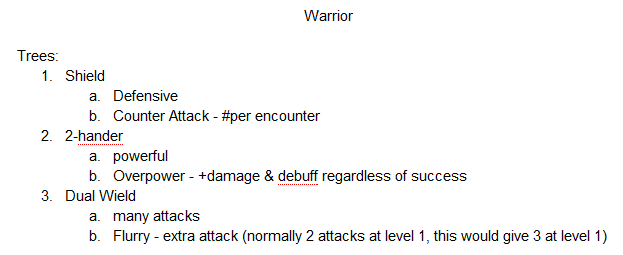
The warrior specs would be shield, 2-handed, and dual wield. The shield spec would focus on defense. The 2-handed spec would focus on powerful attacks and debuff type abilities that originate from overpowering the opponent. The dual wield spec would focus mainly on doing damage through fast, multiple attacks.

The rogue specs would be dagger, bow, and tools. Dagger spec would focus on melee attack, evasion, and maneuverability with weakness exploitation. Bow spec would (of course) focus on ranged attacks. The tool spec would focus on traps and other gadgets to use in battle.

The mage is much like your typical wizard with the specs of arcane, pet, and enhancement. The arcane tree is the typical spellcasting tree, focus on damage spells and other things, such as teleportation. The pet tree would have a permanent companion with special abilities for the pet or to temporarily enhance the pet. The enhancement tree is the one that I'm most unsure about and would love to find a better idea for, it would have buff spells. You can see how it's a fairly shallow idea that needs more. Illusion may be added, as well as debuff abilities, I just need to solidify it.

The priest wouldn't be similar to the WoW priest. The priest would be very tied to the games lore. The priests would be those who celebrate and practice balance and be very tied to the original geomancer concept. The specs would be life/death which would focus on healing, nature, and decay magic. Then there'd be the earth/wind specs and the fire/water specs, which would focus on manipulating those particular opposing elements.

Next time I'm going to talk about how the specs would work, since they function very differently from the WoW specs which are probably what most people reading this are thinking about.

Tuesday, July 26, 2011

Adventures in Amateur Game Design, part 1: Introduction


This was originally going to be "Adventures in Amateur Game Design: Part 1: Introduction: How I got started: Fun with subtitles" but Sarah told me that was stupid. The idea, however, remains the same. Why did I decide to start making a game and what is it?

The idea began to develop after watching How to Train Your Dragon. I really thought that movie established a credible basis upon which to design a game. It's even something that gets poked fun at in the movie.  So I really liked the vikings versus dragons setting.

As far as classes go, there were four: defender, warrior, archer, and geomancer. The defender was a shield using, defensive class. Warrior and archer are self-explanatory. The geomancer would be the mage-type class with an emphasis on some Avatar-esque elemental magic. All the classes would have some magic that would go with their particular niche. They would have attack magics as well as support oriented magic. The defender had personal and party defense magic. The warrior had attack and party buff magic. The archer had attack and enemy debuff magic. The geomancer was just plain magical.

For the system, it would have been a d10, White Wolf-type, system that would use the other dice for damage. I wanted abilities to be of the D&D 4th edition type where they have a certain number of uses per a period of time. I also wanted an initiative system that would allow for dynamic turn ordering, where a character could be 'faster' and have their turn come around more often. Furthermore, I wanted a character to be able to abstain from action to have their next turn come around faster.

That was pretty much all I had before I ran out of ideas and steam roughly a year ago. The idea has since returned to me in full force and I'll be talking about the things that I've changed since then and the inspirations for where they came from. I'll be talking in depth about how I'm going to capture each of these ideas that I've had. Stay tuned, because I think this will get pretty interesting.