Showing posts with label RPG. Show all posts

Wednesday, October 5, 2011

Time-Traveling Gnomes


I had what may be an awesome idea. It takes place in an alternate history earth where several key points in history went differently and have severely impacted the future. Why did these events happen differently? Because a gnome (like a garden gnome) invented a time machine and accidentally screwed it all up. Now, it's up to your band on gnomes to use the time machine to go back in time and set events straight. Armed with a history book and your diminutive stature, you have to set history right, for better or worse.

The idea first came to me as an gnome-based RPG. I was trying to come up with a good hook for a gnome RPG and was having trouble. The trouble with such small gnomes is that they aren't disposed to grand, heroic acts because of their size.

Speaking into Joan of Arc's ear to guide her to action.

Ensuring Hitler meets his end.

Being the second gunman.

Acting as Einstein's inspiration.

The gnomes can debate and examine these points in history. If they aren't sure that what they've been sent to do is the right thing, they can look for evidence that maybe it is. They can choose not to do it and see what they outcome is. They get to remold the world from these critical points in time, setting new and different events into motion. Changing history.

Tuesday, October 4, 2011

Games as Data Collection

You can thank Metal Gear Solid 3 for introducing me to Starsailor.

As I was tutoring students for the ACT today and they were working some problems, I had an idea. The idea would be to design games explicitly to collect data on people. You can see how they react in certain situations instead of asking how they would react in certain situations. In addition to testing their reactions to situations, you could also use the games to test things such as persistence.

The question now becomes, "What issues arise with this form of data collection as opposed to a survey?" For starters, it's far more complicated to put together. Secondly, you need to make sure that the game is easily understood and controlled by the players. Point-and-click adventures and text-based RPGs may be the most approachable forms. Third, you need to make sure that the players aren't necessarily concerned about the ending. You don't want people trying to game for the best outcome, you want them to play the game for their natural reaction to the events at hand.

I think it's a very interesting potential field of study and type of research tool to study people. I wouldn't mind pioneering the format, personally. Shame I already have a job and other things to do. Speaking of which, I'm tired, and I'm going to go to sleep. I've had a headache all day and have a full day ahead of me.

Wednesday, September 14, 2011

Adventures in Game Design, part 11: Rogue Abilities

Internet is back on and I'm ready to blog again. I came up with tons of ideas while I was under the internet blackout, and not all of them pertain to this game. But this does. I came up with an incomplete list of abilities for the rogue class. Abilities are listed in no particular order, may have a limited number of uses, and will likely require a roll to succeed.

Dagger: 
Main Spec Ability: Sneak Attack - When an opponent can't defend themselves properly, the rogue deals extra damage. 
  • Running Slice - The rogue can take an attack while moving past an enemy
  • Blind - The rogue uses a powder to blind the target temporarily, lowering their vision, attack and defense
  • Quick Attack - The rogue takes a single attack very quickly (uses one of the rogues main actions, but grants initiative speed as if the rogue hadn't used the action)
  • Disarm - The rogue deftly removes the opponent's weapon.
  • Deflect - The rogue (makes a roll to) use his daggers and skill not to parry an attack, but to actually cause that attack to hit a target adjacent to the rogue and within the range of the attacker.
Bow: 
Main Spec Ability: Multishot - The rogue fires multiple arrows at once, each attacking a different target.
  • Moving Shot - The rogue takes a less accurate shot during a move
  • Ricochet - The rogue causes the arrow to bounce off a wall to hit an otherwise unreachable target or to catch a target off guard.
  • Aimed Shot - The rogue takes a full turn to fire a longer flying, more accurate, more damaging shot.
  • Arrow Stab - The rogue uses an arrow to stab an opponent (when stuck in melee range). Allows the rogue to attack in melee without using an action to switch weapons. If the enemy dies, the rogue is granted a shot as a free action.
  • Undecided.
Trap:
Main Spec Ability: Grenade - The rogue throws a grenade which explodes, dealing AOE damage. May have an explosion delay.
  • Flamethrower Trap - A stationary turret that spouts flames at nearby targets.
  • Bear Trap - If stepped on the target sustains direct damage, bleed damage, and a movement penalty until the trap is removed.
  • Grappling Hook - I'm still thinking about the combat uses of it. Tie up opponents? Disarm weapons at range?
  • Smoke Bomb - obscure vision while in the cloud and for a certain number of turns after. Provides a block of line of sight for a safe getaway.
  • Trip Wire - pretty obvious
A suspension of disbelief or "it's magic" may be required with regard to how the rogue stores all these tools. I worry about the trap rogue. I want to make sure they feel viable. I think it may really come alive with whatever magical abilities it gets to choose.

Sunday, September 4, 2011

Adventures in Amateur Game Design, part 10: Initiative and Action Systems

A shirt from Penny Arcade
There is this mantra that seems to exist in the RPG community. It is "Move Minor Standard" meaning that on your turn you get a move action, a minor action and a standard action. I've always had a problem with that system, particularly that your move and standard actions can't be mixed. In D&D, you can use your standard action as a move action but you can't substitute a move action for a standard action.

My plan:
My plan for my game (which needs a proper name) is to have two standard actions and a minor action on a turn. A standard action can be either a move or another action. This means that you can take two attacks on a turn, an attack and a move, or two moves. Because of this choice, I don't plan on having a D&D style attack system where you get multiple attacks on a turn as you level up. An attack is 1 attack if you have one weapon, and 2 attacks if you dual wield (but weaker of course).

A problem with this system is that moving feels like a penalty, because in moving you give up an action. And movement doesn't kill monsters. So how do you ameliorate this? I approached this from a class specific viewpoint.

Fixing the problems with this system:
For the warrior, they get the charge ability. If they move at least 10 feet (2 squares) and it is in a straight line, then if their next action is an attack, it is more likely to succeed and will do more damage when it does succeed. For the rogue, there are two different situations. For a dagger rogue (which is a dual wield type), once during any move, if they more past an opponent, they get a single free attack (only one weapon) on that opponent. For a bow-wielding rogue, they can take a running shot, which is a less accurate attack that can be done while moving. I haven't decided what my opinion is on attacks of opportunity yet, I may not have them. For the casters, some of their spell will be cantrips, more simple/less effective/more minor spells that can be cast while they are moving. This opens up the possibility for some of the spell upgrades that can be invested in to change a spell to a cantrip.

As a side note, for casters, some spell will take the full turn, most will take just one action, and some will be cantrips. Cantrips can also be done as a standard action, they don't have to be done while moving.

Another shirt form Penny Arcade
Initiative:
Tying into this is the initiative system. In all the systems that I've seen, initiative breaks down into turn order. What I want is for everybody to have a speed which determines how often they get to have a turn. Essentially, each person has a number for their combat speed.

At the beginning of combat, everybody rolls for an initial initiative. The person with the highest initiative goes first. After each person takes their turn, their initiative is set to zero and everybody adds their speed to their initiative and the highest person is chosen to go again. In the event of a tie for who is highest, both people go in a random order and then only after both have gone are their initiatives set to zero and the speed are added.

How do these tie in together?
In my system, there may be times where you choose not to take one of your actions or you may not use either of your actions. Choosing to not take an action should make your next turn come faster. If you only use one of your actions, your speed in increased by 50% until your next turn, meaning that is should come in about 66% as much time as normal. If you choose to forego both of your actions, your speed in increased by 100% so your next turn only takes 50% as long to happen.

All of this comes from my own dissatisfaction with how standard RPGs function and ways that I think they could improve. One flaw with this initiative system is that it's complicated, there are lots of numbers to keep track of. Perhaps and iPhone/Android app or computer program is in order to help keep track of this. Or DMs can have their players keep track of their own initiative and the DM keeps track of the monsters.

What needs to be decided:

  1. How is initiative speed determined? I kinda want rogues to be slightly faster than other players
  2. How is initial initiative determined? 

Wednesday, August 3, 2011

Adventures in Amateur Game Design, part 5: What I haven't figured out.

There are many things that I still haven't figured out how I want them to work. I certainly haven't figured out what I want the specific abilities to be. There are major systems that I still need to nail down first.

Attacking
I know that I want attacking to be on a d10 system, that much is sure. What I don't know is how many attacks players might get, if they get multiple attacks at all. I don't know how I want to do damage, or even health. If I have health scale with level, then I feel like I should do a multiple attack system like in D&D, but I don't really like the multiple attack system.

Stat/Skill Increases
I want the character's stats and skills to increase as they level, but again, I don't know how I want to do this. There's the White Wolf system where you get points that can be invested in things, where things with a higher value require more points to raise. On the other hand, there's the D&D system where stat and skill increases come automatically as you gain levels.

Health
Should I have health scale with your level or should I have health scale directly with your constitution and nothing else? Which system I use then has drastic ramifications for how healing and damage will work.

Setting
At this stage, I don't really know what I want the setting to be like. The original vikings versus dragons idea could stick around, but it's going to need to be much, much more to compelling. I think I'll start by designing a campaign and then working things around that.

Since I've started my full-time job, I've had drastically less time to think about this game, as you might imagine. I've also had drastically less time to blog. So updates will probably be less frequent.

Saturday, July 30, 2011

Adventures in Amateur Game Design, part 3: Specialty Design

Like this, but also completely not like this.
So how do the specializations in my RPG differ from the specializations that most people are accustomed to from World of Warcraft? Currently in World of Warcraft, your specialization provides you with a special ability as soon as you pick it at level 10 and provides you with many, minor customization choices as you level. What I don't like, and Blizzard also doesn't like, is that many of the choices feel like false choices where many of the things are 'mandatory' in order to play optimally. I also don't like how many choices there are and the fact that in making one choice, you often have to invest multiple points to make that choice. Furthermore, whichever tree you pick to put points in as your 'secondary' tree doesn't really change your playstyle, just your efficacy.

For my design, I wanted your spec choice to occur at level one, so that different players of the same class can feel different from the beginning. This is reinforced by your primary spec giving you a special ability at level one. As you level up, your spec automatically gives you new abilities at certain levels. To allow for customization and choice, there is a customization system for each class. As currently conceived, the warrior and the rogue have similar systems and the priest and mage share similar systems. This will be the topic of the next post in the series.

Furthermore, after picking a primary spec the player also picks one of the two remaining specs to be their secondary spec. Despite the level one ability, the only difference between your primary, secondary, and tertiary specializations is the rate at which you gain new abilities from them. Meaning that some abilities won't be gained by players who don't choose it as their primary spec. This, too, will be the topic of a later post.

Another aspect of WoW specializations is that certain abilities, despite being available to people who picked each spec, aren't used by players of each spec. For example, every WoW rogue learns Rupture, but now all of them will use Rupture. This seems like a counter-intuitive design and so any ability that the player gets, I want them to use. To that end, if an ability is attained by a player of one spec, I want it to be just as effective and useful to a player of another spec.

In short, for the specializations we have:
  • chosen at character creation,
  • provides an immediate ability that is unique,
  • meaningful secondary specialization,
  • ability strength equality,
  • and an engaging customization system.
Details about the customization systems is what will follow in the next post.

Thursday, July 28, 2011

Adventures in Amateur Game Design, part 2: Changes

Since the original inception of the idea, almost everything about the classes has changed. To start, there would still be four classes. Except they would go from being defender, warrior, archer, and geomancer to warrior, rogue, mage, and priest. Furthermore, each class would go from being a set list of abilities to a three-specialization implementation. So what are all of these classes?

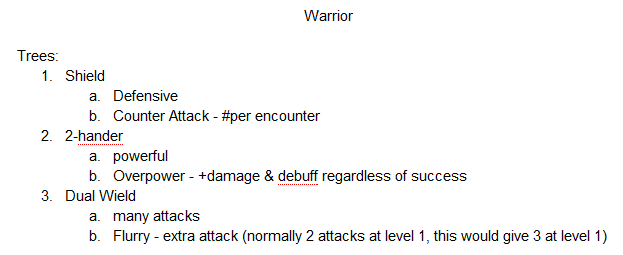
The warrior specs would be shield, 2-handed, and dual wield. The shield spec would focus on defense. The 2-handed spec would focus on powerful attacks and debuff type abilities that originate from overpowering the opponent. The dual wield spec would focus mainly on doing damage through fast, multiple attacks.

The rogue specs would be dagger, bow, and tools. Dagger spec would focus on melee attack, evasion, and maneuverability with weakness exploitation. Bow spec would (of course) focus on ranged attacks. The tool spec would focus on traps and other gadgets to use in battle.

The mage is much like your typical wizard with the specs of arcane, pet, and enhancement. The arcane tree is the typical spellcasting tree, focus on damage spells and other things, such as teleportation. The pet tree would have a permanent companion with special abilities for the pet or to temporarily enhance the pet. The enhancement tree is the one that I'm most unsure about and would love to find a better idea for, it would have buff spells. You can see how it's a fairly shallow idea that needs more. Illusion may be added, as well as debuff abilities, I just need to solidify it.

The priest wouldn't be similar to the WoW priest. The priest would be very tied to the games lore. The priests would be those who celebrate and practice balance and be very tied to the original geomancer concept. The specs would be life/death which would focus on healing, nature, and decay magic. Then there'd be the earth/wind specs and the fire/water specs, which would focus on manipulating those particular opposing elements.

Next time I'm going to talk about how the specs would work, since they function very differently from the WoW specs which are probably what most people reading this are thinking about.

Wednesday, July 6, 2011

What happened to turn-based RPGs?

Growing up, some of my most important gaming experiences were turn-based RPGs. Final Fantasy 6, Chrono Trigger, and Earthbound were three of the most important games to me of the Super Nintendo era. These days, the turn-based RPG is in decline. Square-Enix themselves have abandoned the TBRPG format for their flagship Final Fantasy series. They aren't gone, certainly, and there are new turn-based RPG releases, but they are fewer, further between, and not as 'big' as they used to be.  Why?

I'm sure there are several reasons, but I think that one of the big ones is the increased strength of modern consoles allowing for better artificial intelligence.

The main appeal of the classic turn-based RPG (TBRPG) was that you had a party, and savvy players would exploit the synergy created by their party members to make a strong group. Furthermore, the draw of the TBRPG was the complex stories and character development that you got by having a large roster of characters.

In order to have the multiple characters all act, this used to require their actions to be selected by the player, since having the computer choose the actions intelligently would have consumed processor cycles that couldn't be spared. Since choosing actions for multiple characters in real time would be difficult for the player, a turn-based system was adopted.

With more powerful consoles, it became more possible for the console to come to intelligent decisions regarding movement and action, not only for the enemies but also for your allies. This freed up the player to just control one character, allowing them to create a greater depth of control and gameplay for this one character.

The turn-based RPG game does stand alone as a great type of game, one that I enjoy immensely. But it's good now that it's no longer required in order to do a party-based story.

Wednesday, May 12, 2010

Summer Projects

Summer is nearly upon us, and I've decided that I should take upon myself some summer projects.  These will vary in scope and in discipline and will hopefully give me something to do while I'm not taking any classes.

Project the first:  Statistics Project
I don't know what the topic of the project will be, it's scope, or what.  But I feel that I should do some sort of statistics research this summer.  I could expand upon my WoW project, or the 'Cars of Little Rock' project that I did for last semester, or I could do something entirely new.

Project the second:  Finish/Update This

Project the third: Program a mathematical drawing program
The program would empower the user to create mathematically defined shapes/pictures.  Plotting points, connecting them with lines, drawing circles of defined radii, etc.  The program should automatically detect where lines and circles intercept each other, and allow the user to place a point there.

It's basically a program that I've wanted in the past, and I feel that I could program.  It would also do me well to help retain why programming skills.

Images should be exportable to either an image format, or offer a text interpretation that would be usable in TeX.

Project the fourth: A gaming marathon for charity
You see lots of people doing gaming marathons to collect donations for charity (specifically Child's Play).  I'd like to do one of these, but instead of playing several games from the same series.  I would play several 2D platformers from different series.  Some of the games could be newer releases, some of them older releases.  I think it could be really fun. 

Project the fifth: Viking RPG
After I saw "How to Train Your Dragon" I was inspired to create a simple RPG system that was suited around Vikings and Dragons.  Since having the original idea, it has deviated quite a bit from "How to Train Your Dragon," so thinking of it as being related to the movie isn't the best analogy.

Outline:
  • Vikings
  • Dragons
  • d10 system
  • 4 classes
    • Defender - a brute force warrior.  Hearty, and skilled with shields.  Can even use them as weapons.  Has defensive and shield related magic.
    • Fighter - skilled with all manner and configuration of weapons.  Can use special attacks and buff type magic.
    • Archer - especially skilled with ranged weapons.  Can use special attacks and debuff type magic.
    • Mage - skilled in a wide array of magical abilities.  Most vulnerable when unprotected, but most deadly when left alone.
Undetermined:
  • Stat/Combat System details
  • Spell details
  • etc.
 Project the sixh: Algebra Book
I've spent the better part of a few years now teaching Algebra to all types of people.  This one is a big maybe, but I might work on an Algebra book typeset in TeX.  None of this pretty pictures and fancy schmancy charts and graph stuff.  I feel that much of what they put in Algebra books these days is a distraction, and only serves to increase the cost and size of the books.

Project the seventh: Secure employment
Pretty straightforward. 

Project the eigth: Find some way to make money from the internet
Also self explanatory

I bet all of this could easily keep me busy.  I'll clearly not get all of it done, but it's nice to have goals.