Originally I wrote most of this is a Google Doc and deleted it. I had seen a lot of thoughts and takes on the situation and didn't really want to inundate twitter with Yet Another Nick Robinson Take. However, as time has gone on I haven't seen some of the things that I had taken away from the situation echoed elsewhere.
Something that I've been trying to get a grasp on is what can I learn from this situation. Most importantly, are there ways that I could have sniffed that he was not as good of a person as I thought he was before this situation exploded. I've come around to two things that I should have picked up on.
First, Nick's public persona wasn't consistent. While in his videos and podcasts for Polygon he was generally a nice, funny person, he wasn't like that everywhere. Despite loving his videos he made for work, I only briefly followed him on twitter because he was kind of a nasty asshole. He was rude and sarcastic and I didn't like it. He wasn't a nice person there. At the time, I didn't take away from that experience that I should be wary of his general character. I didn't think that maybe he's not a nice person and just puts on a nice face for his work projects.
I feel like the conclusion is that a nice/good person is going to be generally nice/good in every context. Not 100% of the time (we all have bad days), but if there's a significant part of a person's interactions with other people where they aren't nice, that's a sign of something and shouldn't be ignored. A corollary to this is the Waiter Rule saying that you can tell a lot about a person's character based on how they treat waiters/waitresses. There are lots of versions of this rule, such as a person should pay good attention to how their significant other talks about their exes and I think I need to take better notice of such things.
(Something to add to the "Waiter Rule" section is that if a person is being abused/attacked/threatened in some way, they don't have to be nice in response necessarily. Those situations aren't normal circumstances, but the ways that a person responds or deals with the situation could speak volumes, such as those who bring up Donald Trump or Chris Christie's weight into every criticism or people who are popular on social media who sic their followers on any and all critics.)
Secondly, I follow (at least) one of the people who he harassed, and they had tweeted a criticism of the "soft boy" aesthetic, saying that it (the appearance of being a nice, harmless person) could be used to hide their bad behavior or protect themselves from accusations of bad behavior. At the time, in the fandoms/communities I was in, there were two people who came to mind as being "soft boys" and Nick was one of them. When I read that criticism, I took it as an abstract, theoretical critique and not as something that was grounded in their real world experience. While pinning that on Nick would be difficult, since there wouldn't have been much of a way to be sure who they were referring to, my failure to read the criticism as coming from a place of real experience was a failure on my part. These sorts of criticisms probably come from somewhere and I should have realized that.
Anyway, that's what I've got.
(
Monday, August 7, 2017
Saturday, March 25, 2017
On Super Mario Run

If you've put a lot of time into a particular Mario game, then chance are there are levels where you can enter into a state of flow, where all you have to do is run forward and you're able to time your jumps to weave your way through strings of coins, avoid hazards, and bounce of the head of enemies. Achieving this is one of the most enjoyable experience that I've had playing games, and if you've experienced it I'm sure you'll agree. It's the same goal that speedrunner look for, uninterrupted forward momentum.
Super Mario Run's design is closer to the former, but manages to achieve the feeling of the latter.
If you're not familiar, in Super Mario Run Mario is always running and you can only control when Mario jumps. There is nuance to the control, pressing your screen for longer will allow him to jump higher, and tapping again while in midair makes him do a spin that halts his descent and extends the jump. You can also jump off of walls.
This, combined with some other mechanics, allows Mario to elegantly chain bounce off of enemies, through strings of coins, and achieve that desired that of flow relatively easily. Super Mario Run gives you the thing that you've wanted from Mario games without asking for the hours of dedication that others have asked for before. Add to this the 3 difficulty levels of coin hunts as optional objectives for each level and you've got a game with depth enough that's kept me playing it pretty near constantly since it came out for Android three days ago.
While many people have really liked Super Mario Run, some are frustrated that it's not a traditional Mario experience (they do acknowledge that they understand why it can't be a traditional Mario game), but I've particularly enjoyed it because it's NOT a traditional 2D Mario game. Frankly, if I want to play a traditional Mario game, there's tons of them to choose from, even some I haven't played. Super Mario Run has offered me something new, which if they were to offer to me again for some of the stages in the next 2D Mario game, I'd be excited.
P.S. There are other feature in the game, such as the Toad Rally and the Kingdom Builder. These aren't very exciting or interesting and feel like designs from a period when they may have been flirting with a more micro-transaction oriented revenue model. However, their existence doesn't detract from the main gameplay experience, except when the tutorial takes your time to explain them to you.


Friday, March 17, 2017
On Breath of the Wild

It had been 100 years since the times that I remembered, and all but a few that I cared about were long dead. I stopped my training and preparations short to finish the mission by destroying Ganon and saving Princess Zelda. Afterwards I went back out into the land I now remembered was known as Hyrule to continue finding the ancient shrines that granted me strength and to continue doing what I knew how to do, help people. I helped a man build a town from nothing and find a wife. I showed weapons to a child who had heard about them from his now gone grandfather and who desperately wanted to see them himself. I helped so many people it became hard to find more people who needed help. I found some men tearing down an abandoned house down and bought it for myself. I invested in that house, made it nice, made it my own. I settled down. Hyrule is safe, I hope.
I finished Breath of the Wild this week for the most part. I beat the game, all the shrines, and the side quests. I still have some unupgraded armor and some side tasks that aren't tracked that I haven't done, but I've done the things that I really care about. Truth be told I don't have a lot of experience with open world games. Prior to BotW I guess you could say the last ones I played was Metal Gear Solid V and Shadow of Mordor though Grand Theft Auto: Vice City is more similar to BotW. I'd say that the closest experience that I've had to Breath of the Wild would be World of Warcraft. They both really capture a feeling of exploration, especially during the my early time playing the WoW in the base game and its Burning Crusade and Wrath of the Lich King expansions.
The Legend of Zelda series of games is one that's near and dear to my heart. If you take the original game's release date of Feb 21, 1986 and do the time conversion to American Central Time, my birth was only a handful of hours off. Like Link, I'm also left-handed (though that's changed for Link since motion controls) and I have pointy ears. I saw people play the first two Zelda games but the first one I really got to dig into and beat for myself was A Link to the Past. I've been hooked ever since and now that I have Breath of the Wild done, all I need to do is wrap up my playthrough of Majora's Mask and I'll have completed every canonical Legend of Zelda game, console and handheld.
Running out of significant things to do in Breath of the Wild has been bittersweet. I've loved the game immensely and I've been glad to do everything that I've done and am sad to have run out of major things to do. If the game would let me I'd gladly cross the great canyon that separates Hyrule from the rest of the world to the north and west or drive a sand seal through the Gerudo Desert to parts unknown.
It was so amazing to play a game, not just a Zelda game, that pushes you out into the world and says "Go where you want. Here's your goals, but I'm not going to stop you from doing what you want to do." There are entire zones that aren't necessary to any of the main quests. This is very different from the previous entry Skyward Sword which was very structured/linear. Like many people I enjoyed Skyward Sword but I didn't finish it until a year or more later because I just wasn't drawn to it. I've been consumed by Breath of the Wild for the past week and a half and I really think that's because it's really earned being called an adventure game. You quest and explore and are HEROIC. It's truly amazing to not know exactly how to get somewhere or what you'll encounter along the way.
One of the recurring complaints about Breath of the Wild has been w/ the durability system they added for weapons and shields. While it is frustrating for a great piece of gear to break, it creates a tension and adds a layer of strategy to the battles that I really enjoy. It adds value and strategy by forcing you to consider what weapon you want to use against a particular enemy and making you make sure you have a good spread of weapons for the enemies that you're encountering. Finally breaking out the weapon you've been saving for a special occasion or an enemy that's just pissed you off is incredibly satisfying. All they really needed was a nicer UI for dropping/exchanging items.
The oddest thing is that I don't know if I'd want a Breath of the Wild 2. The Zelda games generally have the same rough story/map, it'd be too much if they had the same gameplay as well. For a mechanical successor to BotW to succeed it's going to need to take place somewhere new or have a different story archetype. Even if there's never another Zelda that I love as much as Breath of the Wild I'll still be incredibly happy. They've done something incredibly magical with it that was the Zelda game that I wasn't even aware was the one I've always wanted.
Wednesday, November 9, 2016
Don't Read This Post
This post isn't so much about getting people to read my words as much as it is about me having things that I need to say. Needless to say that I'm very upset. I'm upset that this rhetoric worked. I'm upset at what this means about the next 4 years for our country.
Be kind. Stay safe. Take care of yourself. I love you all.
I'm not really interested in having a conversation about which group is to blame for this elections or how people should have seen this coming.
I worry that our reliance on polling and other things to predict the outcome of the election before it even happens is too much. I worry that maybe some people got complacent and didn't vote. I think the failure wasn't so much in the polling but rather in how much of each demographic group was expected to turn up, and that Trump supporters mobilized far more than they were expected to. I was worried for this whole election that the existing models wouldn't work for this election and it seem like my worry was correct, and I'm not happy about it.
I believe in a country that is Of the people, By the people, and For the people. I don't believe that such a government will be perfect because people are not perfect, but I have more faith in it than the alternatives. It's not perfect because there is an implied part of that statement that wasn't written down when this country was being formed that won out yesterday, that some people weren't and aren't considered to be people enough to have their votes valued. But as much as I hate republicans for voter suppression, I don't have much faith that democrats wouldn't try to suppress votes if they felt it would be good for them.
I believe that it is of the utmost importance that everybody vote and that the system we use to vote is incredibly important. I feel like the symptoms of a bad voting system are voter turnout and tactical voting. Everyone should vote and everyone should vote for who aligns the most with their views. Not only do we need to eliminate voter suppression and make voting more accessible for people, we need to make sure that people feel incentivized to vote.
A lot has been said and will continue to be said about the Electoral College. As of right now, it values votes in different states differently, because of how the number of votes in each state is calculated. It also causes candidates to value states differently, because they feel that some states are locked up for a particular party. Many people make choices about whether or not they can vote for a third party based on how "safe" they feel their state is and many people don't turn out to vote because they think that voting in their state is meaningless (that it is "safe" or "locked up" depending upon your perspective), and that's incredibly fucked up and sad. I'm not a fan of Nebraska and Maine's systems either, where there are districts that vote individually because it opens things up to gerrymandering.
But above that, I believe that only being able to vote for one candidate is bad. It leads to a two-party system by discouraging people from voting for third parties and encouraging people to vote for a "viable" candidate. This means that people aren't able to accurately express their political views. The Center for Election Science advocates strongly for a move to approval voting, where you select all the candidates you would "approve" of winning and each one receives a vote. In this way you can vote for your niche candidate who is closest to your personal view point but you can also vote for a "viable" candidate. I'm also a fan of single-transferable voting, where you rank as many candidates as you want to and your ballot initially is counted for who you ranked as number 1, and then once the votes are in the least popular candidate is eliminated and all votes for them are transferred the the next ranked candidate on the ballot. This elimination and transfer process is repeated until a winner (>50% of remaining ballots) emerges.
Be kind. Stay safe. Take care of yourself. I love you all.
Be kind. Stay safe. Take care of yourself. I love you all.
I'm not really interested in having a conversation about which group is to blame for this elections or how people should have seen this coming.
I worry that our reliance on polling and other things to predict the outcome of the election before it even happens is too much. I worry that maybe some people got complacent and didn't vote. I think the failure wasn't so much in the polling but rather in how much of each demographic group was expected to turn up, and that Trump supporters mobilized far more than they were expected to. I was worried for this whole election that the existing models wouldn't work for this election and it seem like my worry was correct, and I'm not happy about it.
I believe in a country that is Of the people, By the people, and For the people. I don't believe that such a government will be perfect because people are not perfect, but I have more faith in it than the alternatives. It's not perfect because there is an implied part of that statement that wasn't written down when this country was being formed that won out yesterday, that some people weren't and aren't considered to be people enough to have their votes valued. But as much as I hate republicans for voter suppression, I don't have much faith that democrats wouldn't try to suppress votes if they felt it would be good for them.
I believe that it is of the utmost importance that everybody vote and that the system we use to vote is incredibly important. I feel like the symptoms of a bad voting system are voter turnout and tactical voting. Everyone should vote and everyone should vote for who aligns the most with their views. Not only do we need to eliminate voter suppression and make voting more accessible for people, we need to make sure that people feel incentivized to vote.
A lot has been said and will continue to be said about the Electoral College. As of right now, it values votes in different states differently, because of how the number of votes in each state is calculated. It also causes candidates to value states differently, because they feel that some states are locked up for a particular party. Many people make choices about whether or not they can vote for a third party based on how "safe" they feel their state is and many people don't turn out to vote because they think that voting in their state is meaningless (that it is "safe" or "locked up" depending upon your perspective), and that's incredibly fucked up and sad. I'm not a fan of Nebraska and Maine's systems either, where there are districts that vote individually because it opens things up to gerrymandering.
But above that, I believe that only being able to vote for one candidate is bad. It leads to a two-party system by discouraging people from voting for third parties and encouraging people to vote for a "viable" candidate. This means that people aren't able to accurately express their political views. The Center for Election Science advocates strongly for a move to approval voting, where you select all the candidates you would "approve" of winning and each one receives a vote. In this way you can vote for your niche candidate who is closest to your personal view point but you can also vote for a "viable" candidate. I'm also a fan of single-transferable voting, where you rank as many candidates as you want to and your ballot initially is counted for who you ranked as number 1, and then once the votes are in the least popular candidate is eliminated and all votes for them are transferred the the next ranked candidate on the ballot. This elimination and transfer process is repeated until a winner (>50% of remaining ballots) emerges.
Be kind. Stay safe. Take care of yourself. I love you all.
Tuesday, November 10, 2015
Pandemic Legacy Disease Backstories
I was originally thinking about telling the story of each of our games of Pandemic Legacy, but I don't have the skill or the attention span to see that through. So I think this will be the only post.
Sarah and I started playing the board game Pandemic Legacy recently. It takes the game of Pandemic where you work as a team of doctors and researchers trying to cure the world of four diseases and turns it into a multi-game campaign where events that transpire in one game will affect what happens in the sebsequent game. You rip up cards, place stickers on the board, and open up secret compartments as the games go on.
One of the cool things that the game asks you to do is to take a pen and write the name of each disease on the board. After careful consideration, these were the names we picked. I also came up with a bit of backstory for each of them.
"Robo Fever" (Red)
"Robo fever" is the nickname for a new disease that has sprung up in east Asia after cybernetic implants became commonplace in the region for practical reason and fashion reasons. It is currently suspected that the bacteria feed off of the synthetic compounds in the implants but require the acidic environment of the human gut to reproduce. Technically the name "Robo Fever" is a misnomer since those affected should be classified as cyborgs at most and not as robots. While the CDC isn't particularly concerned about the effect this will have on those with vanity implants/enhancements, there is significant concern for the effect this disease will have on those with medical implants and prosthetics.
Affluenza (Blue)
It doesn't always pay to be an early adopter. Although this flu variety has since made it to the general population, it started showing up among wealthy people and tech workers in San Francisco. Investigations have tied it back to early adopters of the Ploylent Meal Substitute that went on market several months ago. It's hypothesized that someone at Ploylent's manufacturer had a mutated form of the flu and got it in the supply. The innovative packaging meant to preserve the substitute during transport also managed to keep the flu alive during transport.
Although it's different from typical flu varieties, existing flu research has greatly aided in finding a vaccine and effective treatments.
Gakarrhea (Yellow)
This disease causes frequent, diarrhea-like bowel movements. It earned its name because the consistency of those bowel movements was "slimy" and green and resembled Nickelodeon's "Gak" from the 90s. Although diarrhea is symptom and not a disease, the name Gakarrhea has stuck since it's a trademark sign of this particular disease and came about before the disease had been isolated and understood.
"Pluto Pox" (Black)
The world was rocked when a nuclear explosion detonated in Afghanistan that appeared to target a terrorist stronghold in the area. Naturally, America was blamed for the attack. America disavowed involvement in the attack and cast suspicion on Russia. After the explosion a new disease showed up in the area, which wasn't similar to anything seen in the aftermath of a previous nuclear bombing. It's marked by pockmarks that always appear in pairs, resembling Pluto and its moon Charon. Researchers believe that the radiation from the blast mutated some pre-existing disease and are currently hoping that will help them develop a cure.
Some of those afflicted with the disease believe that it has made them immune to the effects of the radiation and are attempting to settle in regions that are still considered dangerous. Research has not backed up this claim.
Sarah and I started playing the board game Pandemic Legacy recently. It takes the game of Pandemic where you work as a team of doctors and researchers trying to cure the world of four diseases and turns it into a multi-game campaign where events that transpire in one game will affect what happens in the sebsequent game. You rip up cards, place stickers on the board, and open up secret compartments as the games go on.
One of the cool things that the game asks you to do is to take a pen and write the name of each disease on the board. After careful consideration, these were the names we picked. I also came up with a bit of backstory for each of them.
"Robo Fever" (Red)
"Robo fever" is the nickname for a new disease that has sprung up in east Asia after cybernetic implants became commonplace in the region for practical reason and fashion reasons. It is currently suspected that the bacteria feed off of the synthetic compounds in the implants but require the acidic environment of the human gut to reproduce. Technically the name "Robo Fever" is a misnomer since those affected should be classified as cyborgs at most and not as robots. While the CDC isn't particularly concerned about the effect this will have on those with vanity implants/enhancements, there is significant concern for the effect this disease will have on those with medical implants and prosthetics.
Affluenza (Blue)
It doesn't always pay to be an early adopter. Although this flu variety has since made it to the general population, it started showing up among wealthy people and tech workers in San Francisco. Investigations have tied it back to early adopters of the Ploylent Meal Substitute that went on market several months ago. It's hypothesized that someone at Ploylent's manufacturer had a mutated form of the flu and got it in the supply. The innovative packaging meant to preserve the substitute during transport also managed to keep the flu alive during transport.
Although it's different from typical flu varieties, existing flu research has greatly aided in finding a vaccine and effective treatments.
Gakarrhea (Yellow)
This disease causes frequent, diarrhea-like bowel movements. It earned its name because the consistency of those bowel movements was "slimy" and green and resembled Nickelodeon's "Gak" from the 90s. Although diarrhea is symptom and not a disease, the name Gakarrhea has stuck since it's a trademark sign of this particular disease and came about before the disease had been isolated and understood.
"Pluto Pox" (Black)
The world was rocked when a nuclear explosion detonated in Afghanistan that appeared to target a terrorist stronghold in the area. Naturally, America was blamed for the attack. America disavowed involvement in the attack and cast suspicion on Russia. After the explosion a new disease showed up in the area, which wasn't similar to anything seen in the aftermath of a previous nuclear bombing. It's marked by pockmarks that always appear in pairs, resembling Pluto and its moon Charon. Researchers believe that the radiation from the blast mutated some pre-existing disease and are currently hoping that will help them develop a cure.
Some of those afflicted with the disease believe that it has made them immune to the effects of the radiation and are attempting to settle in regions that are still considered dangerous. Research has not backed up this claim.
Monday, February 2, 2015
Pandemic: The Cure - standard deviation and probability
 |
| Initial setup |
Bottling up the diseases is great because it removes that disease die from play and helps you discover the cure, but until you discover the cure that die of yours you used to "bottle" it up is locked up and you can't use it, meaning you'll have fewer possible actions on your turn, making you less effective until the cure is discovered.
 |
| Disease Dice |
| Value | Black | Yellow | Blue | Red |
| 1st | 0 | 0 | 0 | 0 |
| 2nd | 3 | 2 | 1 | 1 |
| 3rd | 3 | 2 | 2 | 1 |
| 4th | 3 | 4 | 3 | 4 |
| 5th | 4 | 5 | 6 | 6 |
| 6th | 5 | 5 | 6 | 6 |
| Avg | 3 | 3 | 3 | 3 |
| Std Dev | 1.67 | 2 | 2.53 | 2.68 |
So in terms of trying to cure the diseases, the likelihood that the total of the values across all the dice you roll of a color will meet the required sum is different. Below is a table of probabilities of curing the disease with various numbers of a color of dice. The amount needed to cure a disease is normally 13, but sometimes can be 11.
| Black | Yellow | Blue | Red | |||||
| # Dice | 11+ | 13+ | 11+ | P13+ | 11+ | 13+ | 11+ | 13+ |
| 2 | 0.00% | 0.00% | 0.00% | 0.00% | 11.11% | 0.00% | 11.11% | 0.00% |
| 3 | 32.87% | 7.41% | 34.72% | 12.04% | 34.26% | 20.37% | 40.28% | 23.15% |
| 4 | 70.14% | 46.91% | 67.67% | 45.76% | 60.88% | 45.06% | 62.73% | 45.76% |
| 5 | 89.51% | 77.22% | 86.52% | 73.53% | 79.90% | 67.30% | 78.29% | 67.36% |
| 6 | 96.81% | 91.85% | 95.03% | 88.94% | 90.71% | 82.81% | 88.70% | 82.04% |
| 7 | 99.12% | 97.42% | 98.33% | 95.86% | 96.05% | 91.82% | 94.62% | 90.59% |
You'll see that for certain numbers of dice and goal numbers to reach, the probability of curing the disease can be quite different. For example, with 3 dice and a goal of 13 the probabilities range from 7.41% to 23.15%. Most differences are <10%, but that can be a fairly significant difference.
You'll see that no die is universally easier or harder to find cures with. Getting 13+ is only really possible once you have 4 dice. A goal of 11 isn't very likely until you have at least 3 dice, and even then the odds are very bad. It's very hard for a single character other than maybe the generalist to amass 4 or more dice by themselves. After you have 3 dice bottled up you only have two dice left. So getting the 1 in 6 result of being able to bottle up on your dice when you only have two dice is fairly unlikely. The game allows you to trade your bottled up dice to another player if you're on the same square. This probability table tells me that that's a very important part of the game.
Advanced discussion:
In the above two tables, I ordered the dice colors by their standard deviations, lower on the left and higher on the right. One thing you might notice is that for 3 dice, the higher variance dice (aka higher standard deviation) have a higher probability of success. You'll notice that for higher numbers of dice, the colors with a lower standard deviation tend to have a higher chance of success.
When you have 3 dice, the average value of the sum is 9 (because the average for any given die is 3). Nine is insufficient for either goal so results near the average are bad. So you want a result that's far from the average, meaning you want a higher standard deviation. When you're at 5+ dice, the average result, 15, is above the goal so lower standard deviations are better.
When average is bad and you want that extreme result, you'll do better with a higher standard deviation. When the average is good and you don't need an extreme result, you'll do better with a lower standard deviation.
 |
| Player Dice, showing all faces |
Epidemic Roll Change
Another place where probability plays a big role (roll?) is with epidemics. Each character die has one face which, when rolled, will advance the epidemic track. The generalist, with their seven dice instead of the normal 5, stands a much greater chance of rolling these values on their turn. To balance this, the generalist is allowed to ignore the effect of the first epidemic they roll each turn. This has a huge effect, and it makes the generalist have an overall lower change of advancing the epidemic track than other characters. Below is a table of probabilities for how far each character will advance the epidemic track on their initial roll of dice (with full dice i.e. no dice locked up from bottling up diseases).
Another place where probability plays a big role (roll?) is with epidemics. Each character die has one face which, when rolled, will advance the epidemic track. The generalist, with their seven dice instead of the normal 5, stands a much greater chance of rolling these values on their turn. To balance this, the generalist is allowed to ignore the effect of the first epidemic they roll each turn. This has a huge effect, and it makes the generalist have an overall lower change of advancing the epidemic track than other characters. Below is a table of probabilities for how far each character will advance the epidemic track on their initial roll of dice (with full dice i.e. no dice locked up from bottling up diseases).
| Advancement | Normal | Generalist |
| 0 | 40.19% | 66.98% |
| 1 | 40.19% | 23.44% |
| 2 | 16.08% | 7.81% |
| 3 | 3.22% | 1.56% |
| 4 | 0.32% | 0.19% |
| 5 | 0.01% | 0.01% |
| 6 | NA | 0.0004% |
| Avg | 0.83 | 0.45 |
The other advantage of being the generalist is that when you have no epidemics on your initial roll (28% of the time w/ 7 dice, higher w/ fewer) you can freely reroll dice to try and get a better result w/ no fear of the consequences of rolling an epidemic.
Wednesday, January 7, 2015
The Core Loop vs The Revenue Funnel
Here are some thoughts I had the other day about F2P game design as "loops" versus the common analytical tool of a "funnel" and how the design goals of these games collide against the business decision of being F2P. For more ideas of what a "core loop" is, a Google Image search will give you lots of examples.
Something I've been thinking about a lot is Loops vs Funnels
— Tech Warker (@taufmonster) January 6, 2015
when I see games pitched, or another F2P game analyzed, they'll talk about the "Core Game Loop" the various actions that feed each other
— Tech Warker (@taufmonster) January 6, 2015
"kill -> level up/get resources -> gear up -> kill harder things" etc. It's key to have one to have a something ppl play indefinitely
— Tech Warker (@taufmonster) January 6, 2015
and indefinite play is key to F2P. But the most common type of analysis I see done is funnel analysis, such as a Tutorial funnel or payments
— Tech Warker (@taufmonster) January 6, 2015
Tutorial funnel is seeing what % of your installs make it through each step of the Tutorial.Very useful in finding where bad parts of it are
— Tech Warker (@taufmonster) January 6, 2015
Funnels show up in lots of places, including revenue. Logins -> Buy Page Viewer -> Package Clickers -> Succesful Payment -> Avg Package Size
— Tech Warker (@taufmonster) January 6, 2015
So F2P games end up not as a Loop but a spiral. Doing game actions that make you circle some inevitable end (paying).
— Tech Warker (@taufmonster) January 6, 2015
It reminds me of those charity gravity well things you see in malls. You put the coin in and it orbits the center.
— Tech Warker (@taufmonster) January 6, 2015
Eventually it falls in. Your money runs out. You have to pay again in order to keep playing.
— Tech Warker (@taufmonster) January 6, 2015
Mike Sacco coined a nice term for this combination
@taufmonster The Core Toilet
— Mike Sacco (@mikesacco) January 6, 2015
Sunday, January 4, 2015
I kinda work in the games industry
This post is sort of a combination of a lot of things that have been bouncing around in my head for a while.
I kinda work in the games industry. It's weird. The company I work for definitely makes games. We released several this year. But we make F2P/social games so I feel completely disconnected from the types of games that I like to play. A lot of my coworkers aren't really gamers. We don't really talk about games at lunch or when we talk about our weekends.
I don't know if working at other F2P/social game developers feels like this.
Gaming news sites don't write about our types of games, except for the rare one that penetrates into the public eye: Candy Crash, Clash of Clans, Kim Kardashian: Hollywood, Farmville, Words with Friends.
I play all of our games, at least to try them out. I've really enjoyed several of them. I'm even spent money in a couple of them with no regrets. These are definitely games, but they're different. They're not a subtype of "traditional" but more like a newly discovered relative.
When G****gate flared up, nobody wanted us to take a stand. Nobody at work even talked about it. Only one person who I talked to about it had even heard of it.
Granted, we aren't really part of gaming culture. We're part of startup/tech culture. That's where we're located; that's who we recruit from; it's where people leave us to go. Our products live on the same platforms. We do the same analyses. By the same token the core group that influence the direction our games go, product managers (not designers), tend to come not from game design backgrounds, but business and finance. They come up with the features that go into the game and define how they should work. But they've never designed games before, never studied it at all.
We make games, but we aren't much of a gaming company.
Businesses include "goodwill" on their balance sheet sometimes. This reflects that there's more to a business than just their asset. That a brand has value. That's because a brand name can be exploited for monetary gains. Designing F2P games feels like managing "goodwill" at a personal level. Endear the player to the game enough that when the moment of pinch occurs (when the player's assets are not enough to overcome whatever challenge they face) that they will be sufficiently invested in the game to justify spending money on the game. Nobody likes spending money at these moments but, if you play it right, they will.We make games, but we aren't much of a gaming company.
It's psychological manipulation as a business model. These aren't objects of art, dealing out enriching experiences. They can be fun but they aren't what I want to make.
When GDC rolls around, despite it being nearby I feel no compulsion to go. The talks there aren't for our games. They particularly aren't for me. My job isn't really one that exists in traditional gaming. I'm a data analyst. I don't design or code. I pull data from our databases to make sure the game is performing well and to investigate our user behavior. There's little need for my job when game development means putting a game out there and then mostly moving onto the next one. Our games live for a long time, we need to know how they're doing so we can make changes to make them better. To get more installs. To get more money from our players. I do good work. I'm always trying to figure out how to write better SQL, how to make better, more informative reports, how to make more productive insights. I'm proud of my work.
I've been thinking a lot about the upcoming year and I don't want to live in the Bay Area anymore. I like working where I do. I love working with the people I do. I love doing my work. If I could do my job but live anywhere I wanted to, I would in a heartbeat. I don't know where I would choose to move though. The Bay Area is just too big for our tastes, and it just doesn't work. We have to live too far away from where we work and still end up paying too much in rent to be able to save enough money to buy a house someday. And rent prices seems to be going up too fast for raises/promotions to make much of a difference.
But the one big goal for 2015 is to get the heck out of here. Whatever that takes. It's not somewhere practical to live the for a long time so we may as well get out of here now.
Wednesday, December 31, 2014
The most important games to me from 2014
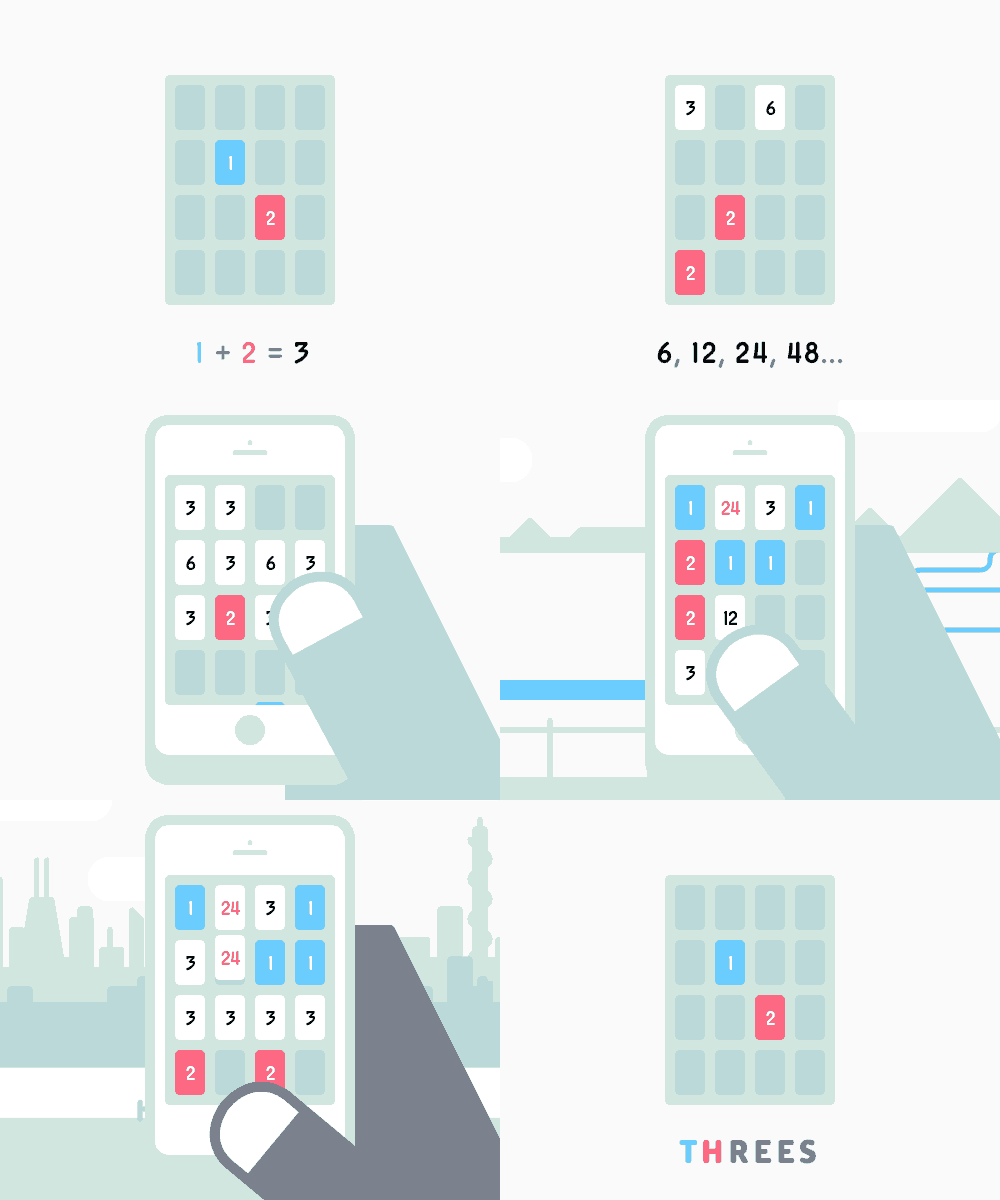
Episode 5 of five out of ten magazine features an essay by Brendan Keogh about games exactly like Threes. About how these deeply systemic game are hard to talk. Graphics, story, sound, and some elements of gameplay are easy to talk about, but systems are harder. Threes is kinda like Tetris in that new tiles are always entering the board and you have to figure out how to combine them to make more room. In Threes there are things you have control over (how you're going to shift and combine tiles) and things you don't have control over (what tile is coming up next and where it enters). You're given enough knowledge about what tile is coming next and where it can enter that you can make intelligent decisions about what to do.
It's the things that you don't have control over that make the things you do have control over fun and interesting. Threes is a focused example of how random effects, information, and choice mix together to make an amazing gameplay experience.
I reached my pinnacle in this game in October by getting a 3072 tile on my board. I've done it a couple more times since then but I highly doubt I'll ever do better. But I keep playing.
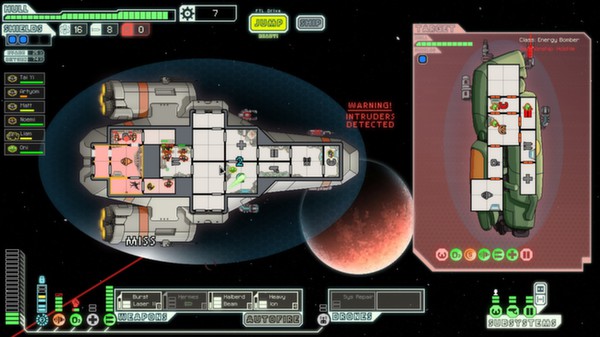
FTL: Faster than Light
FTL came out in 2012, but it received a significant update this year, which is when I really fell for it. FTL is a roguelike, which is an utterly useless descriptor, unless you're familiar with the game Rogue, in which case it still doesn't tell you anything about the game. Roguelikes are games that have a relatively short duration but make up for that by using random generation to create replayability. Roguelikes must have a definite end goal and be hard. Failure must be an reasonably possible outcome.
FTL has you controlling a spaceship and it's crew, racing to alert the Federation of the oncoming rebel threat, like a reverse Star Wars. As you play you'll defeat enemy ships and get scrap and other material which you use to upgrade your ship. FTL asks you to overcome increasingly difficult enemies by figuring out where best to spend your scrap to complement your ships current build and the enemies your facing. Every run through FTL feels different even if you're using the same ship (of which there are 29).

I love Hearthstone. In particular I love Hearthstone Arena. I love it for all the same reasons I love the above two game. Hearthstone Arena asks you to construct a deck out of randomly selected cards that are presented to you three at a time to use against other people who have similarly constructed a deck. Hearthstone arena is great because you don't have to buy the cards to use in it. You don't even have to pay to enter unless you don't have enough gold, which brings me to my second point.
Hearthstone's daily quest system is perfect. You get a quest every day, you can save up to three daily quests, and every day you can reroll one of your quests. If you want to play casually you can reroll quests to try and get quests that can be completed at the same time. If you want to be hardcore and try to get the most coins possible from quests you just reroll your 40 gold quests to try and get 60 gold quests. They challenge you to try new classes but offer you enough flexibility to avoid them if you want.

If the above games are about choice granting you power and control to face randomly generated adversity, then PT is the opposite of that. It's not random. You have no power. PT is the scariest fucking shit I've ever played and it's free if you have a PS4. You're stuck in a hallway with no way to fight what haunts you. You can escape, but you have to figure out how, and it's not easy. PT is like nothing I've ever played before.
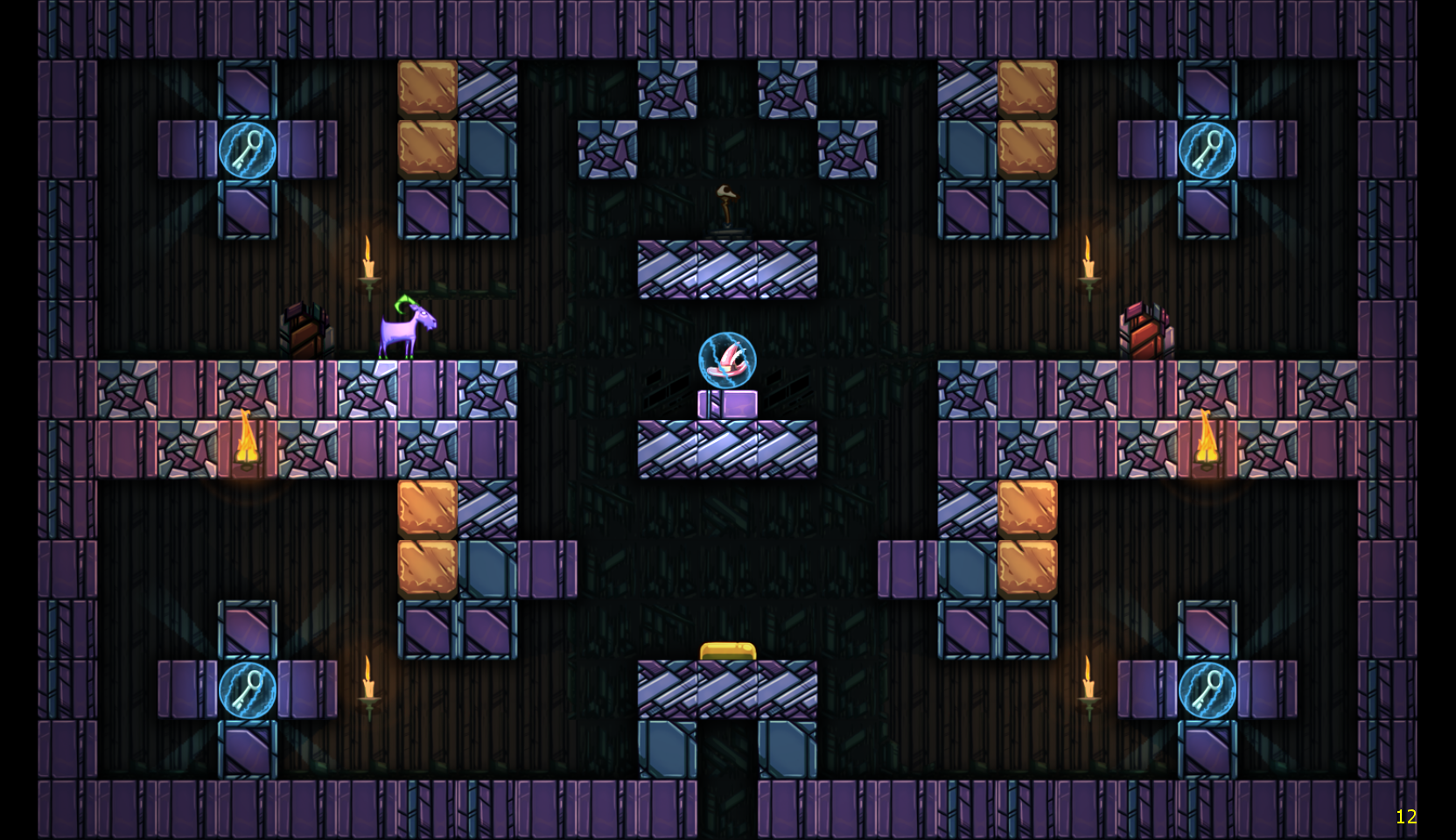 |
| Goat of the Year 2014 |
I know that Goat Simulator got more attention for it's title, wacky gameplay, and satirical bent but I enjoyed this game far more. Platformers are one of my favorite categories of games. Puzzles too. Puzzle platformers tend to fall flat but Escape Goat 2 manages it perfectly. It stays fresh and fun throughout without becoming impossibly obtuse, which is what generally happens with puzzle games. It has charming graphics and sound. It has a goat and a mouse. There's one puzzle that comes to mind that was really just too hard, but I was able to look up a solution fortunately. I don't really have too much to say about this game really. It's just a really solid game that deserves more attention than it got.

Desert FUCKING Golfing. Desert Golfing is an incredibly simple game. It doesn't integrate with facebook or twitter. There are no in-app purchases. Contrary to mobile game best practices, it costs $1.99 to download. There's no daily bonus that begs me to log back in. Its feels like a rebellion against F2P and social gaming. It's the complete opposite of current trends.
You just golf. Place, drag, release. Place, drag, release. Place, drag, release. Next hole.
The difficulty comes and goes. When it's hard you're relieved to get past it. When it's easy, you celebrate the skill you've gained.
Nobody at work understands why I love Desert Golfing.
I'm stuck in Desert Golfing, stage 2303.
UPDATE: I loaded up Desert Golfing right after writing that sentence and beat that stage first try. IT TOOK ME SO MANY TRIES
Other games I really enjoyed but don't really have words for right now:
Mario Kart 8
Shadow of Mordor
Monument Valley
Shovel Knight
The Uncle Who Works for Nintendo
Sportsfriends
Nidhogg
Monday, October 20, 2014
Final Fantasy VI
As Alexa Corriea pointed on out twitter:
FF6 struck me with it's story and character, filled with twists and turns, a large cast of interesting characters, and brilliant villains. I loved the characters so much that I used to pretend that I was a member of their team, hanging out with them on board the Blackjack or the Falcon. Part of that was because I was a fairly solitary kid. I didn't have very many friends, nor did I hang out with them very much outside of school. It's not that I was a reject, I just didn't try to make friends or try to hang out with them. I was very happy in my world and in the worlds of the games that I played. I suppose I was also pretty publicly a nerd, and I didn't really know how to talk to people, and I had trouble making eye contact, but I was doing alright by it.
I think part of the reason the characters are so strong is because you meet them in the World of Balance, regain them in the World of Ruin and find out how they react to this disaster, and then dive into their past and history in their optional sidequest. I miss sidequests, I think they're really important to developing the game world's story.
My brother and I both played FF6 a lot, even together. We watched each other play and offered tips. We didn't play too many video games together once we got much older. We drifted apart, he got his own room, we stopped playing as many games together. Eventually he'd start misbehaving, doing drugs, causing trouble, and making family life difficult. Things have gotten better but we're still distant and I still reminisce about those old days when we'd play together.
I played Final Fantasy VI over and over all the way up and through junior high, periodically dipping back into the game for nostalgia trips when I felt I needed them. I moved on to other things in high school, when we got a PlayStation 2 and FF9, FFX, and Kingdom Hearts were the RPGs that I played. When art went off to college and wanted to take the SNES with him, I obliged. When he dropped out after a semester and moved back home. A lot of the SNES games didn't come back, particularly the RPGs that I loved, that we had bonded over. When I questioned him about where they had gone, he said that he had loaned them to people and hadn't got them back. I pressed him about getting them back, but he always pushed it off. I not think that he probably sold them. I can only imagine what he did with the money. I've never really talked with him about this. We don't ever talk about that time in our family's life.
I almost always played with Sabin and Edgar in my party. I don't know if it's because they're strong or because I just wanted to see brothers that were distant yet loved each other.
I started playing piano in 5th grade and my former kindergarten teacher was my first instructor. I took lessons all the way through high school. For a brief period I took lessons from a jazz piano instructor. Once while there for a lesson I saw a book of piano music that belonged to one of her students. It was a collection of sheet music for FF6's soundtrack. I asked begged her to ask her student where he got the music and when she found out and told me, I ordered a copy immediately. Once I started college I didn't do a good job of staying in practice. Pretty much the only music I would keep playing was music from my FF6 collection and a collection of songs from across all the Final Fantasy games.
The music of FF6 is very deeply ingrained in me. Sometimes I feel that the way that I can best express emotion is by playing its music on the piano. I've purchased it's soundtrack in various forms and arrangements time and time again. It takes me back in time, helps me remember, reminds me of friends I haven't spoken to in a long time. It takes me back to when I was playing the game growing up. FF6 is so important to me. It's hard to say that my life would be different had it never existed, but as it stands I find it hard to imagine it'd be the same.
Happy 20th anniversary of the English language version of Final Fantasy 6!
— Alexa Ray Corriea (@AlexaRayC) October 20, 2014
I was 8 years old at the time, but I can't for the life of me remember when I actually got the game. I don't remember a lot of things, it turns out. I do, however, remember playing the game quite a bit. To say that Final Fantasy VI is a big part of development as a gamer would be an understatement. It, EarthBound, Chrono Trigger, Secret of Mana, and Illusion of Gaia combined to form a quintet of RPGs that were and are very important to me to this day.FF6 struck me with it's story and character, filled with twists and turns, a large cast of interesting characters, and brilliant villains. I loved the characters so much that I used to pretend that I was a member of their team, hanging out with them on board the Blackjack or the Falcon. Part of that was because I was a fairly solitary kid. I didn't have very many friends, nor did I hang out with them very much outside of school. It's not that I was a reject, I just didn't try to make friends or try to hang out with them. I was very happy in my world and in the worlds of the games that I played. I suppose I was also pretty publicly a nerd, and I didn't really know how to talk to people, and I had trouble making eye contact, but I was doing alright by it.
I think part of the reason the characters are so strong is because you meet them in the World of Balance, regain them in the World of Ruin and find out how they react to this disaster, and then dive into their past and history in their optional sidequest. I miss sidequests, I think they're really important to developing the game world's story.
My brother and I both played FF6 a lot, even together. We watched each other play and offered tips. We didn't play too many video games together once we got much older. We drifted apart, he got his own room, we stopped playing as many games together. Eventually he'd start misbehaving, doing drugs, causing trouble, and making family life difficult. Things have gotten better but we're still distant and I still reminisce about those old days when we'd play together.
I played Final Fantasy VI over and over all the way up and through junior high, periodically dipping back into the game for nostalgia trips when I felt I needed them. I moved on to other things in high school, when we got a PlayStation 2 and FF9, FFX, and Kingdom Hearts were the RPGs that I played. When art went off to college and wanted to take the SNES with him, I obliged. When he dropped out after a semester and moved back home. A lot of the SNES games didn't come back, particularly the RPGs that I loved, that we had bonded over. When I questioned him about where they had gone, he said that he had loaned them to people and hadn't got them back. I pressed him about getting them back, but he always pushed it off. I not think that he probably sold them. I can only imagine what he did with the money. I've never really talked with him about this. We don't ever talk about that time in our family's life.
I almost always played with Sabin and Edgar in my party. I don't know if it's because they're strong or because I just wanted to see brothers that were distant yet loved each other.
I started playing piano in 5th grade and my former kindergarten teacher was my first instructor. I took lessons all the way through high school. For a brief period I took lessons from a jazz piano instructor. Once while there for a lesson I saw a book of piano music that belonged to one of her students. It was a collection of sheet music for FF6's soundtrack. I asked begged her to ask her student where he got the music and when she found out and told me, I ordered a copy immediately. Once I started college I didn't do a good job of staying in practice. Pretty much the only music I would keep playing was music from my FF6 collection and a collection of songs from across all the Final Fantasy games.
The music of FF6 is very deeply ingrained in me. Sometimes I feel that the way that I can best express emotion is by playing its music on the piano. I've purchased it's soundtrack in various forms and arrangements time and time again. It takes me back in time, helps me remember, reminds me of friends I haven't spoken to in a long time. It takes me back to when I was playing the game growing up. FF6 is so important to me. It's hard to say that my life would be different had it never existed, but as it stands I find it hard to imagine it'd be the same.
Sunday, November 17, 2013
On Cycles
 |
| Flower - a PS3 game that's been upgraded for PS4 |
Thinking back on who/where I was at that time and all that's happened since then has been really interesting. It's easy for me to think of the PS3 launch as having been "not long ago" but when I think of everything that's happened it starts to seem more like "really long ago". I've graduated twice, had 5/6 different jobs, lived in 7 different places, gotten married, moved across the country, been to Blizzcon 3 times, and so much more. Seven years ago I had never played WoW, my parents were still thinking they'd retire to the retire to the country, and I'd never had a cat. And despite being "liberal", I was completely ignorant about social justice issues (which I hear is pretty typical).
This is all probably not surprising since it was over 25% of my life ago, but it's really easy to forget how much can happen in a period of time that seems so short.
It's kind of weird to only be thinking about this because a new video game console came out but I think it totally makes sense. As a gamer, these consoles and the experiences I have on them are not only significant to me but they also form the background of my life experiences. When I think about a game or a console I don't just remember the things that happened in the game but also the who and where I was and the what was happening in my life at the time I was playing. For example if I think about Kingdom Hearts or Final Fantasy X I think about talking with my friend in the high school parking lot. If I think about Metal Gear Solid 4 or Mega Man 9 I remember living in my parent's house after college and in the first couple months on grad school. Journey wan't just a fantastic gaming experience but I also remember having the front door open to the house we were renting at the time and waiting for Sarah to get home from work. With an MMO it's possible to have distinct attachments to expansions because of the real life experiences that were happening during each of them.
I think this is why we can get nostalgic for old games even if they aren't good, even if newer games in that series are "better". By starting up that game and playing it you can transport yourself back in time to when you were first playing it. Sonic games will always be tied to when my brother and I shared a room when we were very young, before he moved out into his own room and we began to drift apart. SSX reminds me of the Christmas when we had an ice storm in Arkansas and we had to stay with a family friend until the power came back.
It's said that smell is the sense that has the strongest tie to memory. Have you ever smelled a food and just been transported back to some great childhood memory of eating something tasty? Perhaps this is because smell is often used to identify things that might be poisonous or otherwise bad for us if we were to try and eat them. But wouldn't it make sense that action has a stronger tie to memory. Playing an old game can not only be fun but it has the ability to take you back in time.
This console launch has me remembering who I was in college, and thinking about everything that's happened in the interim. Much has happened and I've really grown a lot as a person in the mean time. I've met a lot of people and done a lot of great things. A console cycle can sometimes feel short, but a lot can actually happened. I can't help but wonder what's going to happen between now and the next generation of consoles.
Wednesday, October 9, 2013
Board Games!
 |
| This is actually an old picture, it's gotten much worse. |
We have 56 games, in total. Not all of them are in that picture, because some of them are actually behind the others. For example, you can see Munchkin there but we actually have other versions of Munchkin, they're just stashed behind Carcassonne, Ghost Stories, and Yahtzee.
There's quite a variety there, too. You see classic games like Risk and Monopoly, but there's plenty of other games too. There's the cooperative fire-fighting simulator Flash Point: Fire Rescue. There's the popular Eurogame about connecting train routes Ticket to Ride. There's the literally-only-sixteen-cards get-your-love-letter-to-the-princess simulator Love Letter (a truly excellent game). There's also the dexterity-challenging magnet-balancing game Polarity.
This might seem like a sudden shift for me but it's really a natural extension of a trend that's been going on for roughly a decade.
 |
| Forbidden Island, a cooperative game where you play as treasure hunters trying to get four relics from an island before it sinks. |
I can't really say that I know what caused it. Maybe it was because of my friend the next room over my freshman year of college. Maybe it's because that was the year Katamari Damacy was released. Maybe it's because that was the year that the PSP and the DS were released, and I hadn't really been into portable gaming since the original Pokemon some long time prior. Or possibly it's because of all these things. Ever since that year, however, I've constantly been seeking new gaming experiences. I would rather play small, mediocre, yet novel games as opposed to a full-price game that's well polished yet doesn't bring much new to the table. In the past this has meant playing mobile/handheld games and download-only games, but now it's extending to tabletop games.
Tabletop games really offer a lot of things that video games don't.
Meat Space Nine
Tabletop games are all about playing with your friends right around you. You can see and talk to each other in ways that are hampered by communicating over headset or having to share real estate on a screen. This isn't to say that there aren't great video games that you can play with your friends all on the same couch, Smash Bros. and Towerfall and great examples of such, but this is what board games are all about. It is their jam.
 |
| Dungeons & Dragons: Castle Ravenloft |
No need for dexterity
Tabletop games are almost always turn-based as well (Escape: The Curse of the Temple notwithstanding). Many people can't play competitive video games because of a reliance on manual dexterity, fast reaction times, having to juggle a lot of information without time to think, or they can get nauseous in the case of a first-person game. This gives tabletop games an extra level of accessibility that video games don't have.
Hackability
Most video games go to great lengths to keep you from playing them in ways that the developers don't intend. You can't make your own rules, except on a social level ("Nobody's allowed to pick Oddjob, okay!?"). You can't add and remove components. You can't do anything, usually. Tabletop games literally cannot avoid this. Don't want to play with a particular rule? GONE. Want to add your own class to the roster of characters? DO IT. Want to add a rule or more content to the game? EASY. Think something is unbalanced? CHANGE IT. They're literally powerless to stop you. This makes them great for budding game designers to experiment with how changing rules affects the gameplay or for hobbyist to make something that they love even better. If I think that Smash Bros isn't balanced well it takes a ton of effort to make it more balanced. If I think a Dungeons and Dragons class is unbalanced, that's easy to fix.
More apparent mathiness
One thing that really appeals to me in particular is, in addition to their hackability, is that their turn-based nature makes it easier to see the math behind the game and optimize your gameplay. For example, in Ticket to Ride, you get 1 point for a 1 train section, 2 for 2, 4 for 3, 7 for 4, 10 for 5 and 15 for 6. Here you can easily see that you get more points per train from doing longer routes and should try and do those if possible. This advantage becomes even more clear when you realize that by playing trains there is an opportunity cost in that any turn spent playing trains is a turn in which you aren't drawing cards. So you could spent two turns playing 3 trains each and be down 6 cards and only have 8 points or you could spend two turns, 1 playing 6 trains and 1 drawing cards, and have 15 points and only be down 4 cards.
I have by no means given up on video games. I still love and play those. Most recently I've been playing a lot of Hearthstone and Spelunky.
Friday, June 7, 2013
Your ideas about WoW players are wrong - engagement bias
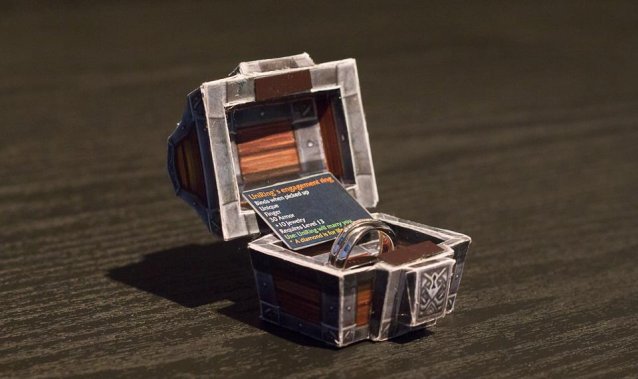 |
| Not that kind of engagement |
That sentence might seem a bit surprising but I can assure you that it's 100% true. The primary culprit here is engagement bias, which is something you have to consider when you're analyzing a game-as-a-service, like WoW. Suppose 7 million people play WoW in a given week. Let's look at them by how engaged they hypothetically are (as measured by how many days they played that week).
| Engagement | Player Count | % played today | # played today | % DAU in bucket |
| 1 Days | 1,000,000 | 14.29% | 142,857 | 3.57% |
| 2 Days | 1,000,000 | 28.57% | 285,714 | 7.14% |
| 3 Days | 1,000,000 | 42.86% | 428,571 | 10.71% |
| 4 Days | 1,000,000 | 57.14% | 571,429 | 14.29% |
| 5 Days | 1,000,000 | 71.43% | 714,286 | 17.86% |
| 6 Days | 1,000,000 | 85.71% | 857,143 | 21.43% |
| 7 Days | 1,000,000 | 100% | 1,000,000 | 25% |
Here we see that if you look at the people who play on a particular day (DAU - Daily Active User), there is a distinct bias towards users who have a higher weekly engagement. Side note: players who play in a given week are called WAU. Even though the WAU are evenly distributed among the engagement buckets, the DAU are heavily skewed towards the highly engaged. Then again, WAU isn't how Blizzard likely defines 'player' for WoW, they likely use subscribers as the definition of the player, since that's how they get their money and the $15 a low-engaged player gives them is the same as the $15 a heroic raider sends them.
What this means is that the people that you see every day in the game aren't really a good representation of WoW's subscriber base. People aren't as engaged with the game as they appear to be. From a development and design standpoint, the highly-engaged users are the least likely to let their subscription lapse, so features are often made to appeal to the casual crowd/make casual players more engaged. If you look at the history of WoW this is what you'll see. Even heroic raiding was oriented around this because it allowed them to make regular raiding easier and more accessible to the casual player.
This is just one example of engagement bias, which is a recurring problem in user-centric data analysis and therefore is a recurring problem in the games-as-a-service industry. Engagement bias is the phenomenon that more active users are often more likely to be counter/sampled.
Back when I was working on analyzing the results of my 2011 WoW Survey, one question I wanted to answer was "What are the correlations between classes?" meaning that I wanted to know which classes a player was more or less likely to play if they played another class. For example, "Are people who play Warlocks more or less likely to play a Death Knight than someone who plays a Rogue?"
Suppose that the average respondent to my survey listed two different classes among the ones that they play. At the time, this means that roughly 20% of respondents played any particular class (class representation actually varied wildly). When I pulled the percent of Warlock players that ALSO played Paladins I found a much higher number, 40% or greater. This baffled me for a long time. For each combination of classes, this same thing happened, the percentage of X players that also played Y was higher than the percent of the general population that played class Y.
Why was this?
Among the people that I surveyed, they varied widely among the number of characters they played. Some people only listed 1 or 2 characters, some listed 10 or more. When I selected all the players who played a Warlock, the highly-engaged players (those with more characters) were more likely to be in that group than the low-engaged players (those with few characters). So the group of Warlock players had, on average, more characters than the general population. So when I calculated how many of them also played Paladins, I received a much higher number than with the general population.
Of course, there was something else that would skew the results of my analysis. I got my data not via the actual numbers but by getting survey results that mainly came from MMO-Champion. Since these are people that are participating in the WoW community, they are going to tend to be more engaged than the general WoW playing population.
Engagement bias is just one of the many things you have to keep in mind when you're analyzing game players. For example, during my WoW survey, I also found that MMO-Champion users tend to skew more male than respondents from other sources that I've used. For this reason and more when I was doing my analysis I was careful to make sure to state that the numbers were not to be taken as absolute facts, but as being "directional", meaning that it'll likely indicate what the differences between two groups or what may be more or less popular for a group even if the exact values aren't true for the overall population.
This is just one of the slew of problems that you run into when doing user-facing data analysis, something which I'll be covering in a later post.
Engagement bias is just one of the many things you have to keep in mind when you're analyzing game players. For example, during my WoW survey, I also found that MMO-Champion users tend to skew more male than respondents from other sources that I've used. For this reason and more when I was doing my analysis I was careful to make sure to state that the numbers were not to be taken as absolute facts, but as being "directional", meaning that it'll likely indicate what the differences between two groups or what may be more or less popular for a group even if the exact values aren't true for the overall population.
This is just one of the slew of problems that you run into when doing user-facing data analysis, something which I'll be covering in a later post.
Thursday, June 6, 2013
Wildstar just might get me to switch from WoW
I know I just got back into WoW but WildStar looks really phenomenal. WildStar is a beautiful looking MMO that's currently in development. It looks absolutely fantastics. The characters look very expressive and the environments look fantastic. It's currently in beta right now and I'm really enjoying seeing how it turns out. There are two factions, the Dominion and the Exiles. Right now it looks like there are currently 6 classes, of which four have been revealed and they all look really cool.
One of WildStar's features is one that I wish WoW had, player housing. In WildStar, your house floats on a rock in the sky and is highly customizable and interactive. There are several different house models, it can get attacked, your friends can visit it, and you can return to it from anywhere at anytime. This will be a really great place for me to log in and log out so I don't log in and have the first thing I see be a mass of people. People stress me out, and having this space to get into the game will be really great.
Another really cool looking feature is Paths. Just like WoW, WildStar will have races and classes but in addition to that it will have Paths. Paths are all about the content that you like to do. If you like to fight, be a soldier. If you like seeing all the sights, be an explorer. If you like to learn all the lore, then be a scientist. And if you like to craft things, then be a settler. Soldiers get more combat content, scientists get missions to examine objects, explorers head to remote areas, and settlers build building and other things. Any race/class can be any one of the classes and having them work together provide great benefits to a group.
There are tons of other things that look great about Wildstar, like movement. It not only has jumping, but double-jumping. It also has rolling and dashing. It looks like it's currently targeted for release later this year.
Wednesday, June 5, 2013
The Next-Gen Systems: The PS4, XBox One, and WiiU
 |
| Controller comparison not to scale. The WiiU pad is HUGE |
Nintendo has embraced the second-screen the most with its inclusion in the default controller for the WiiU. Having already had some experience using it I can say that it allows for some very interesting designs. Nintendo Land really shows off some of its potential, but other games like New Super Mario Bros. U don't do much interesting with it. Though the simplest use of it is as a duplication of the main screen so you can play games TV-less, which I've already found to be great.
The PS4 is doing its second-screen implementation by making Remote Play with the Vita a core feature of the console. Remote Play is one of my favorite features of the PS3 (and something I was really hoping would be a core part of the Vita) and I'm very excited that it will be a more core part of the PS4. One advantage for remote play is that it can work non-locally, allowing you to stream content over the internet and Sony is requiring that Remote Play be worked into each PS4 game.
The XBox One's second-screen comes in the form of SmartGlass, which we don't really know much about but should give applications additional content on a paired tablet device w/ SmartGlass installed.
Each system's motion control is a continuation of what they did for the last generation. The Wii Remote motion control technology (but not the form factor) has been included in the WiiU Gamepad. It's also compatible with the Wii Remotes from the Wii. The PS4 controller has more advanced motion controls included in it than the PS3's Sixaxis had, as well as a motion controller-esque light on the front of the controller. They've also included a touch pad on the controller and it's compatible with the same motion controllers from the PS3. The XBox One is including a more advanced Kinect that comes with the console by default which must be plugged in at all time.
The last shared feature among the consoles is social networking/sharing. Friends were a major addition to the current generation but social networking didn't really explode until after they were all out. The 360 came out in November 2005 and the PS3 and Wii came out in November 2006. Facebook didn't become open until September 2006 and Twitter started in July 2006 but didn't take off until much later. Social networks have become firmly embroiled in our everyday lives now and as such are becoming embedded in our next consoles. Facebook and Twitter are already in the Vita, which combined with the ability to screenshots makes it a great combination.
Nintendo has set up its own social network for the WiiU that's based around various boards for each game, called the Miiverse, users can post screenshots and drawings to the Miiverse and ask for help from each other. The PS4 is getting close with facebook as well allowing users to upload videos of gameplay to various sites or even stream gameplay through UStream. The XBox One will also allow users to upload videos of gameplay to the internet and will no doubt have integrated social network features. They haven't been discussed at length yet, however.
I've very excited for all the consoles. I'm most excited for the PS4 (I'll admit to fanboyism), but I'm expecting good things from all of them. The video uploading and streaming/sharing features look really intriguing and the second screen functionality I've experienced with the WiiU and with Remote Play for the PS3 give me great hope for how that's going to turn out on these consoles.
With E3 coming up I'm really excited for what we're going to be seeing, more so than I've been in years. I'm hoping to hear more about the gaming features of the XBox One from Microsoft and I'm hoping to see more games from Sony and Nintendo. Which features and consoles are you most excited for?
The PS4 is doing its second-screen implementation by making Remote Play with the Vita a core feature of the console. Remote Play is one of my favorite features of the PS3 (and something I was really hoping would be a core part of the Vita) and I'm very excited that it will be a more core part of the PS4. One advantage for remote play is that it can work non-locally, allowing you to stream content over the internet and Sony is requiring that Remote Play be worked into each PS4 game.
The XBox One's second-screen comes in the form of SmartGlass, which we don't really know much about but should give applications additional content on a paired tablet device w/ SmartGlass installed.
Each system's motion control is a continuation of what they did for the last generation. The Wii Remote motion control technology (but not the form factor) has been included in the WiiU Gamepad. It's also compatible with the Wii Remotes from the Wii. The PS4 controller has more advanced motion controls included in it than the PS3's Sixaxis had, as well as a motion controller-esque light on the front of the controller. They've also included a touch pad on the controller and it's compatible with the same motion controllers from the PS3. The XBox One is including a more advanced Kinect that comes with the console by default which must be plugged in at all time.
The last shared feature among the consoles is social networking/sharing. Friends were a major addition to the current generation but social networking didn't really explode until after they were all out. The 360 came out in November 2005 and the PS3 and Wii came out in November 2006. Facebook didn't become open until September 2006 and Twitter started in July 2006 but didn't take off until much later. Social networks have become firmly embroiled in our everyday lives now and as such are becoming embedded in our next consoles. Facebook and Twitter are already in the Vita, which combined with the ability to screenshots makes it a great combination.
Nintendo has set up its own social network for the WiiU that's based around various boards for each game, called the Miiverse, users can post screenshots and drawings to the Miiverse and ask for help from each other. The PS4 is getting close with facebook as well allowing users to upload videos of gameplay to various sites or even stream gameplay through UStream. The XBox One will also allow users to upload videos of gameplay to the internet and will no doubt have integrated social network features. They haven't been discussed at length yet, however.
I've very excited for all the consoles. I'm most excited for the PS4 (I'll admit to fanboyism), but I'm expecting good things from all of them. The video uploading and streaming/sharing features look really intriguing and the second screen functionality I've experienced with the WiiU and with Remote Play for the PS3 give me great hope for how that's going to turn out on these consoles.
With E3 coming up I'm really excited for what we're going to be seeing, more so than I've been in years. I'm hoping to hear more about the gaming features of the XBox One from Microsoft and I'm hoping to see more games from Sony and Nintendo. Which features and consoles are you most excited for?
Tuesday, June 4, 2013
Getting Back Into WoW After a Long Break
 |
| The good old days |
Coming back to WoW is hard. Logging into old mains means coming back to bags full of items which you don't remember what they're for, abilities which might not (or definitely will not, depending on how long you've been away) work the same way they used to, you're behind on content, and you're definitely rusty, potentially having lost some of the muscle memory of how to play your class. My level 90 Priest has all these things in her bags and all these abilities I don't remember how to use and there are all these dungeons and scenarios I have no idea how to run. I'm worried that if I tried to run anything I'd be terrible and everybody would hate me. My level 86 Druid is primarily Guardian but the class/spec changed so much in Mists that I don't even know how to play him anymore.
WoW isn't alone in this issue. Any game-as-a-service that updates its content and systems is going to have this problem with returning players having trouble catching up. They've certainly worked on making coming back into the game easier for players over the years. Simplifying the talent and abilities systems have done wonders for that. But the baggage of items, quests, and being behind on content is a harder problem to solve. I could just vendor the items but that's sub-optimal in terms of profitability and my brain tells me, "No! Don't do it!"
The game is complicated now. It may be (debatably) easier now than it was in Vanilla but it's far more complicated. With daily quests, normal and heroic scenarios, normal and heroic dungeons, normal and heroic raids, justice and valor points, LFR, and reputations (some of which are gated) PVE is incredibly more complicated than it has ever been. PVP has evolved significantly from what it was in Vanilla as well.
So I've been eschewing my high-level characters since coming back to WoW and have been leveling some classes I haven't leveled to the level-cap before. I've got a Draenei Prot Warrior (yet ANOTHER attempt at doing so), a Human Affliction Warlock, and a Night Elf Assassination Rogue. None of them are level 30 or above yet but I've really been enjoying the experience. Starting a new character lets me forget about all the things that have changed that keep me from playing the characters that are at higher levels. It lets me forget that things used to be different and that I don't know how the game works anymore.
I haven't really leveled a pure DPS class before, and leveling these has so far been really fun. I hope that this will help me get back into the game and really get back into endgame activities, which I haven't done since early Cataclysm. If you're having trouble getting into WoW lately, or haven't played in a long time, I highly recommend rolling a new character, it's very freeing and I haven't lapsed as quickly as I have in the past. I'm really looking forward to what these new characters will bring me.
Monday, June 3, 2013
3 features I wish WoW had
 |
| A little patch of home |
Housing is something that I would love to see in WoW. I'd really like to see it done right. The house in Halfhill doesn't fit what I really want. I would love it if we could each have our own private housing but it'd be part of a guild neighborhood. The guild neighborhood could have shared projects where the group could work together to add things like a bar, profession areas, things like a moonwell. It would then make a great personal gold and time sink but also a group time sink. It would also be great at giving a group identity and group goals. Maybe if they had player housing there'd be fewer people having RP sex in low-level inns.
The second thing I'd really like to see is the ability to mail items to my bank. One really annoying thing when questing is running out of bag space because there are too many things in your bags that you're saving for the AH or professions. If I could mail items to my bank then I'd be able to alleviate that problem without having access to my bank, which is something they no probably don't want us to have.
The last item is most concerning to me as part of the community. I've made tons outside of the game that also happen to play the game. However, we often can't play with each other unless we go out of our way to level a character of the faction opposite the one that we normally play. I'd love to be able to run dungeons and do raids with Real ID friends. I understand that multi-faction dungeons/raiding could break the immersion a bit but it would be very loved feature by the WoW community.
I can't but wonder if we'll ever see features like these.
Thursday, January 24, 2013
Ding! Experience Points are Weird

While these places are all very different, they have one thing in common: I dropped whatever I was doing, went to go do something else, and questioned when, if ever, I would go back. This is my experience with all of my characters when they reach the level cap, and I wager it's what happens to most everyone else, as well.
And that's weird.
It's weird to have the story flow interrupted by these non-story events that send me away. That tell me I'm done, even though the story isn't over. It seems like it would be more natural and much cooler if these important game moment synced up with important story moments. The main culprit in this is experience point. Every thing you do gives you experience points, as long as it's something that's deemed suitably difficult (the enemy/quest isn't too low of a level).
In some ways the game experience would be improved if leveling were tied to moments instead of a bar filling, but there's far too much that would complicate the matter. What about experience gained through PVP? Is grinding completely purposeless? What about people trying to level as pacifists? What about experience gain bonuses (heirlooms, rested XP, etc)?
Perhaps quests and PVP and killing NPCs can still grant experience and still potentially give you levels, but certain quests that signify major moments will make you character level, regardless of how far away the next level is, as long as your current level is at or below a certain point. Making it so that you will only level up if you're below a certain level will help keep people from manipulating this system to gross effect.
This could make the questing experience more interesting, by making those big moments more impactful. It would seem that it would need to be a rare occurrence, at most once per zone, to try and keep people from exploiting it. A question still remains about what to do with level caps. Would you want to save those for some expansion defining moment? Or would you want them to just occur at some major moment like other levels could? It's a tough question and there are pluses to both sides.
All said, I'm tired of reaching these very important game events during very minor story events. Sometimes they aren't even during any sort of story event at all. It's certainly an interesting idea and a change that I would welcome. What do you think?
And that's weird.
It's weird to have the story flow interrupted by these non-story events that send me away. That tell me I'm done, even though the story isn't over. It seems like it would be more natural and much cooler if these important game moment synced up with important story moments. The main culprit in this is experience point. Every thing you do gives you experience points, as long as it's something that's deemed suitably difficult (the enemy/quest isn't too low of a level).
In some ways the game experience would be improved if leveling were tied to moments instead of a bar filling, but there's far too much that would complicate the matter. What about experience gained through PVP? Is grinding completely purposeless? What about people trying to level as pacifists? What about experience gain bonuses (heirlooms, rested XP, etc)?
Perhaps quests and PVP and killing NPCs can still grant experience and still potentially give you levels, but certain quests that signify major moments will make you character level, regardless of how far away the next level is, as long as your current level is at or below a certain point. Making it so that you will only level up if you're below a certain level will help keep people from manipulating this system to gross effect.
This could make the questing experience more interesting, by making those big moments more impactful. It would seem that it would need to be a rare occurrence, at most once per zone, to try and keep people from exploiting it. A question still remains about what to do with level caps. Would you want to save those for some expansion defining moment? Or would you want them to just occur at some major moment like other levels could? It's a tough question and there are pluses to both sides.
All said, I'm tired of reaching these very important game events during very minor story events. Sometimes they aren't even during any sort of story event at all. It's certainly an interesting idea and a change that I would welcome. What do you think?
Wednesday, January 23, 2013
SQL Part 2 - Counting and More

SELECT

     count(*)

FROM logins

WHERE

     game_id=1 AND login_time::date='2013-1-1'1;
The
count(*)2 function gives the number of rows that meet the criterion, and therefore (in this case) return one record with one column, with the value there being the count. You don't have to put a * in the parenthesis, you can also put a field in there. If we had put count(user_id) it would have counted the number of rows where user_id isn't NULL. NULL is a special value a field may have that means that no information was supplied. In this case, it would return the same result, since every login record should contain a user_id.The above example is a bit silly, since if someone logged in multiple times on January 1st, they would have more than one record in
logins on that date. Chances are we want a count of the distinct users that logged in on that particular date, which we would code asSELECT
count(distinct user_id)
FROM logins
WHERE
game_id=1 AND login_time::date='2013-1-1';Adding the
distinct modifier inside the count() will have it count how many different user_ids appear in the selection. Combining all of this, we can figuring how many users logged into WoW on January 1st and how many times they logged in on that day, on average, asSELECT count(distinct user_id) as "users", count(*)/count(distinct user_id) as "logins/user"
FROM logins
WHERE
game_id=1 AND login_time::date='2013-1-1';The first column will tell us how many people logged in on January 1st and the second column tells us the average number of times those users logged in on that date. It does so by taking the total number of logins and dividing by how many people did those logins. The '
as "X"This was a bit of a potpourri section to cover a couple topics before we dig into something more complicated next time.
Question: Given the char_info table outlined here, calculate the average number of quests that have been completed by a level 90 character. Hint: remember that an average is calculated as the sum of the values divided by how many values there are. Where
count() counts how many non-NULL entries are in a selection, the sum() function will add up the values.Answer: here.
1 The "
::date" is necessary because login_time is a timestamp and we want to see if it's equal to a date. In short, the database considers '2013-1-1 12:31:56' and '2013-1-1' to be different. '2013-1-1' is considered to be equal to '2013-1-1 00:00:00' (the midnight joining 2012-12-31 and 2013-1-1).2
count() and many other similar functions that summarize data are called "aggregate functions".
Subscribe to:
Posts (Atom)